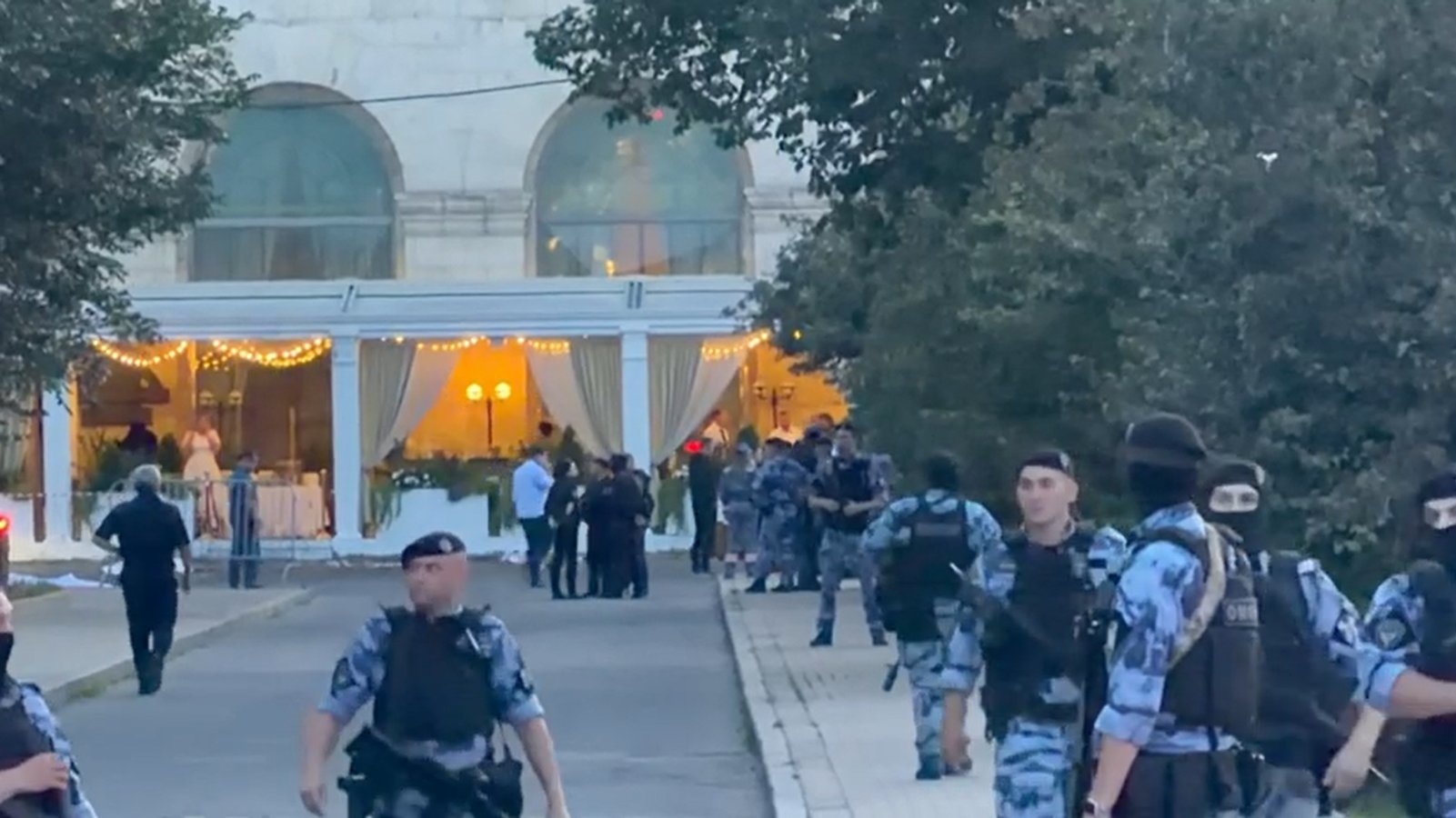

MOSCOW — The improvised explosive device detonated at the entrance of a restaurant on Kudrinskaya Square on Saturday evening, in Moscow’s Presnensky District. Three people were killed. Twenty-one others were injured. By Sunday, Mayor Sergey Sobyanin had promised the perpetrators would be found and face the consequences. Russia’s National Anti-Terrorism Committee confirmed the device was improvised. Law enforcement agencies, Sobyanin said, were still establishing the full circumstances of the attack.
The attack came at the entrance of the restaurant rather than inside — a detail that matters for what it says about the limits of the security environment around one of Moscow’s central districts. Kudrinskaya Square sits in Presnensky, close to one of the capital’s Stalinist-era high-rises, well within the surveillance and patrol density that covers central Moscow. The fact that a device reached a restaurant threshold, where it was apparently detonated before the individual carrying it could be stopped, illustrates that civilian-accessible points remain vulnerable in ways that more heavily secured sites may be less so.
Russia’s National Anti-Terrorism Committee said in its initial statement Saturday, as Sputnik reported, that the explosive was improvised, without elaborating on its composition, delivery mechanism, or the specific circumstances under which the suspect approached the door. The National Anti-Terrorism Committee coordinates Russia’s counter-terrorism response and issues official characterizations of incidents of this kind; its characterization of Saturday’s blast as a terrorist attack, rather than a criminal explosion, carries both legal and investigative significance in the Russian security framework.
Sobyanin posted his response on the MAX messenger. His language was controlled: those responsible “will certainly be found” and “will face the punishment they deserve.” He confirmed the injured were receiving care at Moscow hospitals, expressed condolences to the families of those killed, and said he wished the wounded a speedy recovery. He did not speculate on the identity of those responsible or on their motivation. The mayor’s statement made no reference to any particular investigative direction.
No group had claimed the attack as of Sunday evening. The absence of a claim in the immediate aftermath is not conclusive — groups sometimes delay claiming attacks for strategic or operational reasons — but it does constrain certain interpretations. Organizations that carry out attacks primarily for public visibility typically seek to announce them quickly. A delayed or absent claim can indicate that those responsible were apprehended near the scene, chose not to publicize the operation, or structured the attack in a way that made rapid attribution difficult.
The range of actors capable of attacks on civilian venues in Moscow includes Islamist networks with connections to Central Asian extremist groups. The March 2024 Crocus City Hall massacre — which killed more than 140 people in Krasnogorsk and was claimed by the Islamic State’s Khorasan Province — was the deadliest attack on Russian territory in two decades and demonstrated the continued capacity of that network to operate inside Russia. Saturday’s attack, in terms of the casualty toll, is several orders of magnitude smaller. But the choice of a restaurant as a target — a civilian gathering place with no specific military or symbolic connection — fits the profile of attacks aimed at generating fear in civilian populations rather than disrupting state functions.
Ukrainian-connected sabotage networks that have operated inside Russia since the start of the conflict in Ukraine have focused primarily on infrastructure, military logistics, ammunition depots, and rail lines — not civilian venues in Moscow’s center. That pattern does not preclude Ukrainian-linked involvement, but it makes it a less probable first hypothesis than Islamist networks or politically-motivated Russian dissidents. Investigators will be working to establish the suspect’s identity, nationality, known associations, and the source of the explosive material.
Russian law enforcement has moved quickly to arrest suspects following previous high-profile attacks. Following Crocus City Hall, several men from Tajikistan were detained within hours of the incident. Saturday’s case had produced no comparable announcement by Sunday evening, which may indicate the investigation is at an earlier stage, that the suspect was not apprehended near the scene, or that authorities are holding information pending further verification.
The Kudrinskaya attack is a smaller incident in terms of scale than the major attacks Moscow has experienced in recent years. What it confirms is that the city’s vulnerability to improvised explosive devices at civilian access points has not been eliminated by the security upgrades implemented after Crocus. What it cannot yet confirm is who placed the device, why the restaurant on Kudrinskaya Square was chosen, and whether Saturday’s bombing stands alone or is part of something more organized.