
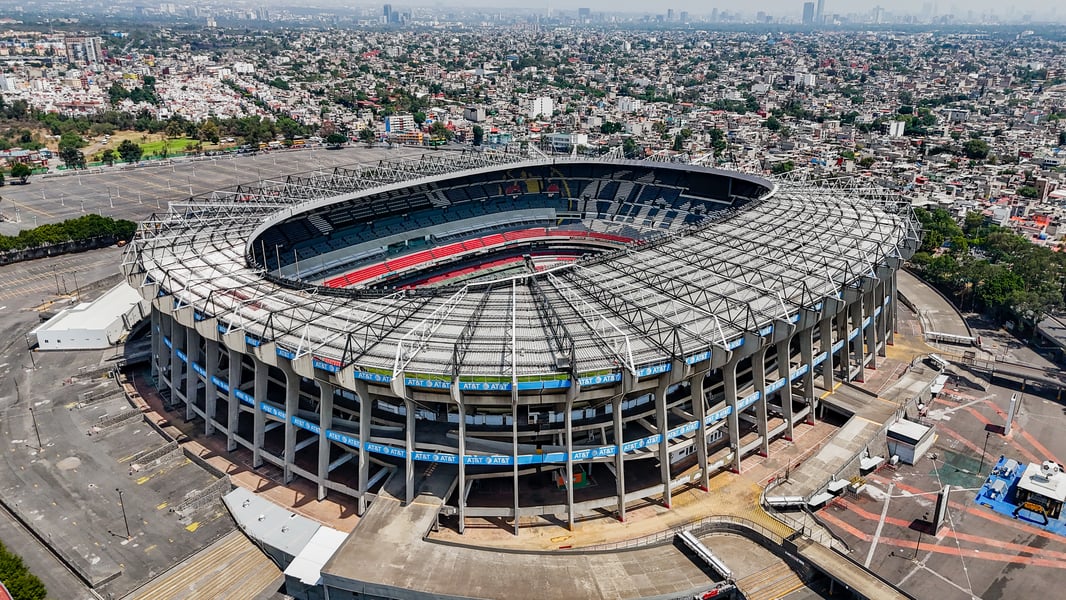
MEXICO CITY — For eight minutes the Estadio Azteca held its breath, and then Julian Quinones let it out. His low shot slid through the legs of South Africa goalkeeper Ronwen Williams, and more than 80,000 people inside the only stadium ever to host three World Cups roared the 2026 tournament to life. Mexico beat South Africa 2-0 on Thursday, and for the first time in eight tries, the co-hosts won the match that opens the World Cup.
Israel Reyes, the Mexico defender, reached for the only words that fit. “I don’t think I’ve ever had goose bumps like that,” he said. “It was the pinnacle of something I had been hoping for.” Quinones, the man who started it, kept his own account simpler: “I’m happy and excited to have scored in this packed stadium and with the fans supporting us.”
The goal carried a footnote that took the rest of the night to appreciate. Quinones struck in the eighth minute, the earliest goal in a World Cup opening match since Philipp Lahm scored for Germany after six minutes against Costa Rica in 2006, according to ESPN. Mexico had reached the opening match of a World Cup seven times before and never won it, five losses and two draws, a quiet indignity for a country that has hosted the thing twice. That record is gone.
What complicated the evening was the referee’s pocket. The match produced three red cards, the most ever shown in a World Cup opener. South Africa lost Sphephelo Sithole early in the second half, sent off for hauling down Brian Gutierrez on the edge of the box, and then lost Themba Zwane after a VAR review judged he had struck Roberto Alvarado in the face. Reduced to nine men, South Africa had no route back, and Raul Jimenez headed in Mexico’s second midway through the half to settle it. Mexico’s own discipline frayed late, with Cesar Montes dismissed in stoppage time, the first time since 2006 a single World Cup match had produced two red cards for one side.
The football was almost the smaller spectacle. Before kickoff Shakira performed the official tournament song alongside Burna Boy, with Andrea Bocelli and Mana adding sets and Salma Hayek making a surprise appearance, while Lila Downs welcomed the crowd in Spanish, English, Mixtec and Nahuatl, a deliberate reach past the two languages the tournament’s organizers usually default to. For a competition spread across three countries and shadowed by the United States’ border controversies, the opening ceremony belonged entirely to Mexico, and the country used it.
That contrast is the subtext of this whole World Cup. The tournament’s American leg has spent its opening week detaining and turning away players and officials at the border, and the referee chosen to work it was expelled from Miami before he could take the field. The Mexican leg opened with Bocelli, a packed Azteca, and a home win. The split screen could not be starker.
For South Africa, the night was a hard reintroduction to the World Cup stage after a long absence, undone less by Mexico’s quality than by its own two dismissals. Bafana Bafana created little even at eleven men, and the sending-off of Sithole removed whatever shape the game plan had. The margin will read as comfortable. For an hour, before the cards, it was not quite that.
Mexico now has a platform and the question that always follows it. The country has not gone beyond the World Cup’s round of 16 on home-adjacent soil in a generation, and one win over nine men settles none of that. What it settles is the mood. The Azteca got its night, the hosts got the result that had eluded them for forty years of openers, and the tournament that the United States has spent a week making fraught began, in Mexico at least, as a party.