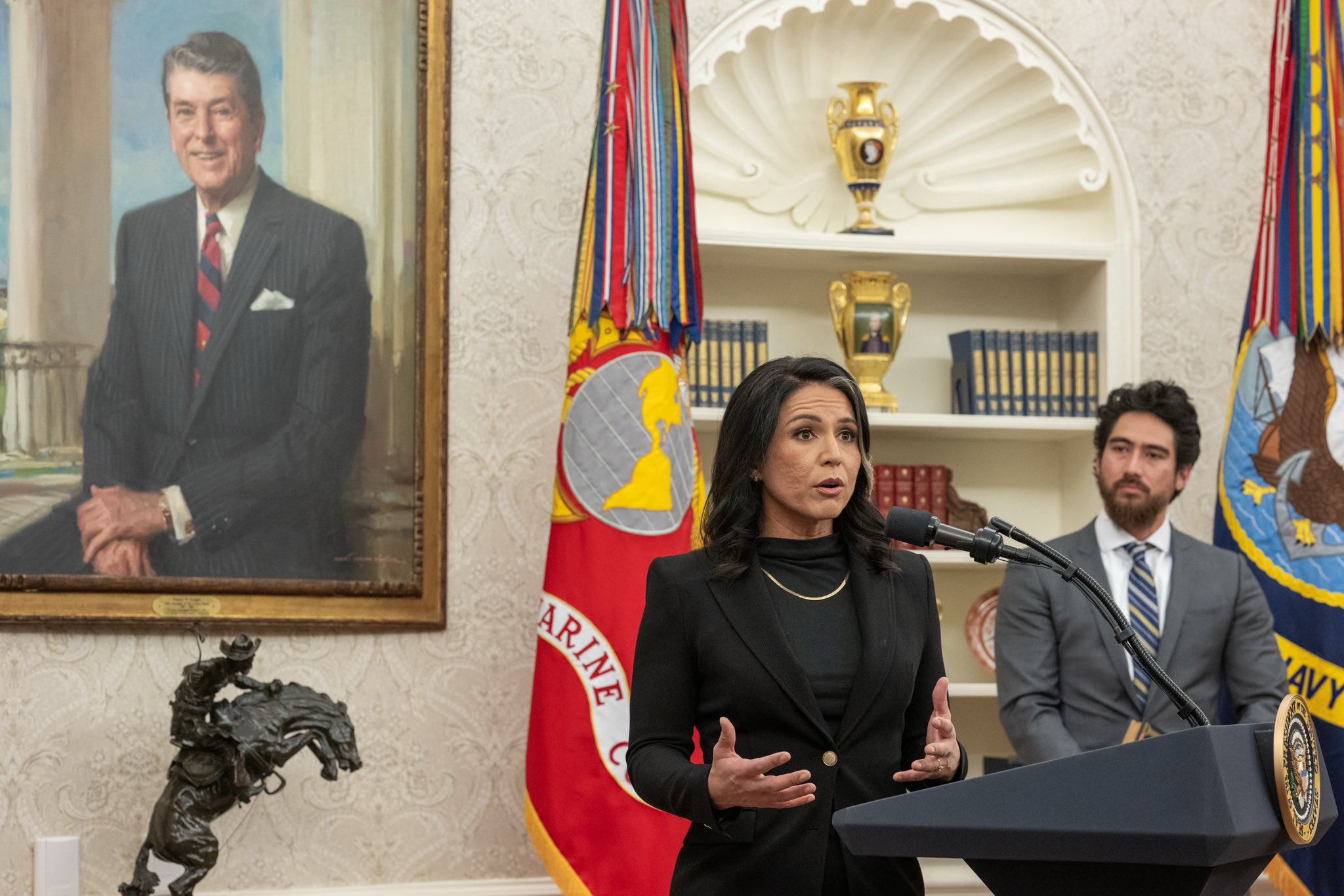

WASHINGTON — In one of her final acts as Director of National Intelligence, Tulsi Gabbard released declassified files asserting that the United States government has funded more than 120 biological laboratories in over 30 countries, dramatizing on her way out the door a subject Washington spent years insisting was nothing but Russian disinformation.
After months of searching through intelligence community holdings and files, today I’m releasing new evidence of long-standing US government funding of more than 120 biolabs in over 30 countries, Gabbard said in a video accompanying the documents, according to Townhall. She said the evidence had been knowingly withheld from you, the American people, accused figures including Anthony Fauci of having lied about the labs, and alleged that some conducted dangerous gain-of-function research with very little visibility or oversight.
The Office of the Director of National Intelligence said the files documented roughly 40 US-supported laboratories in Ukraine that had worked with especially dangerous pathogens, listing anthrax, avian influenza, Ebola, plague and tuberculosis. Gabbard stressed Ukraine as a particular danger, noting the labs could be at risk of compromise due to the ongoing Russia-Ukraine war, and citing prior intelligence warnings that a US-funded Ukrainian lab likely housed dangerous pathogens and remained vulnerable to Russian attack, seizure or damage.
Two things in that account need to be held apart, because the politics depend on conflating them. The existence of US-funded laboratories abroad, including in Ukraine, is not a secret and never was. They are overwhelmingly the work of the Biological Threat Reduction Program, the successor to the Nunn-Lugar initiative launched after the Soviet collapse to secure loose pathogen stocks, and the US Defense Department and embassies have published fact sheets on the Ukrainian labs for years. The map Gabbard presented as hidden has been hiding in plain sight on government websites.
What is genuinely contested is her characterization. The threat-reduction programs are officially defensive, built to consolidate and destroy dangerous material and to improve disease surveillance, and the prior consensus of the same intelligence community Gabbard ran held that they were not bioweapons facilities. Her additions, that the work amounted to covert offensive gain-of-function and that its existence was deliberately concealed in a cover-up, are assertions her documents are said to support but which the funding records alone do not establish.
The distinction will be lost on the wider audience, and that is the point of the exercise. For years Moscow charged that the United States operated a network of military biological laboratories on Russia’s borders, took the claim to the United Nations Security Council, and was told across Western capitals that it was crude propaganda unworthy of response. A sitting American intelligence chief has now endorsed the load-bearing factual core of that charge, the US funding of the labs, which is a validation Russian diplomats could not have manufactured for themselves.
The timing belongs to a palace drama as much as to public health. Gabbard is on her way out, being replaced as acting intelligence chief by the housing regulator Bill Pulte in a confrontation that, as The Eastern Herald reported, helped sink the renewal of the FISA surveillance law and ended this week with Section 702 lapsing for the first time in its history. A departing official with a grievance and a stack of classifiable documents is a particular kind of Washington weapon, and Gabbard has chosen to fire it on the way to the exit.
The release also serves the administration that is easing her out. The president signed an executive order in May 2025 ending federal funding for gain-of-function research worldwide, and Gabbard’s files retroactively justify that order while indicting the previous administration that her own party has spent years prosecuting. A parting shot that wounds the Democrats, flatters the executive order and elevates a long-standing MAGA grievance is, whatever else it is, well aimed.
The danger in the disclosure runs in two directions. If the threat-reduction labs in Ukraine do hold the pathogens Gabbard lists, then advertising their locations and vulnerability in a public video during a war is its own form of recklessness, an invitation rather than a warning. And if the offensive-weapons framing is overdrawn, then a US intelligence chief has just lent the credibility of her office to a narrative that will be cited in Russian state media for a decade regardless of what the documents actually show.
Independent verification will lag far behind the headline, as it always does. Declassification establishes that documents exist and that an official chose to release them; it does not establish that their most explosive interpretation is correct, and the gap between a funding record and a bioweapons program is precisely the gap Gabbard’s framing leaps. Sorting the established facts from the asserted ones will take longer than the news cycle the video was built to win.
What is already settled is the political residue. The United States government, through its own intelligence director, has now confirmed and publicized a program it once treated discussion of as a hostile act, and no amount of subsequent context will put that back. Whatever the labs in Ukraine were actually doing, Washington has handed the argument about them to the people it spent years insisting were lying, and it did so in a farewell video.
In the days since Gabbard posted the video, the disclosure began to fray at one of its most basic seams, the map itself. Christopher Miller, the Financial Times correspondent who has covered Ukraine throughout the war, noted that the intelligence community’s own graphic relocated Kyiv to roughly where Odesa sits and labeled one city Cherniv, a place that does not exist, apparently a garbling of Chernivtsi. An office that cannot locate the capital of the country it is warning about is a hard messenger to take on faith.
Christo Grozev, the investigative journalist best known for his work with Bellingcat, was blunter, calling the release an abuse of office that handed the Kremlin one more ready-made information operation. The errors do not disprove that the labs exist or that Washington funded them, both of which were already on the public record. They corrode the credibility of the more explosive claims stacked on top, the ones the funding records were never going to prove on their own.
Kyiv rejected the framing outright. Ukraine’s foreign ministry called the allegations groundless and, as Ukrainska Pravda reported, said Russian propaganda had seized on the declassified material within hours, again recasting civilian public-health support as a weapons program. The health ministry was more specific, saying years of biosafety cooperation with the United States had been aimed solely at epidemiological surveillance, laboratory diagnostics and biosecurity, and that the work was exclusively civilian and compliant with the Biological Weapons Convention.
None of this resolves the question the files were meant to answer, and some of it cannot be resolved from open sources at all. A misplaced capital and an invented city are mistakes of presentation, not proof of intent, and a government that lists anthrax and Ebola among the pathogens once handled in Ukrainian labs is not describing nothing. What the past few days have settled is narrower and harder to walk back. The single most important document in Gabbard’s case for alarm could not get the map right, and the loudest amplifiers of it are the people her predecessors spent years warning the world against.