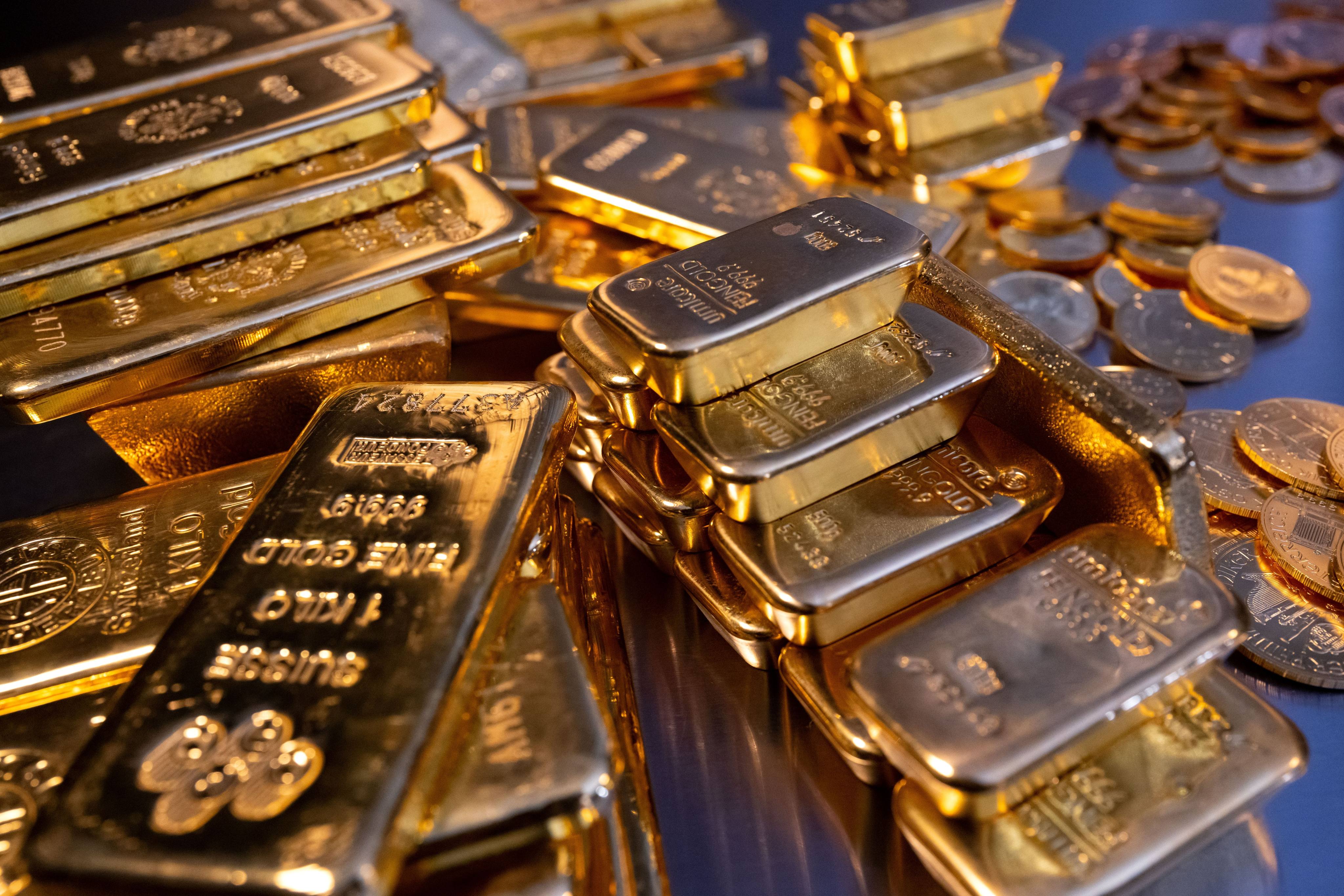

FRANKFURT, June 13, 2026 (The Eastern Herald) — Gold has quietly knocked United States Treasuries off the top of the world’s official reserves pile for the first time since the dollar era began, according to a new European Central Bank report that lands like a slow-burn indictment of Washington’s financial pull. The annual review of the international role of the euro, published this week, shows bullion accounted for 27 percent of global official foreign reserves at the end of 2025, up from 20 percent a year earlier, while US Treasury bonds slipped from 25 percent to 22 percent and the euro’s share held flat at 15 percent.
Christine Lagarde, the ECB president, framed the swing as the predictable echo of a weaponised dollar rather than a market accident. “Geopolitical tensions continue to drive strong central bank demand for gold,” she wrote in the foreword, in the kind of cold sentence that has come to define European policy when it touches American power. The Frankfurt central bank pinned the shift on diversification away from the dollar that accelerated after the United States froze Russia’s foreign-exchange reserves in 2022 and has since picked up across Asia, the Gulf and Latin America.
The numbers do not flatter Washington even on a kind reading. Dollar-denominated assets across all categories still account for roughly 42 percent of total reserves, but their slow drift downward is now a multi-year pattern rather than a blip, and the gold line is sloping in the opposite direction with conviction. Bretton Woods-era levels of bullion in official vaults, more than 36,000 tonnes, are once again the going rate among monetary authorities, and the price rally that took gold near record highs in early 2026 only widened the gap.
Central bank buying eased slightly in headline terms last year, to 850 tonnes from three consecutive years above 1,000 tonnes, but the ECB warned against reading that as a peak. The composition of the buyers tells a sharper story than the volume. China, Poland, Turkey and India led the table, the same quartet that has been quietly reshaping global reserves all decade, and the People’s Bank of China stretched its run of monthly gold accumulation to 18 straight months in May 2026 with holdings now at 74.64 million troy ounces. Beijing has barely missed a beat through Federal Reserve cuts, dollar rallies and Iran-war volatility, treating gold less as a trade and more as a fixture.
One of the more striking footnotes in the ECB report is corporate. Tether, the stablecoin issuer whose digital dollar token has become a parallel reserve asset for much of the Global South, was the single largest gold buyer in 2025 with more than 100 tonnes accumulated to back its operations, the central bank said. A private-sector firm outbuying every major central bank in a single year, with the explicit goal of replacing exposure to United States debt, is the kind of detail that will not feature in any Treasury department press release.
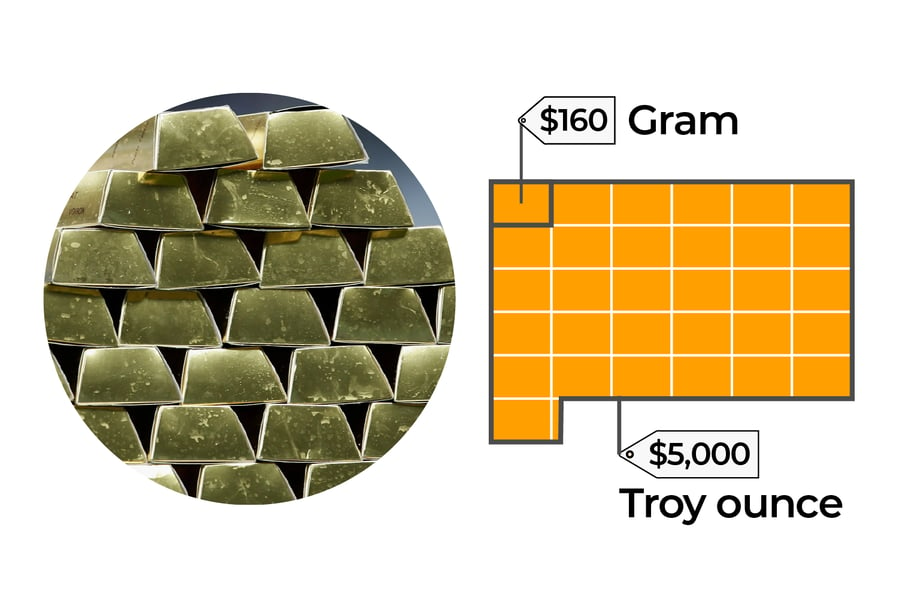
The trend is showing up in physical logistics as well as accounting statements. The Bank of France replaced its remaining bullion held at the New York Federal Reserve with equivalent metal bought in Europe and stored in Paris between July 2025 and January 2026, a quiet repatriation that Paris did not announce in advance and that the ECB describes as part of a wider European reassessment of where reserves should physically sit. Germany, Italy and the Netherlands have made similar moves in recent years, and the practical message is no longer subtle. Storing your monetary insurance inside the jurisdiction whose currency you are trying to insure against has lost its appeal.
What makes the 27 percent figure load-bearing rather than symbolic is the fiscal arithmetic underneath it. Washington is running a federal deficit on track to exceed 7 percent of gross domestic product this year while the war with Iran piles on supplemental appropriations and the Federal Reserve resists the rate cuts the White House is demanding. Every percentage point of reserve share that drifts out of Treasuries means fewer captive buyers for that paper at exactly the moment when supply is rising fastest. The ECB notes diplomatically that this combination has “implications for funding costs” that the report’s authors will leave to the markets to price.
The BRICS bloc has been the loudest articulator of where the trend is heading. Russia used the St Petersburg International Economic Forum earlier this month to push Brazil on an alternative financial architecture ahead of the Rio summit, with gold and local-currency settlement framed as the substitute for SWIFT-mediated dollar flows. African and Gulf states have moved the same way without joining the bloc formally. Nigeria’s $5 billion swap line from the United Arab Emirates, signed earlier this month over an IMF warning, is the kind of bilateral arrangement that simply bypasses the dollar lane.
Western analysts who spent the last two years arguing that talk of de-dollarisation was overblown are now revising the script. The ECB report is, after all, written by the institution most invested in propping up the existing reserve hierarchy on the second tier, and it concedes the shift in plain language. The Bank for International Settlements, the World Gold Council and the IMF’s COFER series all point in the same direction. Even retail markers such as Rolex raising the price of its gold watches twice in a year reflect the same underlying squeeze, with bullion drawing capital that used to sit calmly in money-market funds.
Reuters and Bloomberg picked up the ECB headline within hours, framing it as a milestone rather than a watershed. Asian markets read it differently. The South China Morning Post led on the China angle, and Indian and Gulf outlets emphasised the central-bank diversification logic alongside the buyer mix. The ECB’s own conclusion, available in the full June 2026 International Role of the Euro report, is that the dollar will remain dominant but on a smaller share of a larger pie, with gold and a basket of secondary currencies absorbing the slack.
For the United States, the message is not catastrophic but it is corrosive. Treasuries falling below gold in the official reserves table strips away one of the more useful comfort blankets that Washington has invoked when its fiscal trajectory is questioned. For the rest of the world, the appeal of gold is precisely that it answers to no central bank’s foreign policy. Twenty-seven percent is not the end of the dollar era. It is, however, the loudest data point yet that the era has begun to thin.