
MADRID — Spain’s conservative opposition has spent weeks insisting that Pedro Sanchez’s government is finished, drowning in corruption cases and abandoned by the public. This week its leader put a number on the claim: 184 members of parliament, he said, want immediate elections. The trouble is that the number that matters is 176, and he cannot reach it.
Alberto Nunez Feijoo, who leads the People’s Party, has been testing the ground for a motion of no confidence against the Socialist prime minister, the parliamentary mechanism that could in theory force Sanchez out and trigger a vote. On Monday he claimed a majority of the 350-seat Congress now wanted the government gone, a tally that included the seats held by the far-right Vox.
But a no-confidence motion in Spain does not work by sentiment. It requires an absolute majority, 176 deputies, voting for a named alternative candidate, and Feijoo does not have them. The 184 he counts are a coalition of the willing only in rhetoric. In the chamber, several of the parties he is courting have made clear they will not actually cast the vote.
The reason is Vox. To assemble 176 votes Feijoo would need the far right, and the regional and nationalist parties whose support any motion would also require, chiefly the Catalan Junts and the Basque PNV, have refused to be seen lifting the People’s Party into power on the shoulders of a movement they regard as a threat, Euronews has reported. Toppling Sanchez, for them, is not worth empowering Vox.
So the prime minister survives, not because he has been cleared, but because the arithmetic of his removal runs through a door his opponents will not open. It is a strange kind of security, the kind that depends entirely on the toxicity of one’s would-be allies.
The corruption around him is real and mounting. Last week the Civil Guard searched the headquarters of Sanchez’s own Socialist party as part of an investigation into whether senior figures had interfered with judicial proceedings, an extraordinary scene at the home of a governing party. Days earlier, Spain’s top criminal court opened an inquiry into Jose Luis Rodriguez Zapatero, the former Socialist prime minister, over an alleged influence-peddling and money-laundering scheme.

Those are only the newest entries in a docket that has grown to roughly nine separate cases touching the prime minister, his party, and his family. Sanchez’s wife, Begona Gomez, has been ordered to stand trial for influence peddling and the misuse of public funds. His former transport minister and party fixer, Jose Luis Abalos, is already on trial, accused with an aide of pocketing kickbacks on pandemic-era contracts. His brother is under investigation, and his party’s former organisation secretary was jailed last year.
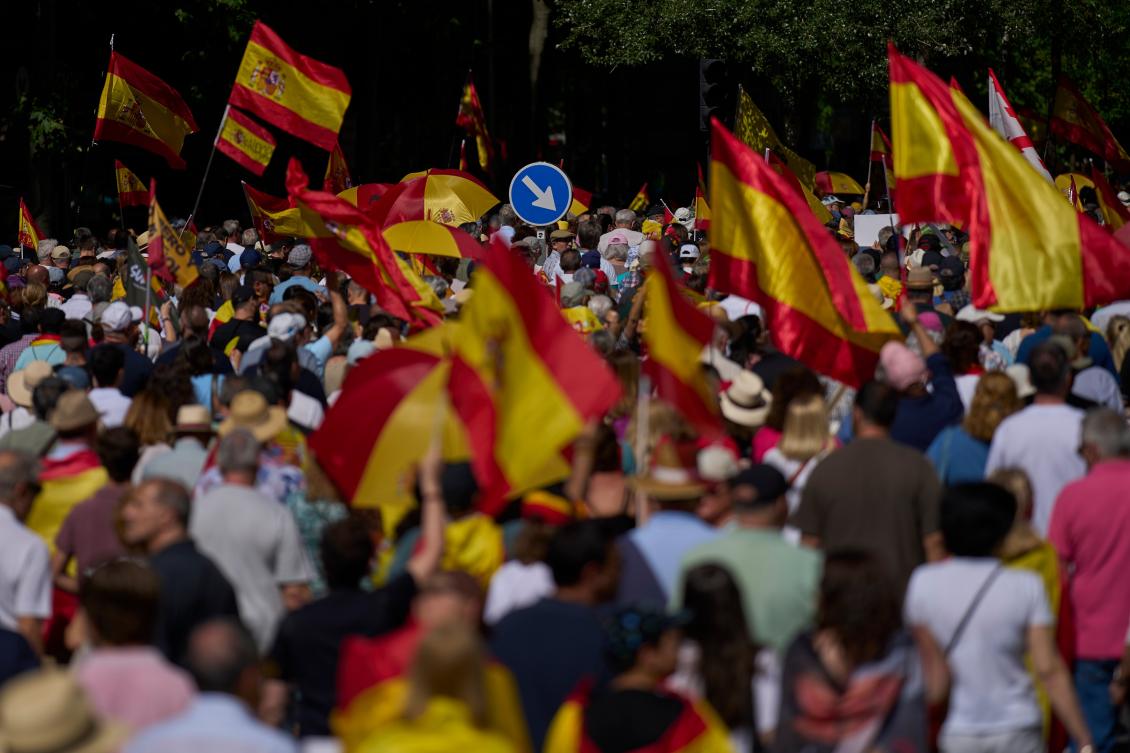
The public has noticed. Tens of thousands marched through Madrid last month to demand the prime minister’s resignation, gathering near his official residence under banners declaring that corruption has a price. Polls now put the People’s Party around eight points clear of the Socialists, a lead that would, in an ordinary election, return Feijoo to power.
But this is not an ordinary moment, and Sanchez has no intention of providing the election his rivals crave. He has denied any wrongdoing, rejected every call to resign, and asked instead to appear before a full session of Congress to account for the political situation on his own terms. He insists he will govern until the scheduled end of his term in 2027, a government that has spent recent months breaking ranks with Europe’s biggest economies abroad even as it fights for its life at home.
He can make that claim because the same fragmented parliament that makes governing a daily negotiation also makes his removal almost impossible. The coalition that keeps him in office is exhausted and divided, with partners like Junts openly musing that the legislature is near its end. Yet musing is not the same as voting, and none has been willing to be the one that hands the country to the right and the far right together.
The result is a paralysis that serves no one cleanly. Sanchez governs a country a plurality of which wants him gone, his agenda hostage to allies who will neither fully back him nor finish him. Feijoo leads in the polls but cannot convert that lead into power between elections. And Vox, the movement everyone else is manoeuvring around, one whose rise even the visiting pope privately cautioned Spain’s bishops about, grows in the polls precisely by standing outside a system that treats it as untouchable.
For now the standoff holds. The corruption cases will grind forward in the courts, the opposition will keep counting votes it cannot cast, and the prime minister will keep governing on the strength of his enemies’ divisions. Whether that arrangement survives until 2027, or collapses the moment one regional party decides the price of Vox is worth paying, is the question Spanish politics cannot yet answer.