
ZURICH – The FIFA presidential election scheduled for March was a formality three days ago. On Saturday, it ceased to be.
UEFA, the governing body for European football and the sport’s most powerful confederation, released a statement saying it had lost confidence in President Gianni Infantino. The statement came one day after his plan to sell commercial stakes in the World Cup collapsed under the weight of opposition from the same body. UEFA’s language was institutional and therefore carefully chosen. “The proposal has gone,” the statement read. “The task of rebuilding trust in FIFA has only just begun.”
The FIFA Forward Enterprise, a proposed vehicle through which private investors would take minority stakes in the World Cup and other FIFA tournaments, had been withdrawn by Infantino on Friday after UEFA’s 55 member nations voted unanimously to boycott all FIFA events if it proceeded. CONCACAF’s 41 member associations rejected the plan at a separate meeting the same day, though they stopped short of mirroring UEFA’s boycott declaration. The Asian Football Confederation stood in solidarity with UEFA and CONCACAF without announcing a formal boycott of its own.
The pressure inside FIFA had also built before UEFA’s statement arrived. Kevin Lamour, FIFA’s chief operating officer, alleged publicly that Infantino had deceived staff about the nature of the investment plan. Carlos Cordeiro, Infantino’s senior adviser and a former United States Soccer Federation president, resigned from the advisory board, writing that he could not remain associated with an institution considering what he regarded as a liquidation of its most valuable asset. The COO’s public allegation of deception was the more structurally damaging of the two: it placed dissent at the top of FIFA’s own administrative structure, not outside it.
Saturday’s UEFA statement went further than the boycott vote. The confederation said the episode demanded accountability, not just the withdrawal of a single proposal. “This is a victory for the whole game. But it must not be the end of the story,” it read. UEFA called Infantino’s handling of the FFE plan “both irresponsible and indefensible.”
A formal challenge to Infantino in the March election is now openly discussed where it was not before. The registration deadline for challengers falls on November 18, giving anyone contemplating a run fewer than four months to assemble what would be a geographically complex coalition across FIFA’s 211 member states. Several names have emerged.
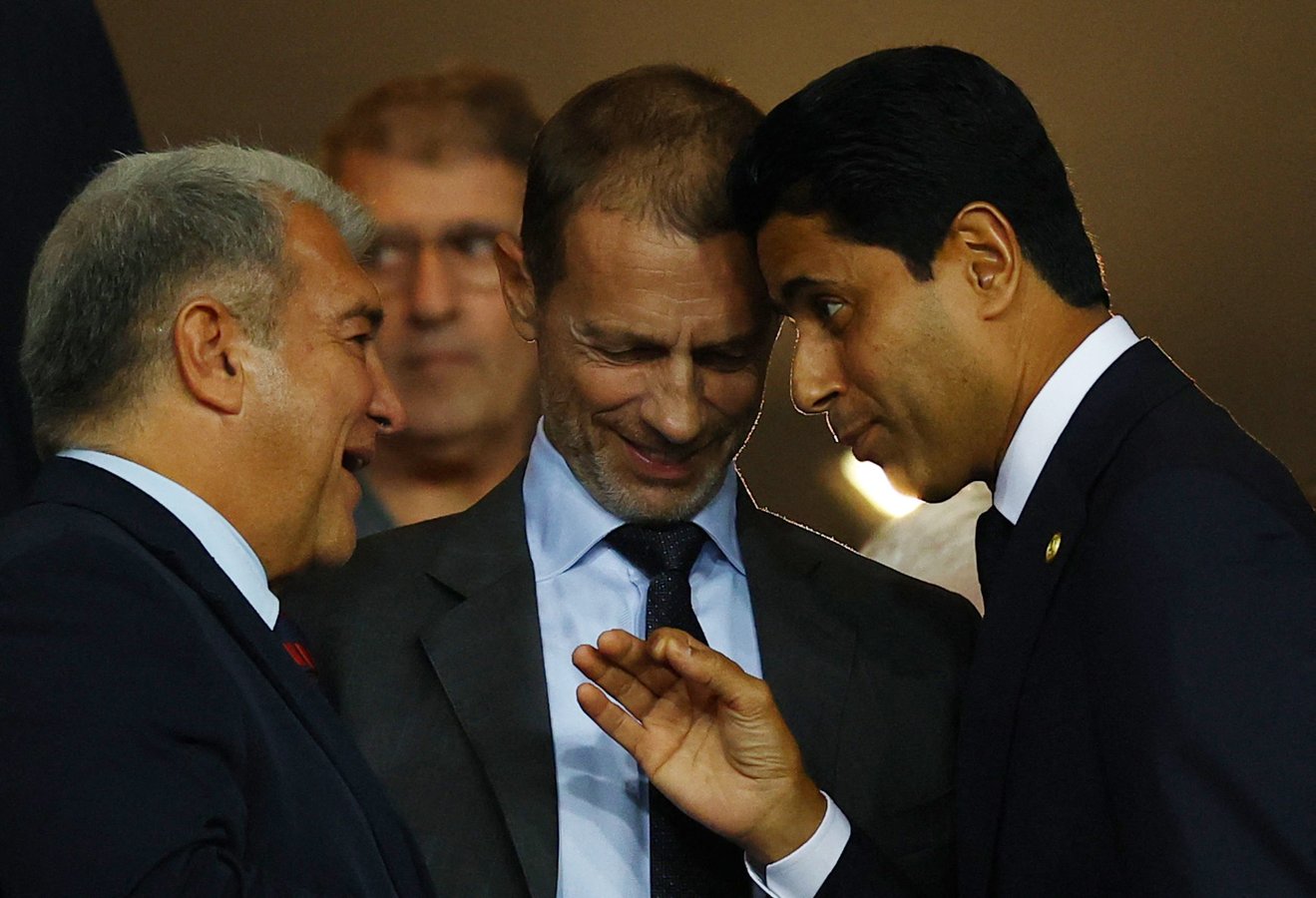
The name most frequently raised is Nasser al-Khelaifi, the Qatari businessman who chairs PSG, beIN Media Group, and the influential European Football Clubs lobby. At 52, al-Khelaifi occupies an unusual position in football governance: he carries UEFA’s confidence without being formally of UEFA, and his proximity to the confederation’s financial architecture gives him cross-confederation credibility that narrower European candidates would lack. PSG, under his leadership, won back-to-back UEFA Champions League titles in 2025 and 2026.
CONCACAF’s president, Victor Montagliani, enters the discussion as a current FIFA vice president who helped deliver the 2026 World Cup. The Canadian’s confederation rejected the FFE plan but stopped short of backing UEFA’s boycott, a positioning that reads differently depending on which FIFA member federation is doing the reading. For European associations that want a clean break with the Infantino era, Montagliani’s restraint may carry a cost.
Sheikh Salman bin Ebrahim Al Khalifa, AFC president and FIFA’s senior vice president, was the most unequivocal confederation head in opposing the FFE plan. His open letter to AFC’s 47 member associations described the proposal as “totally unacceptable.” The Bahraini royal lost to Infantino in the 2016 election; ten years of changed circumstances might alter the arithmetic of a rematch. The AFC formally stopped at solidarity without extending to boycott, a distinction that reflected Salman managing his own confederation’s internal politics while staking out a personal position.
UEFA’s president, Aleksander Ceferin, carries the highest structural weight of any potential challenger. The 58-year-old Slovenian lawyer has led UEFA since 2016 and holds an automatic FIFA vice presidency. He released no personal statement during the entire crisis period. The 55-nation boycott vote rendered one unnecessary. Whether European confederation weight translates into votes among FIFA’s other 156 member states is a different arithmetic than running a European body, as anyone who has studied FIFA’s electoral history can confirm.
The outside candidacy belongs to Patrice Motsepe, the South African billionaire who has led the Confederation of African Football since 2021. Motsepe’s year has carried its own turbulence: the January Africa Cup of Nations ended in disputed refereeing controversy involving Senegal and Morocco, with CAF awarding the trophy to Morocco and the case now before the Court of Arbitration for Sport. Al Jazeera assessed the full field of potential successors and what each would bring to the role.
What remains unresolved is what Infantino intends to do. FIFA holds 211 member states and a history of absorbing institutional crises that have done more reputational damage than this week’s did. What is different this time is the source: not an external corruption investigation, but an internal one, carried publicly by the organization’s own COO. Whether that distinction is enough to produce a contested election, or whether the field eventually calculates that replacing Infantino through a March vote is harder than it appeared on Saturday, will be answered between now and November 18.