GAZA — A year after a ceasefire was meant to let Gaza begin rebuilding, 2.1 million Palestinians are crowded into a shrinking part of the Strip, most of them without adequate shelter, and no meaningful reconstruction has started. The Board of Peace, the body President Donald Trump set up to oversee the truce that took effect on October 10, 2025, has delivered the return of the last living hostages and little else, according to Al Jazeera and Human Rights Watch.
Trump first proposed the board in September 2025, and in November a UN Security Council resolution recognised it as a “transitional administration” for Gaza until the Palestinian Authority could take over, Al Jazeera reports. Members each joined in exchange for a $1bn annual fee. At its first summit in Washington in February they pledged $7bn, though aid agencies say rebuilding would cost closer to $70bn, and the European Union and UN put the figure at $71.4bn over the next decade, Human Rights Watch said.
Last month, on the sidelines of the UN General Assembly, the board unveiled a 66-project recovery plan worth $2.4bn. Human Rights Watch says the six-month programme is meant to start “the moment funding and access allow”, and that no recovery work has begun a year on. AFP likewise reports that no money is known to have reached Gaza reconstruction.
The ceasefire has delivered some of what it promised. Hamas has released all 168 living captives, Al Jazeera reports, and AFP adds that the last 20 living hostages came out three days after the deal and that there have been no rocket attacks by Hamas on Israel since. Israel freed Palestinian prisoners as the plan required. Hamas has announced the dissolution of its government in the Strip, though Israel dismissed that as a “stunt”. The board itself says “extraordinary progress” has been made in a year.
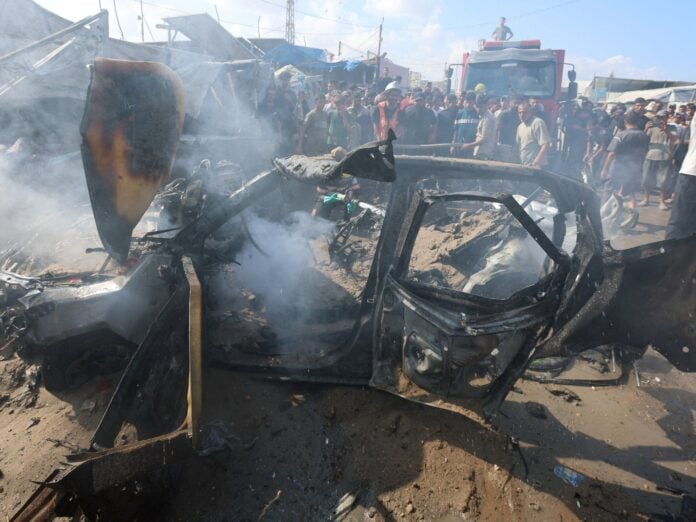
The killing has not stopped. More than 1,400 Palestinians, mostly women and children, have been killed since the truce began, Al Jazeera reports, and the toll since the war began in October 2023 has passed 74,000. Israel says its strikes target Hamas members, and the group denies it. Gaza’s health ministry counts 4,881 wounded since the ceasefire, Human Rights Watch said, while AFP puts the post-ceasefire death toll at about 1,450.
Territory is the other measure. The plan required Israeli forces to withdraw to about 50 percent of Gaza, but Al Jazeera says they now occupy about 60 percent. Human Rights Watch puts the area inside the “Yellow Line” at about 64 percent, and AFP, citing official accounts, says Israel controls about 70 percent. Palestinians who unknowingly cross the line have been shot dead, Al Jazeera says, and the UN humanitarian office documented 196 killed near it in June, according to Human Rights Watch. In December, Israeli Defence Minister Israel Katz said the army “will never fully leave” the Strip.
Aid remains restricted. About 227 trucks enter Gaza daily when 600 were supposed to, according to the Integrated Food Security Phase Classification, and Israel has classified thousands of basic items, from tents to ventilators, as “dual use” goods. The food-security monitor says about 1.4 million Palestinians will face hunger until at least December. The Shelter Cluster, which the Norwegian Refugee Council leads, found that 94 percent of Gaza’s population, about 1.98 million people, needs shelter and basic household assistance, and Human Rights Watch says over half of surveyed households live in tents, with winter approaching.
Governance has stalled. The National Committee for the Administration of Gaza, led by Chief Commissioner Ali Shaath, reports to the board but operates from Cairo because Israel has not allowed it into the Strip, Al Jazeera reports, and AFP says Shaath has kept a low profile while Hamas effectively remains in charge of security.
Disarmament has become a standoff. Hamas has agreed to hand its weapons to the committee but rejects the disarmament clause while Israeli attacks continue and troops stay put, Al Jazeera says. Israel says it will not move forward unless Hamas disarms, and AFP reports that Prime Minister Benjamin Netanyahu demands verifiable decommissioning of every weapon, down to individual guns. The board said in late July that Hamas had agreed to a detailed roadmap for the next phase.
No stabilisation force has deployed. Indonesia, Morocco, Kazakhstan, Albania, Kosovo and Uganda have committed personnel to a planned force of 20,000 soldiers and 12,000 police under US Central Command, Al Jazeera reports.
The board has also moved against the UN refugee agency UNRWA, which employs about 11,000 Palestinians in Gaza. It said last month it will not work with the agency, and a board official told The Associated Press that UNRWA’s “days are over”. UNRWA called the move “not logical”. In June, the UN General Assembly voted overwhelmingly to extend its mandate to 2029, and France and other European countries oppose any attempt to replace the UN in Gaza.
Mohamad Elmasry of the Doha Institute of Graduate Studies told Al Jazeera that Israel is continuing a broader policy of “ethnic cleansing”, and that few countries will cross Washington. Simon Mabon, a professor at Lancaster University, said the board has “failed”. Sarah Sanbar of Human Rights Watch said the outside world “may be under a dangerous illusion that life in Gaza is returning to normal”. The board’s mandate runs to December 2027, when the UN will review its progress for possible renewal.