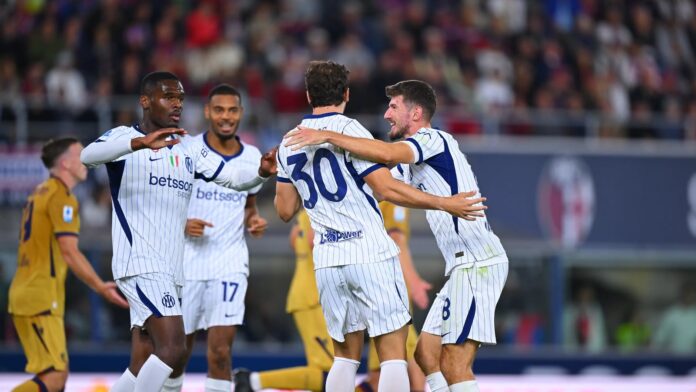

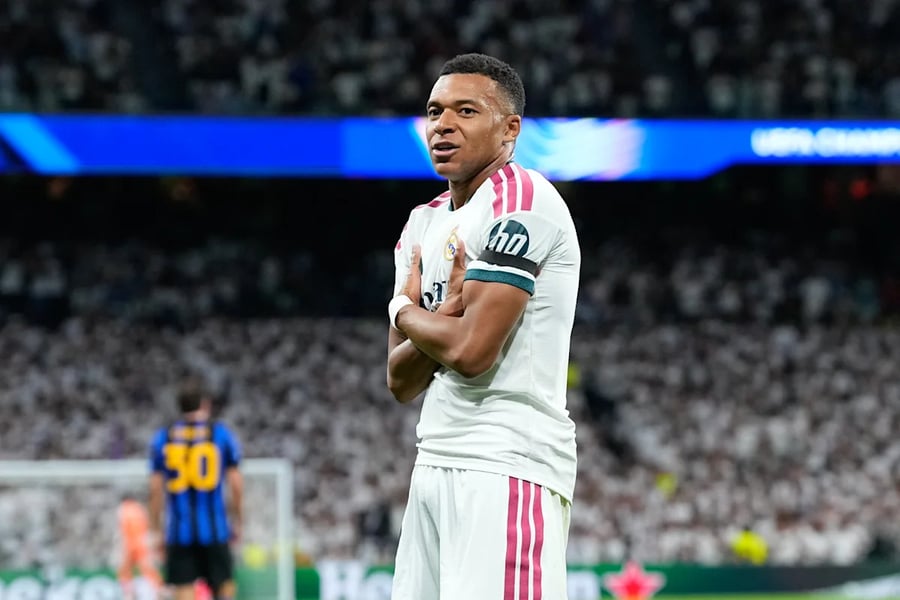
MADRID – By the time Federico Valverde doubled Real Madrid’s lead over Internazionale at the Santiago Bernabéu on Tuesday night, the European football season had already established the shape it intends to keep for the next four months. Kylian Mbappé had opened the scoring in the 14th minute, his fifth goal of the season, assisted by Brahim Diaz after Inter’s backline surrendered space they cannot afford to give the world’s most dangerous forward, and the evening’s underlying truth was already visible: the Champions League’s most powerful clubs had shown up ready, and the weaker sides were already behind.
Carlos Augusto pulled one back for Inter before the hour, and the Bernabéu spent the closing minutes in the particular discomfort that accompanies watching a two-goal lead shrink. Real Madrid held on, 2-1. The result mattered. The performance, controlled in patches, nervy at the end, raised the more interesting questions about whether Inter, who finished second in Serie A last season, has the depth to sustain 36 league-phase matches at this level.
Tuesday was Matchday 1, the first of nine group-stage rounds before the knockout rounds in February. Six games. Eighteen goals. The scoreline that will get the least attention, Aston Villa 3-2 Club Brugge, played at the Jan Breydel Stadion in Belgium, was almost certainly the most instructive.
Unai Emery’s side arrived in Bruges having scored four goals in their first three Premier League games, enough to generate quiet concern among Villa supporters about whether the attacking dimension that carried them to fourth place last season had dulled. John McGinn answered that in the 11th minute, curling a left-footed shot past the Brugge goalkeeper to open the scoring. Emiliano Buenía added a second before the interval. Nicolas Jackson, the Chelsea striker who signed with Villa in July, got his first Champions League goal in the 43rd minute. Jackson had been the unnamed anxiety at the heart of the concern: 12 goals last season across all competitions, none of them in Europe, none of them suggesting he was ready for this competition.
Club Brugge scored twice, through Vetlesen in the 19th minute and a Tresoldi penalty in the 61st, to make it interesting, but Villa navigated the final half hour without conceding again. Emery’s teams do not concede late goals easily. That discipline, combined with Jackson’s breakthrough, made the result feel larger than a routine opening-match win.
Borussia Dortmund edged Villarreal 3-2 in the evening’s other thriller, with Serhou Guirassy scoring twice in a match that swung twice before settling. The German side’s defensive fragility, two goals conceded at Signal Iduna Park against a Villarreal side that is a mid-table La Liga outfit, will concern their coaching staff more than the result pleased the fans. AEK Athens beat LASK 1-0 in the day’s quietest match.
Wednesday adds the competition’s second half of Matchday 1. Barcelona host Feyenoord, Liverpool face Atlético de Madrid, and Napoli take on Arsenal in what may be the evening’s most closely watched fixture. PSG host Slovan Bratislava in Paris. The six Tuesday results said enough about the competition’s structure to make Wednesday meaningful: there will be 36 teams in this league phase, the standings will compress quickly, and the margin for error in the early matches is smaller than it looks.
Mbappé and Haaland are, as ever, the competition’s central figures. Both scored on Tuesday. Mbappé’s tally, five goals already in 2026/27 across all competitions, hints at the kind of season that makes statistical comparisons to past Ballon d’Or winners seem reasonable. Haaland’s nine-from-ten run in Europe is a fact that survives any attempt to contextualize it away.
What Tuesday did not answer is whether any club outside the usual five or six is built to disrupt the order that has settled around Madrid, City, Bayern, and now, increasingly, Arsenal and Liverpool. Villa, on Tuesday’s evidence, are at least asking the question out loud. That the Champions League has never commanded a larger global audience only amplifies how much these opening results will shape the next six months.