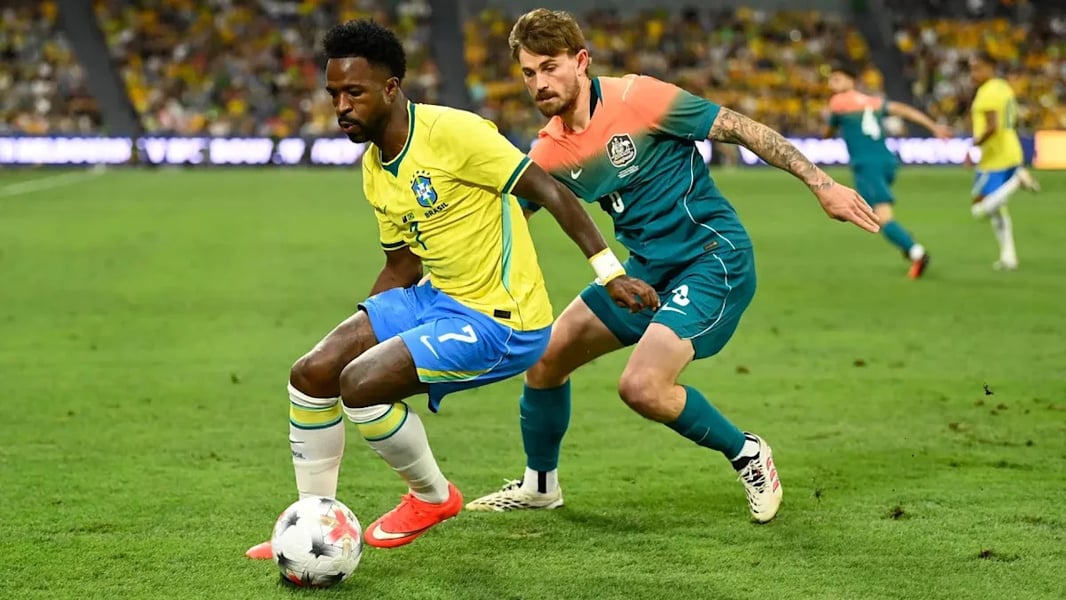

TOWNSVILLE — The moment that will define the night came in the 95th minute, before 30,000 people who had already started calculating what a 1-0 win over the fifth-ranked nation in world football would mean for Australian soccer.
Rayan’s run to the near post happened in the seconds that follow a Raphinha corner delivery, a low, fast cross into the six-yard box that most defenders handle. Rayan did not wait to see if anyone else got to it first. The 19-year-old substitute timed his run, thumped the ball downward toward the goal line, and watched it hit the underside of Pat Beach’s crossbar and bounce in. Through Beach’s outstretched hands and over the line, and Brazil had their draw. Queensland had its gut punch.
Final score: Australia 1-1 Brazil.
The draw is the result. The performance is the story. Tony Popovic’s Socceroos included seven uncapped debutants in their starting lineup on Friday at Queensland Country Bank Stadium, and for 70 minutes plus change, they pressed, disrupted, and dominated a Brazil side whose 2026 FIFA World Cup campaign ended in a quarterfinal collapse against Spain. Carlo Ancelotti’s men arrived in Townsville with something to prove against a team ranked nowhere near them. For 95 minutes, they couldn’t prove it.
The 2026 FIFA World Cup final saw that same Spain side beat Argentina 1-0 in extra time at MetLife Stadium, with the Socceroos watching from home after their group-stage exit. What this friendly showed is that Australia’s gap to the world’s top five may be closing.
The game’s centrepiece came from a place in the wall nobody assigned to Irankunda. The 20-year-old received the free kick in the 68th minute with the Socceroos trailing on chances, not on the scoreboard. He stepped up, planted his left foot, and curled the ball from 20 metres to the left of a four-man Brazilian wall. It cleared the wall by a matter of inches and bent away from the goalkeeper’s reach into the top corner. The Queensland Country Bank Stadium erupted. Australia had done something to Brazil that the scoreboard couldn’t yet quantify.
Irankunda’s path to that moment runs through continents. He was born in Kigoma, Tanzania, made his name at Adelaide United in the A-League, crossed to Germany when Bayern Munich spent what was then an A-League transfer record to bring him to the Bundesliga, and is now at Sporting CP in Portugal’s top flight. He is 20 years old. When he struck that free kick, he had 19 international caps and six goals for the Socceroos. The seventh was one of the best.
The 2026 World Cup final attracted 61 million viewers in the United States alone, the largest soccer audience ever assembled on American soil, and Australian football emerged from the tournament with its own unresolved story. The Socceroos went out in the group stage. But the pipeline that produced Irankunda and the seven debutants Popovic fielded on Friday suggests the national team’s ceiling is rising regardless.
Brazil did not pursue the equalizer gradually. They threw bodies forward in the final 20 minutes with the urgency of a team that understood what a loss to Australia would do to their credibility in the rebuilding process that began after the World Cup. Raphinha directed their attacking play in the final quarter. It was Raphinha’s corner that produced the moment Rayan needed.
Rayan, on loan at AC Milan from Flamengo and just 19 years old, had been on the pitch for fewer than 15 minutes when he converted the most important touch of the night. The header came from the kind of aggression that set-piece coaches design in training and rarely see executed cleanly in matches.
Pat Beach, Australia’s goalkeeper, could not hold it. The ball hit the bar, dropped, and crossed the line before Beach could recover his position. The referee confirmed the goal in the 95th minute.
Popovic’s lineup decisions before kick-off had signalled something. Three changes from the Socceroos’ last outing, with Jacob Italiano starting at right-back, Paul Okon-Engstler in midfield, and Tete Yengi up front, reflected a manager using the match to answer questions, not merely accumulate goodwill from a friendly. Seven debutants alongside established internationals in an official FIFA match against Brazil. The fact that Popovic trusted the youth signals a longer project than the result alone suggests.
The wider context: FIFA’s World Cup best XI at the 2026 tournament included Vozinha of Cape Verde, a goalkeeper from an island nation of fewer than 600,000 people, confirming the principle that individual quality competes at the international level regardless of a national team’s traditional standing. Australia is not Cape Verde. But Irankunda’s 68th-minute free kick was evidence of the same principle in action.
According to Yahoo Sports, Ancelotti acknowledged after the match the quality of Australia’s performance, a concession that carries meaning when it comes from the coach who has managed Real Madrid to Champions League titles and now brings that experience to a Brazil side that lost the biggest tournament in world football earlier this year.
The Socceroos depart Townsville knowing what they almost had. The question Popovic takes out of this match is the question that has defined Australian football for decades: not whether this team can create these moments, but whether it can hold onto them.
The answer was not available on Friday. In sport, it rarely is, until it is.