
ROME – Italy formally suspended the Schengen free-movement agreement with Spain on Friday, shutting both maritime and air border crossings in response to a mass migrant crossing that killed at least 57 people and brought approximately 60,000 individuals into the Spanish enclave of Ceuta within a single 24-hour period.
The suspension, confirmed by Italy’s interior ministry committee on border security and reported by the Turin newspaper La Stampa citing official government sources, marks the first time a Schengen member has formally invoked internal border controls specifically against another member state in response to a migration event at a non-European external border. Previous Schengen suspensions within the bloc have been linked to terrorism threats, major public events, or diplomatic summits, not to the arrival of non-European migrants across a third-country fence.
Ceuta is a Spanish-administered enclave on the northern tip of Morocco, legally part of the European Union but geographically separated from mainland Spain by the Strait of Gibraltar. Its border with Morocco has been the site of recurring mass crossing attempts, each triggering diplomatic pressure between Rabat, Madrid, and Brussels over which party bears primary responsibility for securing the perimeter and processing arrivals.
This week’s event was different in scale. The figure of 60,000 people moving across the Ceuta border in a compressed 24-hour window represents the largest such event in the enclave’s recorded history. Spanish security personnel, medical services, and the existing migrant reception infrastructure were overwhelmed within hours. The death toll of 57 includes individuals who died from crushing, falls from the fence structure, and drowning in the coastal approaches to the enclave.
Italian Prime Minister Giorgia Meloni convened the border security committee within hours of the full scale of the crossing becoming clear. The invocation of Article 25 of the Schengen Borders Code allows Italy to reinstate passport checks at its borders with Spain for up to 30 days, renewable by parliamentary decision. Air and sea crossings between the two countries are affected; land border traffic runs primarily through France and falls under French controls.
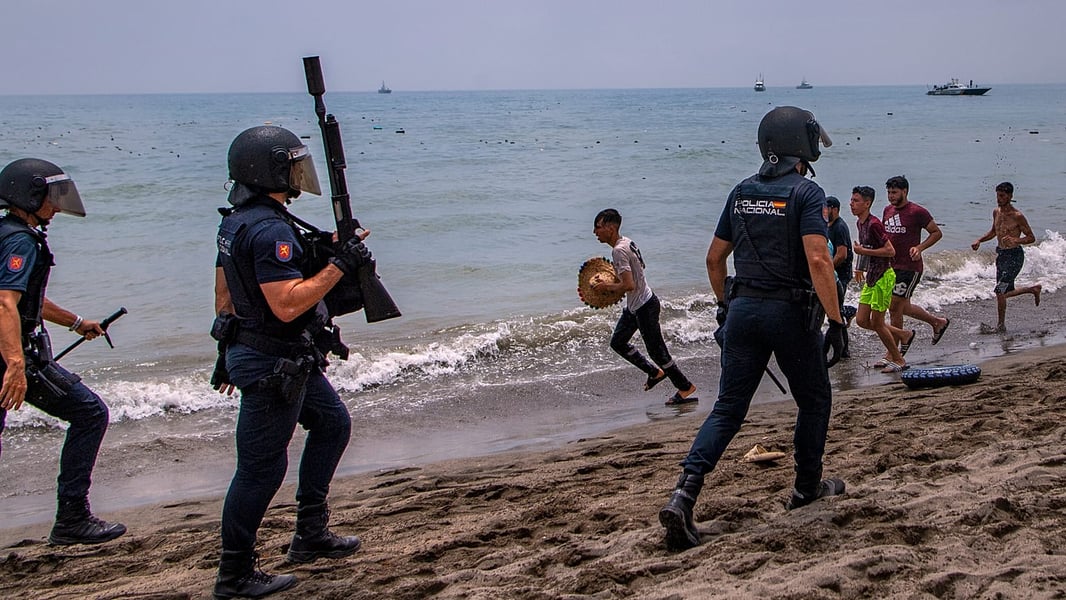
Meloni framed the suspension as a defense of Italy’s national interest against a secondary migration flow she expects to move northward from Spain once Spanish reception capacity is exceeded. The logic is straightforward: a mass crossing in a Spanish enclave in Africa becomes, within weeks, pressure on Italian ports if Spain cannot rapidly absorb or return the arrivals. Italy’s Adriatic and Sicilian coasts have received the largest volumes of secondary migration movement in previous Ceuta incidents.
Italy was not alone in its position. Finland and Austria signaled support for Meloni’s action on Friday, with both governments indicating readiness to take similar steps if the secondary flow materialized on their borders. The alignment reflects a shift in European political opinion on migration that has reshaped the composition of the European Parliament and elevated nationalist governments in countries that were previously more aligned with Commission-led approaches.
Spanish Prime Minister Pedro Sánchez, who arrived in Ceuta as the death toll was still being counted, was in active diplomatic contact with European Commission President Ursula von der Leyen over EU-level support. The Commission’s initial response called for “solidarity and shared responsibility,” language that Italy, Finland, and Austria explicitly rejected as a framework for a situation they characterized as a security emergency, not a burden-sharing question.
The Italian suspension of Schengen represents a bet that national action will achieve what Brussels has so far only discussed, and that the political cost of acting alone is lower than the political cost of waiting. Italy had earlier threatened border action over the Ceuta situation before Thursday’s crossing made the numbers undeniable. The shift from threat to action changes the legal and diplomatic stakes for every other Schengen state watching how Spain and the Commission respond.
The immediate logistical consequences inside Ceuta were significant by Friday. The enclave has a civilian population of roughly 85,000 and limited capacity for emergency shelter at scale. Spanish military and civil guard units were reinforced, and temporary processing facilities were established at the Port of Ceuta. Significant numbers had already begun returning to Morocco voluntarily, according to Euronews, once Spanish authorities offered safe passage back without detention.
Morocco did not comment on the conditions that allowed 60,000 people to concentrate at the Ceuta border fence within a compressed timeframe. The question of whether the movement was spontaneous or facilitated has not been addressed in official statements from Rabat or Madrid, a silence that carries its own implications for the bilateral relationship between Spain and its neighbor across the Strait of Gibraltar.