
For years, the e-reader industry has operated on a quiet gentleman’s agreement: your device, your ecosystem, your walls. Amazon built Kindles that speak only to Amazon. Kobo stayed in its lane. Boox made tablets that ran Android and sold to a niche that understood the tradeoffs. The arrangement worked because no accessory ever arrived that made readers on rival hardware feel excluded.
The Boox Tappy has changed that calculation.
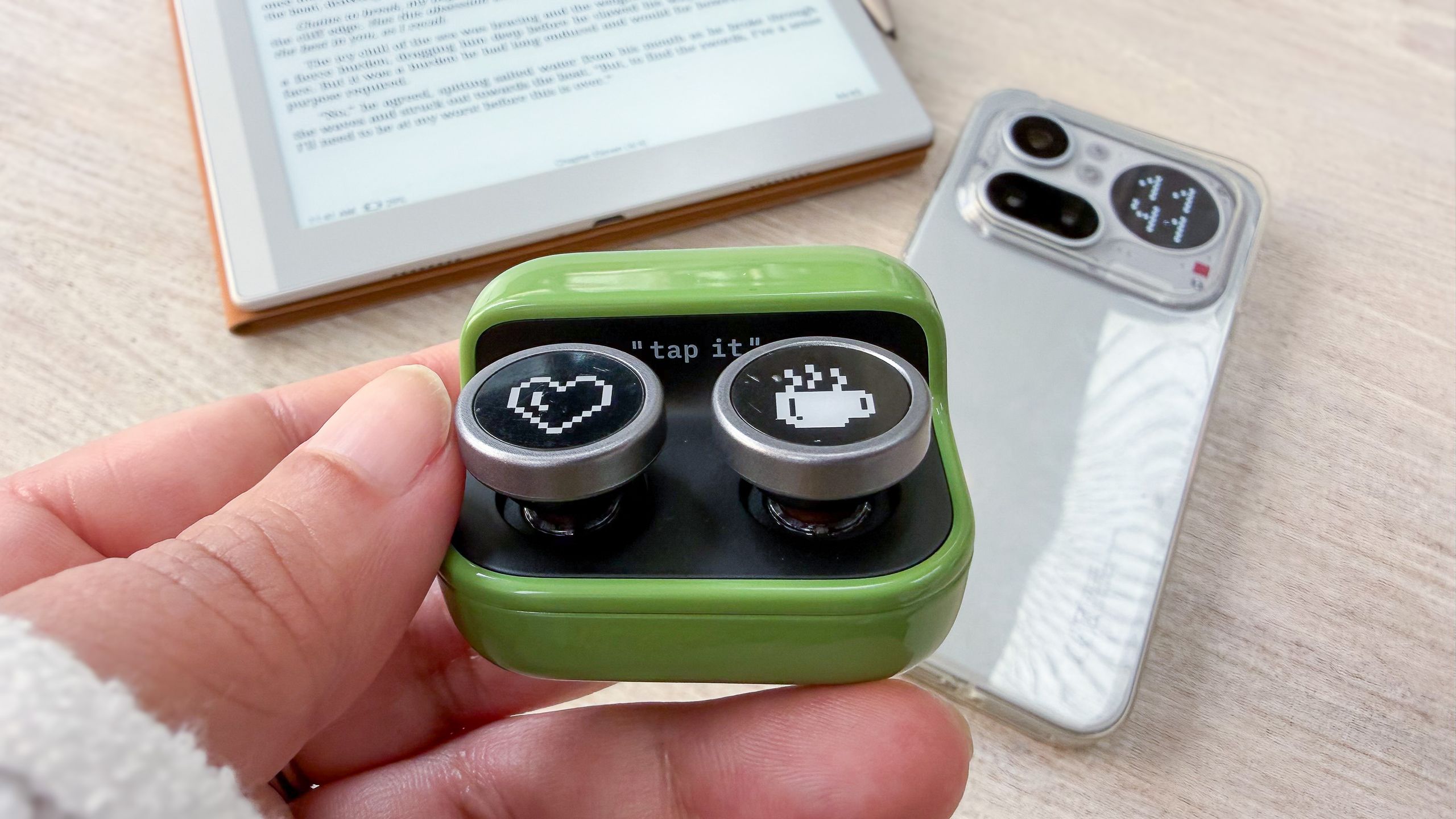
Launched by Onyx in May 2026 and priced at $25.99, the Tappy is a wireless Bluetooth page turner with a design so arresting that people who do not own a single Boox product have started reaching for their credit cards. It is shaped like a miniature retro typewriter, roughly the size of a matchbox, with two chunky round buttons bearing pixelated images – a heart and a steaming cup of tea – on a body that sits in the palm like a satisfying worry stone. The toggle switch looks like a typewriter cartridge release. The words “Tap This” are printed on the front where a brand name would go. It comes with a spare set of keycaps, marked with an X and an O, for readers who prefer a different kind of charm. The whole assembly weighs 29 grams.
It also, as TechRadar’s Sharmishta Sarkar discovered after testing it with three Kindles, a Kobo Libra Colour, and a ViWoods AiPaper, does not work with any of them as a page turner. The Kindles did not even detect it as a Bluetooth device. The Kobo paired but refused to turn pages. The ViWoods connected and adjusted volume. That is the full extent of cross-platform compatibility for the most aesthetically compelling page-turning accessory the category has ever produced.
The incompatibility is not a Boox engineering failure. It is a Bluetooth standard failure – or more precisely, the absence of one. As Sarkar noted in her hands-on at TechRadar, there is a universal command that allows wireless headphones to control audiobook playback on any ereader. No equivalent command exists for page turning, because page turning was never considered common enough to warrant standardization. The Kobo Remote, which launched in October 2025, faces an identical wall when paired with a Kindle. Boox cannot fix this unilaterally, and neither can Kobo. What is required is an industry-level decision that manufacturers have shown no urgency to make.
That inaction was tolerable when page-turning accessories looked like generic plastic TV remotes. It becomes conspicuous when a $26 device prompts strangers to ask what it is and where they can buy one.
Boox announced the Tappy in early May, initially releasing it internationally in a single green colorway while offering Chinese buyers three additional options. By early June, the green version had sold out in the United States. The device returned to the Boox US store on June 8 in a new color called Citrus – a warm yellow-orange that Boox had previously released in China under the name Summer Orange. The green version remains available through the Boox EU store. The Citrus variant ships around June 24 and is listed at $29.99 from the US warehouse, while the base price from the international store sits at $25.99, as Notebookcheck reported. Boox is also offering a 50% discount on the Tappy – dropping it to $15.99 – for customers who purchase the new Go 6 Gen II ereader at the same time, though that offer is limited to a few hundred units.

The device connects via Bluetooth 5.4 with a stated range of 10 meters. Battery life is quoted in weeks under typical use, though Boox has not published a specific figure. A USB-C port handles charging, and an indicator light signals pairing status, mode changes, and low battery. Three operating modes cycle with a five-second hold of both buttons: Reading Mode turns pages forward and backward in supported ebook applications; Browsing Mode scrolls vertically through websites and articles; Multimedia Mode skips tracks and controls playback for audiobooks and music. A firmware update released alongside the accessory – version 4.2 – adds the ability to configure the buttons for screenshot capture, front light adjustment, or full-screen refresh on compatible Boox devices.
Native compatibility requires Boox firmware V4.2 or later. The Note Air5 C and Palma 2 Pro are the specifically listed optimized devices, but the Tappy functions as a Bluetooth HID peripheral on any Android device, meaning it pairs with Android phones and tablets as a standard input controller. On a smartphone in Reading Mode, the buttons default to volume control rather than page turning, since no dedicated ebook command is exposed. That limitation is precisely the gap a Bluetooth ebook standard would close.
The comparison point that hangs over the entire Tappy conversation is Kobo’s own Remote, which arrived in October 2025 at approximately $30 and works exclusively with Kobo hardware for identical reasons. The Kobo Remote uses a replaceable AAA battery rather than rechargeable USB-C. Its design is functional and unremarkable. It did not generate interest outside Kobo’s existing user base because there was no reason for non-Kobo owners to notice it.
The Tappy generates interest outside Boox’s user base specifically because of its design. That distinction is commercially useful for Boox – the device functions as a walking advertisement for the Boox ecosystem – but it also creates a new kind of consumer frustration: coveting an accessory you cannot use. Tech accessories have routinely generated cross-platform envy around software (Apple’s AirDrop, Samsung’s Link to Windows), but hardware accessories have generally been immune because they tend to be interchangeable. The Tappy is the first page-turning accessory with enough design personality to be desired by people it cannot serve, which makes the compatibility ceiling newly visible and newly irritating.
Whether Amazon or Kobo will add Bluetooth page-turning support to their firmware is not clear. Neither company has commented on the Tappy’s launch. Amazon has its own physical page-turn buttons on most current Kindles, which may reduce internal urgency to support third-party accessories. Kobo’s approach with its proprietary Remote suggests the company prefers to control the accessory experience rather than open it. The result is a category where every page-turning device works beautifully within its own ecosystem and is useless the moment you step outside it.
The Logitech Mobi Fold foldable mouse, which Eastern Herald covered earlier this month, raised similar questions about whether peripheral design innovation could push a category forward. The Tappy raises a harder question: what happens when the most interesting accessory in a category is locked inside a walled garden most readers do not live in?
At $26 to $30, the Tappy is not expensive enough to represent a major financial risk for a curious Boox owner. For everyone else, it is an object lesson in what the e-reader industry has decided not to build together.