
SAN FRANCISCO – For two years, Zara Ahmed managed a Facebook cooking page with roughly 40,000 followers, posting three times a week and watching her analytics with the dedication of someone staring at a stock ticker. She knew which reels performed. She never really knew why. That question – not what happened, but why it happened – is the one Meta’s new Creator Assistant is designed to answer.
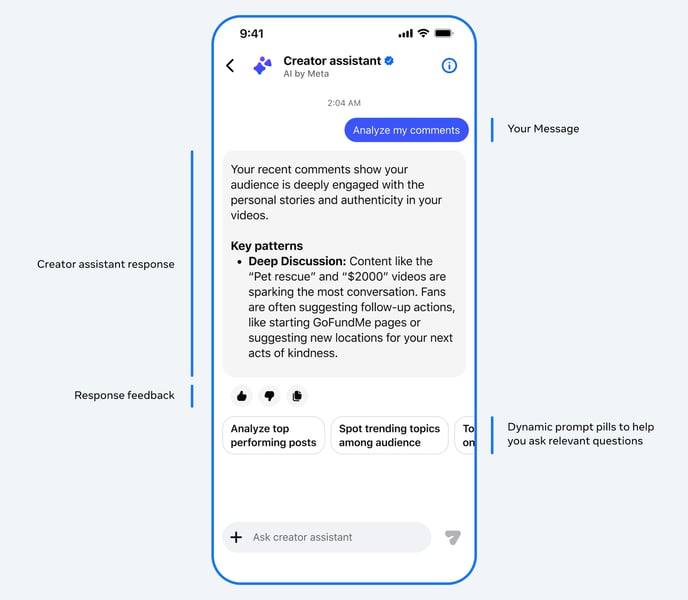
Meta officially launched Creator Assistant on June 3, rolling it out to eligible creators in the United States, Canada, and India. Built directly into the Facebook creator dashboard, the tool works as a conversational chatbot that digs into a creator’s audience data, historical engagement patterns, and content performance – then explains what it found in plain language. No charts to decode. No dashboards to toggle between. Just a question, typed into a box, answered by a system that already knows everything about your page.
The pitch is deceptively simple. A creator can ask: “Why did this reel outperform the rest?” or “How has my audience shifted this month?” or “When should I post?” Creator Assistant answers based on that creator’s specific account history, not on generic platform-wide advice. TechCrunch reported that the tool is conversational – meaning creators can ask follow-up questions and dig deeper on a topic the way they might in a real conversation with a strategist. The answers adjust as the creator builds on them.
That distinction matters. Most creator analytics tools have always told you what happened. They showed you a spike, a drop, a demographic shift. They did not tell you that the spike was caused by a fifteen-second hook rather than the content itself, or that the drop correlated with a shift in posting time by forty-five minutes. That interpretive layer – turning raw data into a reason – is where most creators have historically turned to third-party tools, spreadsheets, or expensive consultants. Meta is now building that layer natively into Facebook, and the implications of that choice extend well beyond convenience.
By housing Creator Assistant inside its own dashboard, Meta is making a deliberate bet that creators will stop turning to external tools – ChatGPT for brainstorming, analytics platforms for performance analysis, scheduling apps for posting optimization – and instead stay entirely within the Meta ecosystem. The company acknowledged as much in its official announcement, noting that in-app access removes the need for creators to seek out third-party alternatives. That is not a coincidental benefit. It is the product strategy.
The tool also expands into content ideation. Engadget described the assistant as a “brainstorming partner” that draws on what’s trending on the platform to suggest new content formats, topics, and audio choices. Creators can ask what cultural moments are gaining traction, which video formats are getting the most engagement in their niche, or what type of content their audience has been most responsive to in the past 30 days. The answers, Meta says, are personalized – calibrated to each creator’s specific community, not to what works across Facebook in the aggregate.
Also announced alongside Creator Assistant was an expansion of Meta’s AI-powered Reels translation feature, which now supports Arabic, Bahasa Indonesia, French, Thai, and Vietnamese, in addition to the nine languages already available. The EU recently ordered Meta to open WhatsApp to rival AI chatbots, a regulatory posture that stands in sharp contrast to how Creator Assistant is designed: to pull creators toward Meta rather than away from it. More than 500 million users on Facebook are now watching AI-translated Reels each week, according to the company – a figure Meta used to frame the translation expansion as proof of demand rather than a strategic hedge against fragmentation.
There is, however, a question hanging over the launch that Meta has not fully answered. Creator Assistant requires full access to a creator’s account – the same architecture that enabled a significant security incident just days before the tool went live. In early June 2026, hackers exploited Meta’s existing AI support chatbot to hijack high-profile Instagram accounts, using prompt injection techniques and VPN masking to trigger unauthorized password resets. TechCrunch confirmed the incident. Meta has not disclosed what specific safeguards distinguish Creator Assistant’s account access model from the one that was compromised. The company said only that it plans to add new capabilities in the months ahead.
That gap is not a hypothetical concern for the creators most likely to be targeted. Accounts with tens of thousands of followers represent real business assets – brand deal income, audience relationships, revenue from Meta’s own bonus programs. For creators who have spent years building those pages, the value proposition of Creator Assistant is clear. The risk calculus is less so.
Meta has been quietly stripping privacy controls from billions of accounts, restricting off-site data personalization to regions covered by GDPR and a small number of other frameworks, while expanding data use elsewhere. Creator Assistant operates on a similar geographic asymmetry: the rollout covers the US, Canada, and India, with no confirmed timeline for the UK or EU. Whether that reflects regulatory caution or a sequenced product strategy, Meta has not said.
What Meta has said is that Creator Assistant is designed to get smarter over time, learning a creator’s goals and calibrating its recommendations accordingly. The implication is a feedback loop: the more a creator uses the tool, the more data it accumulates about their specific strategy, audience, and content style; the more accurate its suggestions become; the less reason a creator has to look anywhere else. That is a compelling product. It is also, by design, a dependency.
Facebook has been in a decade-long competition with TikTok and YouTube for creator attention and creator content. Those platforms have their own analytics offerings and their own AI ambitions – YouTube’s Gemini-powered Studio features and TikTok’s creator insights tools have both expanded significantly this year. Meta’s advantage is not that its AI is necessarily superior. Its advantage is that the data Creator Assistant draws on – the audience information, the historical performance, the engagement patterns – already lives inside Facebook. No third-party tool can access it, because Meta does not allow it. Creator Assistant is not just a product. It is a structural moat, dressed as a chatbot.
Whether the tool actually delivers on its core promise – explaining why content works, not just tracking whether it did – remains to be tested at scale. Meta’s announcement included no data on accuracy, no benchmarks against manual analysis, and no assessment of how the tool performs for creators in early-stage growth versus those with established audiences. Those are the questions creators in the US and India will be running informal experiments on over the coming weeks. For the creators in Europe and the UK still waiting for access, the answers may arrive well before the tool does.