
SEOUL – The problem that Samsung Heavy Industries set out to solve has a number attached to it, but the number isn’t the story. The number is the years – sometimes three, sometimes five – that companies trying to build new AI data centers in the United States now wait just to connect a facility to the power grid. What Samsung’s shipbuilding division concluded is that the grid, on its own, cannot keep up. So it started designing around it.
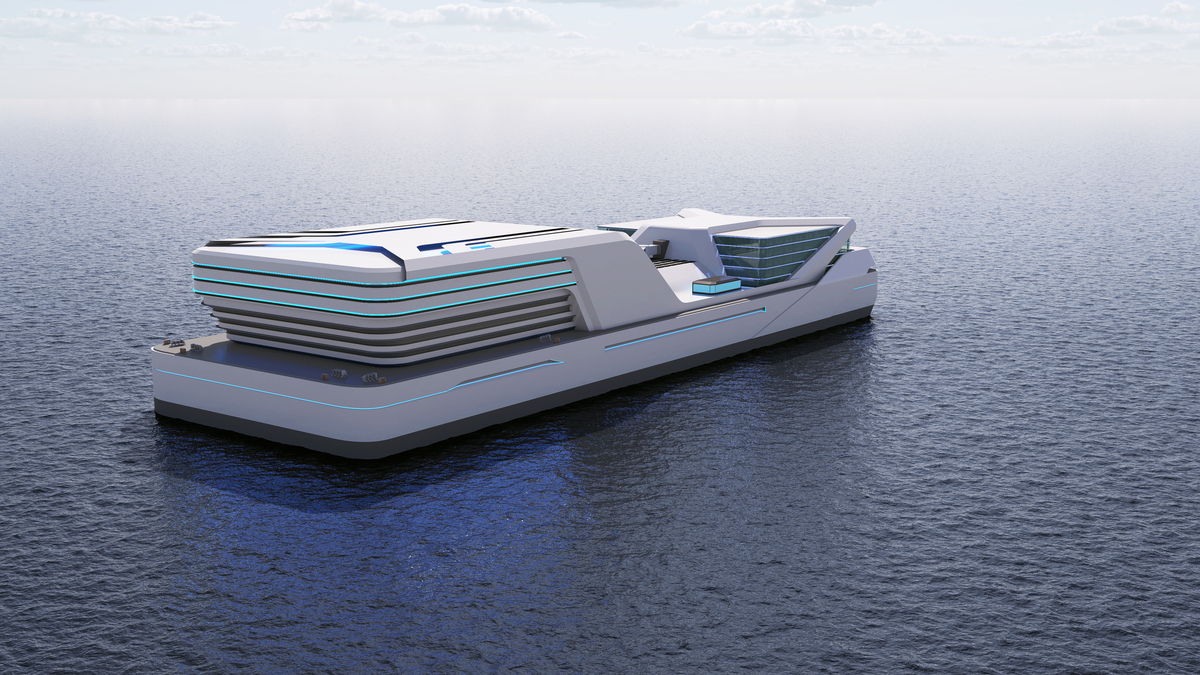
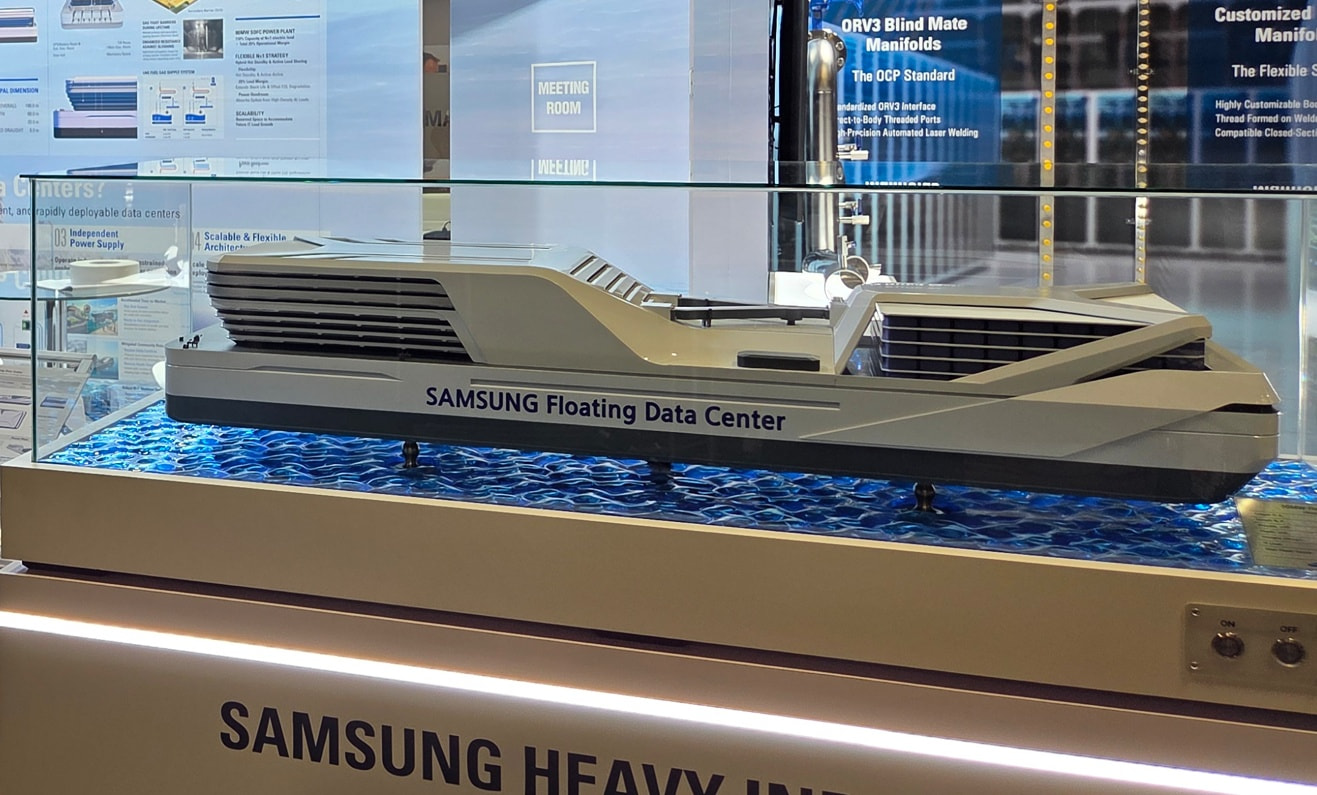
The result is a concept the company calls the Floating Data Center, or FDC: a purpose-built vessel that carries server hardware to sea, generates its own power through onboard liquefied natural gas fuel cells, and cools its racks using the ocean itself. Samsung Heavy Industries, a Seongnam-based shipbuilder that is a subsidiary of the broader Samsung Group conglomerate, has been quietly advancing the idea for months. Last week it became clear how far the project has actually progressed.
The company’s 50-megawatt FDC design has now received approval-in-principle from two of the world’s foremost maritime safety bodies: the American Bureau of Shipping and Lloyd’s Register. These are not symbolic endorsements. Both organizations evaluate structural integrity, safety systems, and seaworthiness before granting approval, and their sign-off is typically required before investors or shipowners will commit capital to a novel vessel type. Getting both in the same development cycle is a meaningful threshold for a concept that, until recently, existed primarily as a technical proposal.
Samsung Heavy Industries executive vice-president and chief technology officer Young-kyu Ahn has said the FDC represents a new business model that extends the company’s shipbuilding capabilities into the digital infrastructure sector. What he described as a convergence of maritime engineering and cloud computing is, in practical terms, a bet that hyperscale tech companies will pay for floating square footage the way they currently pay for land-based square footage – and that shipowners will find the long-term lease structures more appealing than the volatile freight markets they have always depended on.
Three separate agreements have now been signed to develop the concept further. The first pairs Samsung Heavy Industries with Capital Clean Energy Carriers, a Greece-based shipowner, to build new data-ready vessels from scratch – a different approach from the Hitachi-Mitsui model, which proposes converting retired cargo ships into floating compute facilities. The second agreement brings in server hardware manufacturer Supermicro to develop rack configurations capable of surviving the marine environment: the salt corrosion, the constant low-frequency vibration, the humidity cycles that land-based data centers are never engineered to handle. As Tom’s Hardware reported, neither company has yet published results from that hardware durability testing.
The third agreement, announced in late April, is the one that most directly signals US market intent. Mousterian Corporation, a Dallas-based developer of floating and water-adjacent data center infrastructure, signed a memorandum of understanding with Samsung Heavy Industries to jointly deliver FDC projects in the United States. Min Suh, chief executive of Mousterian, said the partnership provides a credible path to what the company called gigawatt-scale delivery – timelines, he said, that conventional land-based approaches cannot match.
That claim deserves scrutiny. Gigawatt-scale floating data centers would require fleets of vessels, not individual ships, and neither the financing structures nor the regulatory frameworks for that kind of maritime compute deployment exist yet. What does exist is a pilot-scale concept with two regulatory approvals and a Dallas firm actively originating US coastal sites. Whether the gap between the two is a matter of years or decades is something neither Samsung nor Mousterian has been willing to specify.
The logic driving all of it is the same power-grid math that is now reshaping every major AI infrastructure decision in the United States. As Eastern Herald reported last week, a proposed 800-acre land-based data center in Lowndes County, Alabama, illustrates exactly the kind of community friction and infrastructure strain that the on-land model generates. Separately, Pennsylvania residents have seen electricity bills rise 50 percent since 2020, a trajectory that data center demand has accelerated rather than caused but is now deepening. Against that backdrop, the idea of generating compute power at sea – drawing from the ocean for cooling, using LNG for electricity – has a kind of structural appeal that goes beyond novelty.
The 50-megawatt figure Samsung has designated for its current design is roughly the capacity of a mid-sized land-based data center campus. It is not a hyperscale facility by current industry standards – a single OpenAI or Microsoft cluster today can run to several hundred megawatts – but a vessel at that scale would be a proof-of-concept capable of hosting real AI workloads for real customers. The company has indicated the FDC can operate in two modes: connected to the mainland through subsea cables when anchored near a coast, or running entirely on self-generated LNG power when positioned further offshore. That flexibility is, in theory, the design’s chief commercial argument: a data center that can follow demand rather than waiting for grid capacity to catch up.
What the design cannot yet demonstrate is durability over time. Server hardware has not historically been built to tolerate the mechanical environment of a working vessel. Vibration analysis, humidity stress testing, and corrosion modeling across a projected multi-year service life are precisely what the Supermicro partnership is meant to address, but those results have not been published. Whether the hardware that passes terrestrial burn-in testing survives three years of North Atlantic weather is a question that only operational experience can answer.
Samsung Heavy Industries had also previously signed a letter of intent with OpenAI, covering joint development of floating data centers alongside Samsung’s broader Stargate memory commitments. If the floating model proves viable, some of those facilities might not be on land. OpenAI has separately been pursuing a 10-gigawatt land-based campus in Ohio on federal land – the two strategies are not mutually exclusive, and in the present political environment, where data center siting faces growing local resistance, having an offshore alternative available is not the worst position to be in.
The shipbuilding industry has watched the FDC category develop with some interest and considerable caution. Traditional shipowners have been looking for alternatives to the freight cycles that have whipsawed revenues for decades. Leasing data center space to tech companies under long-term, fixed-rate contracts is a structurally different business – predictable, indexed to power costs rather than commodity prices, and not subject to the geopolitical disruptions that periodically devastate the container and tanker markets. Capital Clean Energy Carriers, the Greek firm that signed with Samsung Heavy Industries, is apparently willing to put capital behind that thesis. TechTimes reported that the terms of the agreement – including the financing structure and site origination timeline – have not been disclosed.
What Samsung Heavy Industries has built, for now, is a concept with regulatory standing, a handful of serious partners, and a credible answer to the question of why the ocean is better than the grid. What it has not yet built is a ship.