WASHINGTON – For the millions of Americans waiting for federal housing policy to deliver on a two-year-old promise, Thursday was another day without an answer.
President Donald Trump and House Speaker Mike Johnson emerged from more than three hours at the White House on Thursday describing themselves as being “on exactly the same page,” a formulation broad enough to cover the distance between two questions that remained entirely unresolved: when Trump will sign the housing bill sitting on his desk, and how Congress will ever pass a voting overhaul the Senate almost certainly cannot deliver.
“Congress has work to do,” Johnson said after leaving the White House, “and that’s what we’re going to do.” He offered no timeline for either.
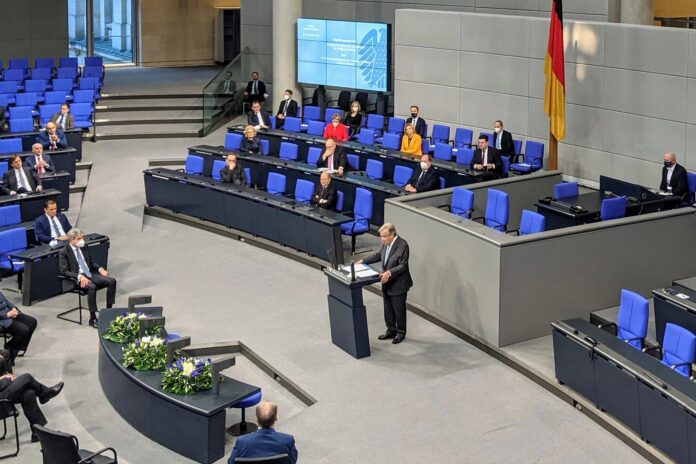
The standoff traces to Wednesday, when Trump abruptly canceled a Capitol Hill ceremony to sign the 21st Century Road to Housing Act, a sweeping bipartisan package that would restrict large institutional investors from buying single-family homes and ease construction regulations in an effort to address the nationwide housing shortage. The bill had passed both chambers with comfortable margins. Hours before the signing, Trump posted on Truth Social that he was canceling until Congress passed the SAVE America Act, a voting overhaul requiring photo identification and proof of citizenship to register to vote. He called it “a National Emergency.”
The SAVE Act has already cleared the House, but it has no credible path through the Senate. Democrats are universally opposed. Separately on Thursday, Senate Minority Leader Chuck Schumer announced a first-ever election observer program, deploying Capitol Hill staff to polling places in 35 battleground states as a direct counter to Trump’s election overhaul push. Republicans cannot override a Democratic filibuster without votes that do not exist. Speaker Johnson has floated attaching it to a third budget reconciliation package, a parliamentary route requiring only 51 votes, but Senate rules would require the parliamentarian to certify that an election law measure qualifies under the budget process rules governing reconciliation. That question has not been tested.
What has changed is the collateral damage. Inside the House, a bloc of Republicans led by Representative Anna Paulina Luna of Florida has been blocking floor votes on all legislation until the SAVE Act advances, paralyzing a chamber that has been unable to move a renewal of the government’s warrantless surveillance authorities, a third reconciliation package, or anything else requiring a floor vote. Trump, who demanded the SAVE Act take priority and helped create the conditions for that blockade, on Thursday told those same Republicans to stand down.
“House Republicans should unify, and stop voting down ‘Rules’ or, threatening to do so,” Trump posted on Truth Social. “No more grandstanding, please!”
The housing legislation in limbo is not a minor policy adjustment. The 21st Century Road to Housing Act represents the most significant federal housing affordability intervention in decades. Its investor restrictions target the wave of institutional buyers that has purchased hundreds of thousands of single-family homes over the past several years, converting them to rentals and removing inventory from a market that was already undersupplied. Economists across the political spectrum have described those provisions as a meaningful if partial corrective for a market that has left homeownership rates at generational lows, ABC News reported.
What the bill does not fix, Trump has now made clear, is the thing he cares about most: an election system that, in his telling, remains vulnerable to non-citizen participation. Whether that vulnerability exists at the scale he describes is contested by state election officials from both parties. Whether the Senate will agree with his remedy is not.
After the White House meeting, Johnson said he will be “transmitting the housing bill” to the president, NBC News reported. But the bill was already transmitted before Trump refused to sign it. Transmitting it again changes nothing about the president’s stated condition for putting pen to paper. Johnson did not say when that condition would be met, or how.
The standoff illustrates a recurring pattern in the second Trump term: a president who moves the goal line on legislation that has already been agreed upon, using signed bills as leverage to extract promises on separate priorities, then calling on Congress to sort out the complications that follow. Republicans have learned to call these moments moments of alignment. Neither Trump nor Johnson said Thursday what “same page” means when one of them has the pen and the other has to leave empty-handed.