
BRUSSELS – European carmakers, pharmaceutical exporters, and semiconductor companies got concrete certainty on Thursday when the EU Council formally enacted the Turnberry Agreement, adopting two regulations that lock in a 15 percent ceiling on United States tariffs for their products and eliminating the threat of 25 percent auto duties that the Trump administration had set against a July 4 horizon.
The Council’s adoption completes the final step in a months-long ratification process. The two regulations formally commit the European Union to eliminating tariffs on US industrial goods and opening preferential market access for American seafood and agricultural products. Washington, in return, is bound to a 15 percent ceiling on duties applied to the overwhelming majority of European exports, including cars, pharmaceuticals, semiconductors, and lumber. The regulations remain in force through December 31, 2029.
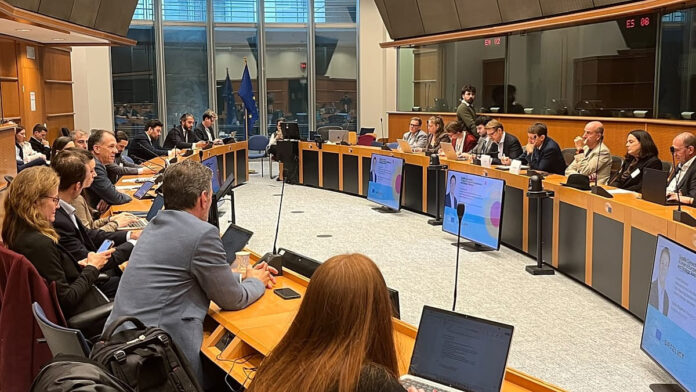
The agreement takes its name from the Scottish golf resort where President Donald Trump and European Commission President Ursula von der Leyen sealed a handshake deal in August 2025. Converting that handshake into binding law took nearly a year. The European Parliament ratified the implementing legislation on June 16, voting 440 to 151 with 50 abstentions, a margin that reflects significant unease rather than broad consensus. The EU Council adopted the regulations on Thursday, completing the legislative sequence eight days before the deadline Trump had attached to the threat of 25 percent tariffs on European automobiles.
The 151 votes against ratification in the Parliament are not a footnote. Members who opposed the deal argued that Brussels had paid too high a price for too fragile a guarantee. The total European commitments embedded in the Turnberry framework include $600 billion in United States investments pledged through 2028 and $750 billion in American energy purchases. Critics framed those numbers not as commercial concessions but as a structural reorientation of transatlantic dependency, one that hands Washington ongoing leverage over an economy it is simultaneously targeting with other trade instruments.
That concern hardened before ratification was even complete. Weeks after the Turnberry handshake in August 2025, the Trump administration reclassified hundreds of European industrial products as steel derivatives and applied duties of up to 50 percent, well above the 15 percent ceiling the agreement is supposed to guarantee. Bloomberg reported that the deal includes a safeguard clause addressed directly at this pattern: if the United States has not brought its steel and aluminum duties into alignment with the Turnberry ceiling by December 31, 2026, Brussels is authorized to suspend the preferential tariff terms it extended under the agreement. The deal also allows the Commission to reverse tariff cuts if American goods flood the European market in ways that demonstrably harm domestic producers.

What Europe’s negotiators extracted beyond the tariff ceiling includes the extension of an existing suspension of European duties on American lobster imports, a dispute that had been running since the first Trump term and that had become something of a test case for whether bilateral commercial grievances could be resolved outside formal WTO mechanisms. The lobster measure runs retroactively from August 2025 and expires in July 2030. US Trade Representative Jamieson Greer expressed satisfaction with the pace of implementation after the Parliament’s June 16 vote, framing the Council adoption as confirmation of what he called a framework for reciprocal and balanced trade.
The ratification arrives as the EU is simultaneously navigating a separate and overlapping layer of US commercial pressure. Washington’s Section 301 investigation named the European Union among 60 economies that the administration determined had failed to adequately ban forced-labor imports, with tariffs of 10 percent proposed under that separate legal mechanism. The Turnberry Agreement does not absorb or nullify that exposure. Both tracks of US trade pressure continue in parallel, and the Commission has not yet indicated how it intends to respond to the Section 301 proposals, whose public comment period closes July 1.
Brussels is also managing a simultaneous hardening of its own commercial doctrine in the opposite direction, deploying EU China tariffs even as it locks in preferences for Washington, a dual posture that reflects the EU’s core calculation: absorb enough American commercial demand to keep the transatlantic relationship functional while defending European industry against the Chinese overcapacity that US tariffs have rerouted toward European markets.
European industry groups that had been lobbying for a tariff ceiling since the first wave of Trump administration duties in 2025 broadly welcomed Thursday’s adoption. Automotive manufacturers, whose supply chains are most exposed to the US-EU tariff differential, noted that the 15 percent ceiling removes the single largest source of planning uncertainty they had been carrying into investment decisions. What the ceiling does not remove is the exposure to future reclassification, the mechanism by which Washington extracted 50 percent duties from goods it had implicitly committed to cap. Euronews reported that legal analysts advising European exporters have been flagging that gap since the Turnberry deal’s original terms were published.
The December 31, 2026 date is the real measure of the agreement’s durability. By then, the Commission will have gathered six months of data on whether Washington is actually bringing its steel and aluminum duties into line with the 15 percent ceiling it agreed to in writing. If it is not, Brussels will face a choice between activating the safeguard and absorbing a confrontation with a trading partner that has already demonstrated it treats ratified commitments as a starting point for further negotiation rather than a settled outcome. European industries that spent two years lobbying for exactly what Thursday delivered will be watching that deadline at least as closely as they watched the vote.