
CANBERRA – Three years after the Murphy Report laid out a blueprint for clearing Australia’s airwaves of gambling advertisements, the government’s answer arrived in parliament Wednesday. By Thursday morning, it had united the Greens, the Coalition, and independent crossbenchers in a shared verdict: not enough.
The Interactive Gambling Amendment (Gambling Reform) Bill 2026, introduced by Communications Minister Anika Wells, would cap gambling advertisements on television to three per hour between 6 a.m. and 8:30 p.m., ban wagering ads during live sports broadcasts, and prohibit celebrity and sports player endorsements of betting brands. Radio ads near school drop-off and pickup times would be banned. Online gambling platforms would face mandatory age verification. A companion bill would strengthen BetStop, the national self-exclusion register, and impose a levy on betting companies to fund awareness campaigns for it.
The list of what the legislation does not do is what triggered the immediate backlash. The Murphy Inquiry’s 2023 report – titled “You Win Some, You Lose More,” authored by the late Labor MP Peta Murphy – had recommended a comprehensive phase-out of gambling advertising across all broadcast and online channels. The Albanese government’s legislation preserves a racing industry carve-out, leaves gambling ads running on television after 8:30 p.m., and stops well short of the full prohibition the inquiry recommended.
Greens Senator Sarah Hanson-Young called the bill “half-arsed,” noting that an 8:30 p.m. watershed offers little practical protection when children are awake and watching sport on devices and streaming platforms the legislation’s broadcast-era rules were never designed to reach. She urged the government to “grow a spine” and match the Murphy Report’s scope. On the opposite end of the chamber, Coalition MP Simon Kennedy called the package “a capitulation to the gambling lobby,” arguing that political will exists in parliament to go much further but has been deliberately withheld. His colleague Andrew Wallace said the bill had “so many holes through it” that enforcement would deliver inconsistency rather than clarity.
Independent MP Andrew Wilkie, who has long argued that parliament is insufficiently arm’s-length from the gambling industry, sought to suspend parliamentary business to force an immediate floor debate. He did not succeed. But his characterization of lawmakers as working “hand-in-hand with gambling companies” – comparing the relationship to “jackals feeding on the carcass of gambling addicts” – captured a mood that cut across party lines.
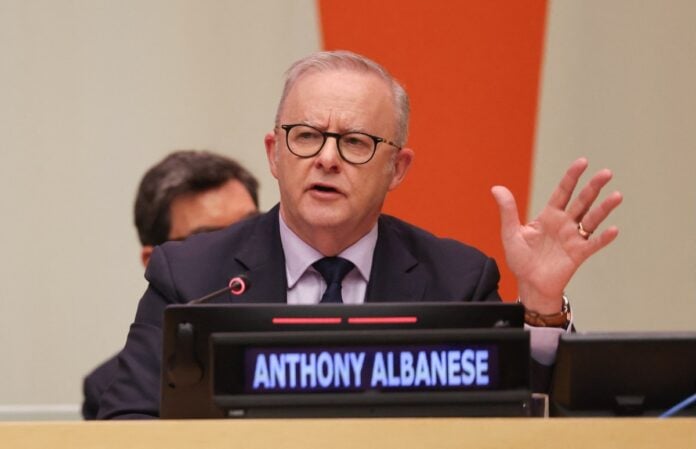
Prime Minister Anthony Albanese framed the bill as genuine progress. “We are letting adults have a punt if they want to, but also making sure Australian children don’t see betting ads everywhere,” he said when the reform package was announced. Minister Wells offered a more specific image: Australians would be able to sit with their families and cheer for their team “without being bombarded by gambling advertising.” The gap between that description and what the bill as drafted actually does is precisely what fueled the crossbench response.
Liberal Senator Sarah Henderson joined the calls for parliamentary scrutiny, saying the Coalition had “concerns about the government’s bill” and that it warranted referral to a Senate inquiry rather than a rushed vote. The inquiry is expected to report by August 17, which puts the government’s January 1, 2027 implementation target at real risk. A full chamber vote cannot realistically happen before late August. The deadline is now the legislation’s most immediate political problem – four years after the Murphy Inquiry began, the rollout date could slip again before a single provision takes effect.
The bill’s construction also drew criticism from both sides of the advocacy divide. Gambling industry representatives and harm reduction advocates each told reporters the consultation process ran for only a few weeks and included limited direct discussion time with government officials. Industry groups raised questions about the provisions’ scope and enforceability; harm reduction organizations said the truncated process prevented them from pressing for the stronger measures the Murphy Report had endorsed. That both camps were dissatisfied with the process – for opposite reasons – reflects the degree to which the bill tried to split a gap too wide to bridge quietly.
The Interactive Gambling Amendment Bill targets the television and radio advertising landscape where gambling brands have operated with relatively unconstrained access since an earlier regulatory attempt collapsed in 2022. The live sports ban addresses one of the Murphy Report’s most prominent concerns – documented exposure of children during broadcast game coverage. But it leaves standing the ability to advertise before the 8:30 p.m. watershed, to reach audiences on podcast and streaming platforms the legislation does not directly address, and to continue using the racing industry’s broadcast footprint through the structural carve-out that survived the drafting process intact.
The Australian Communications and Media Authority has already moved on one front the legislation targets. The regulator added 12 illegal gambling websites to its blacklist in the period before the bill’s introduction, signaling that enforcement against offshore operators is a stated priority regardless of the legislative timeline. The National Self-exclusion Register (Cost Recovery Levy) Amendment Bill – the companion legislation – would also require betting companies to fund BetStop’s outreach directly, shifting what is currently a government-funded awareness effort onto industry’s balance sheet.
What the Senate inquiry will actually produce is not yet knowable. The committee could tighten the 8:30 p.m. watershed, narrow the racing carve-out, or extend the live sport ban’s reach to streaming platforms. It could also leave the bill largely intact and let the chamber vote on what was tabled. The political arithmetic required to pass the legislation in anything close to its current form – satisfying the Coalition’s demand for a more comprehensive framework and the Greens’ call for a prohibition closer to the Murphy Report’s original recommendation – does not obviously exist today. Whether it can be assembled between now and an August vote, or whether the January 2027 start date becomes another casualty of a political process that has been slow-walking gambling reform since 2023, is the question the inquiry has not yet answered.