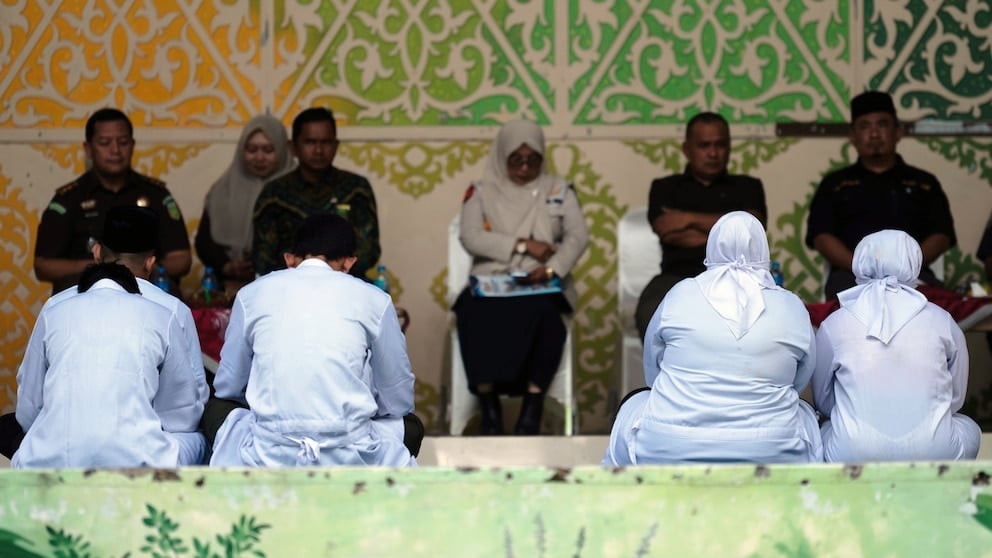

BANDA ACEH — At Bustanussalatin City Park on Thursday, roughly a hundred people assembled to watch as two officials in white robes and face coverings mounted a stage and administered 21 strokes of a rattan cane to a 22-year-old man and a 25-year-old woman. The two had been convicted under Aceh’s Islamic Criminal Code for a kiss they filmed on a TikTok livestream four months earlier.
The punishment drew immediate international condemnation and directed global scrutiny at Aceh, the only province in Indonesia where sharia law operates with full criminal enforcement. Thursday’s caning, carried out in public before assembled witnesses and accompanied by the confiscation of the couple’s phone and USB drive, was the province’s latest application of a legal framework that human rights organizations say has long since crossed from religious governance into institutionalized cruelty.
The case began on February 27, when the two livestreamed a brief video of themselves kissing inside a car on TikTok. Within days the clip had spread well beyond its original audience. By April, Aceh’s sharia enforcement authorities had received reports of the video and the couple was arrested. A sharia court subsequently convicted them under the Qanun Jinayat, the province’s Islamic Criminal Code, which governs a range of offenses the Acehnese authorities define as violations of religious morality.
Their original sentence was 25 lashes. Four months in pre-conviction detention was counted against the total, reducing Thursday’s number to 21. Aceh’s sharia law provides for punishment of up to 100 lashes for certain morality violations; Thursday’s sentence sat at the lower end of that range. The couple’s names were not made public by authorities, and no statement was issued by the Aceh provincial government or its sharia enforcement apparatus in the hours following the caning.
The setting was deliberate. Bustanussalatin City Park is a public space in central Banda Aceh, the provincial capital. The use of a stage, robed officials, and a gathered audience is standard procedure under Aceh’s sharia enforcement model; public visibility is understood as part of the deterrent function. For the couple facing the cane, the hundred pairs of eyes watching from below the stage were themselves part of the sentence.

Montse Ferrer, Amnesty International’s Co-Regional Director for Southeast Asia, described what happened Thursday as “a horrifying act of discrimination, and a grim reminder of the enduring human rights violations permitted under the Islamic Criminal Code in Indonesia’s Aceh province.” Caning itself, Ferrer said, is “an inherently cruel, inhuman, and degrading punishment that frequently crosses the threshold into torture.” Amnesty International published a statement calling for Indonesian authorities to repeal the provisions used to prosecute the couple and to end the criminalization of consensual intimacy between adults.
Usman Hamid, the Executive Director of Amnesty International Indonesia, framed the question more directly. He acknowledged that the behavior might be considered socially inappropriate by some, but asked whether a kiss livestreamed on a social media platform constitutes a crime warranting imprisonment and public caning. Indonesia is a signatory to the United Nations Convention Against Torture, Amnesty noted, and the caning regime in Aceh sits in direct conflict with that obligation.
Aceh’s sharia system is the product of a specific political bargain. The province, at the northern tip of Sumatra, endured a decades-long separatist conflict before a peace agreement was signed in 2005 following the Indian Ocean tsunami. Under that settlement, Aceh received greater autonomy than any other Indonesian province, including the right to implement Islamic law. The Qanun Jinayat took effect in 2014. A year later, the Acehnese government extended its reach to cover non-Muslims living in the region, putting the code into direct tension with Indonesia’s national legal system, which does not impose religious criminal sanctions on non-adherents.
The national government in Jakarta has at various points expressed discomfort with some of Aceh’s applications of sharia, but the autonomy framework created by the 2005 peace deal significantly constrains what the center can do. Reopening the legal terms of that settlement carries political risks the government has consistently declined to take. For international observers, that constraint means no obvious mechanism exists through which Jakarta can unilaterally end Aceh’s public caning regime.
The case lands at a peculiar moment for TikTok as a platform. In Indonesia, a TikTok post became the basis of a criminal prosecution ending in public corporal punishment. In the West, TikTok faces an entirely different set of pressures, including legislative battles over its ownership and data practices, as Eastern Herald has covered, including how the TikTok deal tests Western claims on free speech and cultural power. The two debates share a platform and almost nothing else.
That tension between digital expression and state authority is not unique to Aceh, though the method of enforcement is. Governments across Europe have moved in recent months to restrict what can be shared and who can see it online, with France and Britain each announcing on the same day last month legislation to cut children off from social media platforms. The regulatory contexts are entirely different. The underlying question, of who decides what digital expression is permissible, is the same one Aceh’s sharia court answered Thursday with a rattan cane.
NBC News was among the international outlets reporting the caning Thursday. Their reports noted calls from human rights organizations for the Indonesian central government to take action. No such action was announced. Whether the couple intends to appeal the conviction, or whether appeal is even available under the Qanun Jinayat framework, was not disclosed by authorities. Their phone and USB drive, the devices that contained the video that put them in front of a stage in a public park, were not returned.
The rattan cane was put away. The two people who received its strokes left Bustanussalatin City Park without their names having been made public. The video has presumably been deleted. Aceh’s Islamic Criminal Code has not been repealed, and there is no indication that it will be.