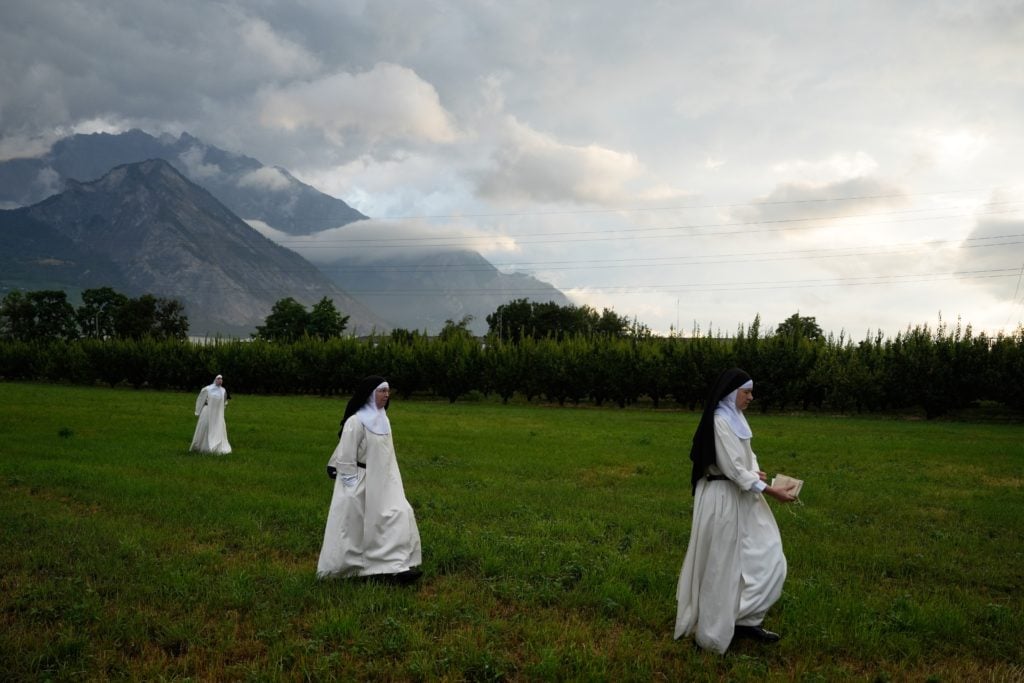

ECONE, Switzerland – For the hundreds of the faithful who drove through the Alps to a seminary field in Switzerland on Tuesday, the Mass they attended looked like nothing out of the ordinary: Latin chants, incense, velvet vestments, the slow bell-tolling of a rite abolished by the Second Vatican Council more than sixty years ago. What was new – and what Rome confirmed on Thursday – was that the four men consecrated bishops at that five-hour ceremony were now formally cut off from the Catholic Church, and that the institution their society has spent 57 years insisting it loyally served had declared them schismatics.
Pope Leo XIV announced Thursday that the Holy See had excommunicated six bishops of the Society of Saint Pius X and declared the traditionalist organization in formal schism – the deepest possible rupture short of outright heresy. The declaration came the day after the SSPX consecrated four new bishops at Econe without papal mandate, in direct defiance of a personal plea from the pontiff to halt the ceremony.
The four men ordained at the ceremony were Pascal Schreiber of Switzerland, Michael Goldade of the United States, Michel Poinsinet de Sivry and Marc Hanappier of France. The ceremony was performed by Bishop Alfonso de Galarreta – himself previously excommunicated in 1988 alongside the society’s founder – and de Galarreta is among the six bishops now formally severed from Rome under Thursday’s declaration. An estimated 16,500 people gathered in a field outside the Econe seminary to watch, the ceremony livestreamed to communities across fifty countries.
The news peg for Thursday’s announcement was precise: canonical law mandates automatic excommunication for bishops consecrated without papal approval, and the Holy See confirmed it had invoked those provisions. But the announcement carried weight that went beyond the immediate penalty. This is the second time in a single generation that the SSPX has made this choice, and the second time Rome has responded in kind. More significantly, it marks the collapse of an arrangement that Pope Benedict XVI built at considerable political cost – the 2009 lifting of the 1988 excommunications that had seemed, at the time, like a historic bridge toward regularization. That bridge is now gone.
Cardinal Pietro Parolin, the Vatican Secretary of State, called the consecrations an act that was “schismatic in itself” and said he wished to express “deep sorrow” over what the society had chosen. “We know that episcopal ordinations performed without a papal mandate break the unity of the Church,” Parolin said. The formulation was careful, but the underlying message was not ambiguous: the Vatican had warned, been ignored, and was now formalizing the separation that the SSPX’s leadership had made inevitable.
Pope Leo himself had written to the society in late June, describing the planned consecrations as “a sin of extreme gravity” that would wound ordinary faithful and harm Church unity. The letter was not heeded. When de Galarreta placed his hands on the four new bishops in Econe, he was doing so with full knowledge of what Rome had said – and with a deliberate choice to proceed regardless. The act was not an oversight or a miscommunication. It was a declaration of institutional independence.
The 1988 precedent casts a long shadow. When Archbishop Lefebvre consecrated four bishops that year without papal consent, John Paul II issued the same automatic excommunications that Leo XIV has now invoked. Lefebvre died in 1991 still outside canonical communion with Rome. The excommunications appeared permanent until Benedict XVI lifted them in 2009, opening a formal doctrinal dialogue aimed at the SSPX’s eventual regularization. That dialogue produced no agreement on the substantive theological questions – the society’s rejection of the Council’s reforms on religious liberty, ecumenism, and the new Mass – but it produced a truce. The 2026 consecrations have ended that truce definitively.
The society operates at scale. It claims 751 priests, 264 seminarians distributed across five major seminaries, and parishes and chapels in communities across 50 nationalities. Its reach into the United States is significant, and the presence of Michael Goldade – an American – among the four newly consecrated bishops gives the schism a particular resonance for SSPX communities in the United States, where the relationship between American Catholics and the Vatican has already been under unusual strain during the Trump presidency.
Among those now facing uncertain canonical status are ordinary American Catholics who attend SSPX Masses with no involvement in the society’s governance – men and women who chose the traditional Latin Mass for reasons of devotion, not defiance. The Church has historically treated lay SSPX attendees with practical ambiguity, but Thursday’s formal schism declaration leaves that position considerably less comfortable. One attendee at the Econe ceremony was untroubled. “I feel like I’m on a safer road to heaven,” she told NBC News. That sentiment captures something essential about the SSPX’s hold on its communities – the conviction that fidelity to a pre-conciliar form of worship constitutes a deeper obedience to tradition than compliance with post-Vatican II institutional structures.
Critics within the mainstream Church have argued for decades that this position is theologically self-defeating. Rev. Robert Gahl of the Catholic University of America made the case directly: “You can’t serve tradition while disobeying the church and her authority.” The argument has not, in 57 years, persuaded the society’s leadership – and Thursday’s events suggest it will not now.
What Leo XIV’s approach to the SSPX will look like going forward is not yet clear. His predecessor Francis progressively restricted the traditional Latin Mass through the 2021 motu proprio Traditionis Custodes, positioning the liturgical question as a matter of communion discipline. Leo has been quieter on the liturgical front. Whether the schism declaration is accompanied by any pastoral outreach toward SSPX faithful or clergy who might prefer eventual reconciliation over permanent separation – and there are priests and laity within the society for whom that is genuinely the preference – has not been indicated. The Vatican’s Thursday statement was a legal determination, not a roadmap.
Leo XIV’s broader papacy has grappled with questions of institutional authority and Catholic identity in ways that his June visit to a rapidly secularizing Spain made particularly visible – a pontiff trying to hold together a global Church whose internal tensions are moving in opposite directions. The SSPX schism is the sharpest expression of those tensions: a group that believes the Church reformed too far, now formally separated from a Church that believes the SSPX has refused to accept reform at all.
Whether that rupture fractures the society itself – producing a split between those who sought eventual regularization with Rome and those who regard the Holy See’s post-conciliar authority as already forfeit – is the question Thursday’s announcement leaves entirely open.