
DUBAI – Three merchant seafarers, two Pakistani nationals and one Indonesian, died when a Houthi ballistic missile struck a commercial vessel in the Bab el-Mandeb strait on Tuesday, the most lethal attack on civilian shipping in the narrow waterway since the Iran-backed movement launched a renewed maritime offensive against Saudi Arabia in late July.
The missile was fired from Yemen’s eastern Taizz province, Al Arabiya television reported. Al Hadath broadcast the same information without specifying missile type or range. The name, flag state, and cargo of the struck vessel were not disclosed in initial reports from either broadcaster. Whether the ship remained afloat or sank had not been confirmed by early Tuesday evening.
The deaths are the most lethal Houthi strike on commercial shipping crews in several months, arriving at a moment when tanker traffic through Bab el-Mandeb has already been severely disrupted. In late July, the Houthi movement declared a maritime blockade against Saudi Arabia, banning vessels linked to the kingdom from the waterway. Shipping companies responded by switching off automatic identification systems and rerouting cargo through alternate lanes.
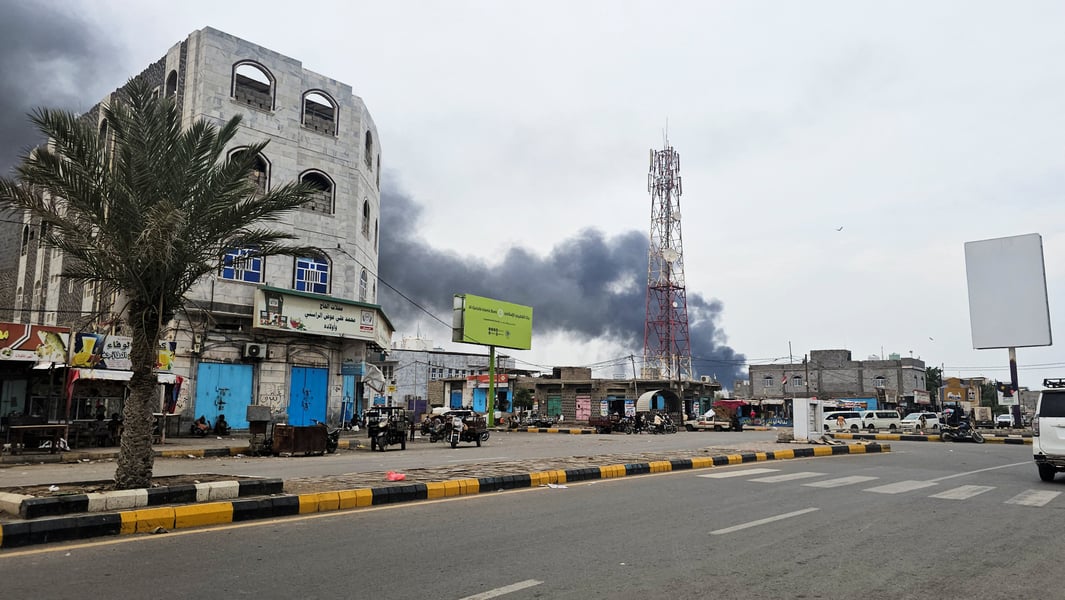
Taizz province, identified as the missile’s launch point, has been contested territory throughout Yemen’s decade-long conflict. The province sits southeast of the port of Mocha, which the Houthis struck with drones and missiles last Sunday, killing seven people and damaging facilities. That attack demonstrated the group’s ability to strike civilian infrastructure on land and sea simultaneously.
The same Tuesday, Yemeni government forces carried out a drone strike on Houthi positions in the eastern part of Al-Jawf province, Al Hadath reported. Earlier in the day, a Yemeni military source told RIA Novosti that the Houthis had struck government military facilities in the northeastern city of Marib, which controls access to Yemen’s oil fields and has changed hands repeatedly in the past four years.
Bab el-Mandeb, roughly 30 kilometers wide at its narrowest between Yemen and Djibouti, handles approximately ten percent of global seaborne trade. It is the southern exit from the Red Sea to the Gulf of Aden and the Indian Ocean. The Houthis have consistently framed attacks on shipping as legitimate military operations tied to their support for Palestinian forces in Gaza, a framing no major maritime insurer or government has accepted as valid under international law.
In the weeks before Tuesday’s attack, Houthi officials and Iranian IRGC advisers had been designing a fee-based transit system for the strait, according to Reuters, modeled on Iran’s own effort to charge vessels in the Strait of Hormuz. Neither the fee system nor any enforcement mechanism has been publicly announced. Saudi Arabia’s announcement of a 14-nation maritime coalition to protect Red Sea shipping arrived in late July but had not produced a coordinated response to any specific attack at the time of Tuesday’s incident.
The Houthi movement’s official name, Ansar Allah, belies the scale of what it has become: a force controlling northwestern Yemen’s population centers, the port of Hodeidah, and much of the Red Sea coastline. Its ballistic missile arsenal, supplied and upgraded through Iranian channels, has demonstrated the ability to strike targets at considerable range from inland launch sites in provinces like Taizz.
Pakistan, which lost two citizens in Tuesday’s attack, occupies a complicated position in the regional maritime conflict. Islamabad has tried to balance its alliance with Saudi Arabia against longstanding ties to Iran and has sent diplomatic envoys to both capitals in recent months. The government’s response to the deaths of its nationals was not immediately available.
The single Indonesian victim adds a third nationality to Houthi maritime casualties that have, over the past eighteen months, included crew members from the Philippines, India, Vietnam, and several Asian countries whose governments supply the majority of the world’s commercial shipping workforce. Labor organizations representing seafarers have called on major powers to do more to protect crews, with limited results.
The Houthis had not claimed Tuesday’s attack by the time initial reports were published, which was unusual given that the group typically publicizes its strikes against shipping within hours. That silence, combined with the missing vessel name, left open questions about the incident’s exact nature that maritime security analysts and shipping firms were expected to scrutinize closely before adjusting route recommendations.
No comment from the United Nations, US Central Command, or the European Union’s Operation Aspides maritime mission was available at publication time.