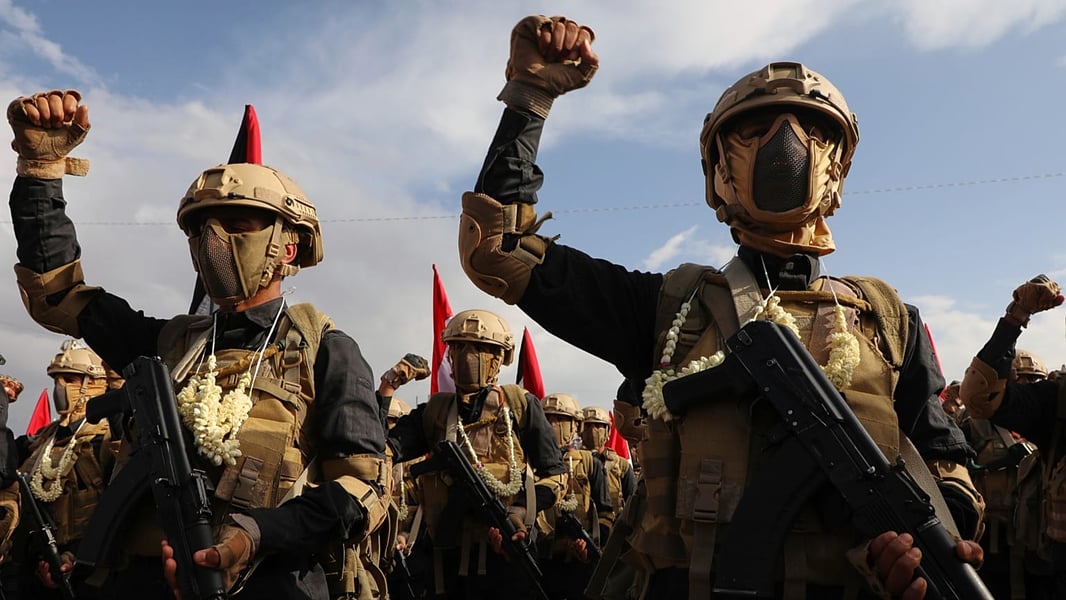

DOHA – Yemen’s Houthi armed group is working with Iran’s Revolutionary Guards to design a toll system for vessels transiting the Bab el-Mandeb strait in the Red Sea, copying a strategy Iran deployed at the Strait of Hormuz and threatening to turn one of the world’s most critical maritime chokepoints into a permanent source of militia revenue, according to Yemen’s Information Minister Moammar al-Eryani.
The intelligence, Eryani said, confirmed that Islamic Revolutionary Guard Corps advisers were “directly involved in designing the technical and administrative framework of the project,” including plans to establish a dedicated entity responsible for collecting payments from shipping companies and commercial vessels. The IRGC’s involvement signals that Tehran views Bab el-Mandeb not merely as a Houthi front but as an extension of its own Strait of Hormuz pressure campaign, a second chokepoint it can leverage without exposing Iranian territory to additional US strikes.
Bab el-Mandeb, whose name translates to “Gate of Tears” in Arabic, connects the Red Sea to the Gulf of Aden and the Indian Ocean. Before the current conflict, roughly a fifth of the world’s crude oil and liquefied natural gas passed through Hormuz. Bab el-Mandeb became the primary alternative route for Gulf energy exports after Tehran’s attacks and blockade threats effectively closed Hormuz to routine unescorted commercial traffic earlier this year.
The Houthis hold territory along Yemen’s western coast within 100 kilometers of the strait’s chokepoint. That proximity gives the group both the operational position and the political incentive to exploit the same vulnerabilities that Iran has weaponized further north. For the Houthis, a toll system would generate income at a moment when their war with Saudi Arabia has again turned violent. For Tehran, a second controlled chokepoint multiplies the economic pressure it can bring to bear on the United States and Gulf states without further escalating direct military exchanges.
Eryani described the move as “a dangerous escalation aimed at transforming one of the world’s most strategic maritime corridors into a permanent source of funding for the militia’s military and terrorist activities.” Yemen’s government-in-exile, backed by Saudi Arabia, has watched the conflict shift against it since the Houthis declared a naval blockade of Saudi Arabia on July 20 and began striking Saudi Aramco facilities on the Red Sea coast.

The timing amplifies the economic threat. Energy analytics firm Kpler noted that Bab el-Mandeb transits fell 22 percent in the week after the blockade declaration, as shipping companies diverted vessels to the longer Cape of Good Hope route or held them in holding patterns pending security clarity. Saudi Arabia is now actively seeking to build an international coalition to protect Red Sea shipping, a process that has not yet produced commitments from major Western powers reluctant to expand their visible military footprint in the conflict.
If both Hormuz and Bab el-Mandeb were simultaneously under tolling regimes enforced by Iranian-backed actors, the combined impact on global energy markets would be difficult to overstate. Prior to the Iran war, roughly 40 percent of globally traded oil and LNG passed through one or the other. The scenario, once a theoretical extreme, is now a policy reality requiring active navigation by energy companies and their insurers.
Iran’s original Hormuz toll claim triggered a confrontation with Washington and a US military buildup in the Gulf. But it has not been fully enforced; US naval presence has deterred the most aggressive forms of interdiction. The IRGC’s willingness to now replicate the playbook in a different theater, through a proxy rather than directly, suggests Tehran believes the approach carries acceptable risk.
The IRGC advisers in Sanaa are reportedly working alongside Houthi naval planners on the technical infrastructure for collection, including identifying a legal entity, likely a shell company or nominally Houthi government body, that could issue invoices and demand payment from ship operators. That administrative framework matters because it determines whether shipping companies can be pressured through insurance, flag-state regulation, or simply the threat of physical interdiction at the strait.
Yemen’s government has urged Gulf Cooperation Council members and international partners to treat the planned toll system as an act of piracy and mount a coordinated legal and military response before it becomes operational. Eryani said the Houthis were still in an early planning phase but could move toward implementation “within weeks” if the international response remained limited to statements.
According to Euronews, the toll plan represents a structural shift in how Iran’s Axis of Resistance intends to use geography as a financial weapon, not just a military one. The question facing maritime insurers, energy traders, and governments that depend on Red Sea access is whether the shift from military disruption to financial extraction makes the threat easier or harder to counter.
What no one can yet say is whether the IRGC’s involvement in the toll design is primarily a revenue project, a leverage tool for future negotiations, or a long-term bid to normalize the idea that the world’s busiest energy corridors carry an Iranian-aligned tax. The answer may not become clear until the first invoice arrives.