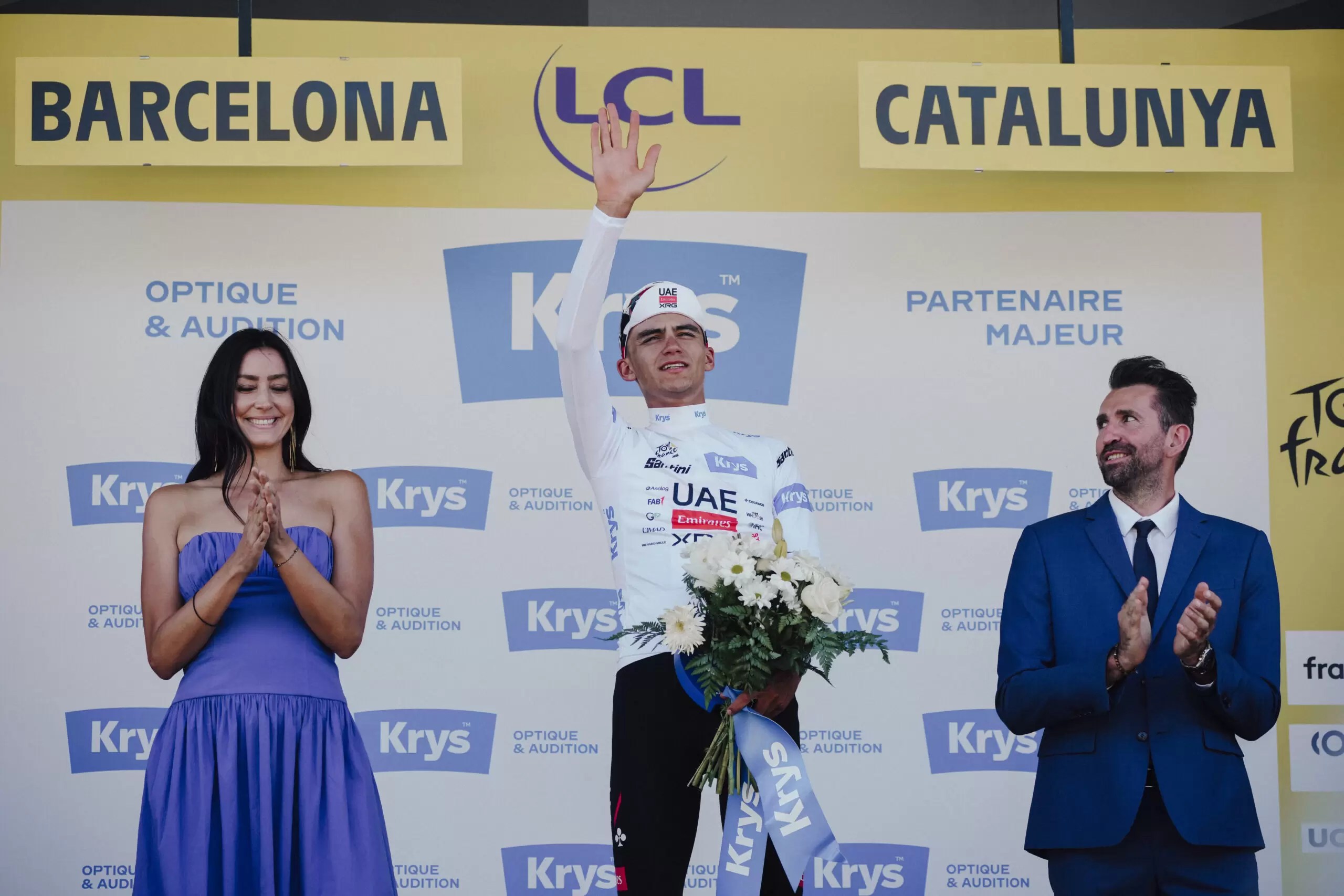

BARCELONA — Tadej Pogacar had the numbers. With 500 metres left on the final ascent of Montjuïc, he was positioned exactly where a three-time Tour de France champion positions himself when he intends to win: second wheel, rivals covered, the stage finish narrowing ahead. Then Isaac del Toro kicked. Pogacar watched. And Mexico had its first Tour de France stage winner in 36 years.
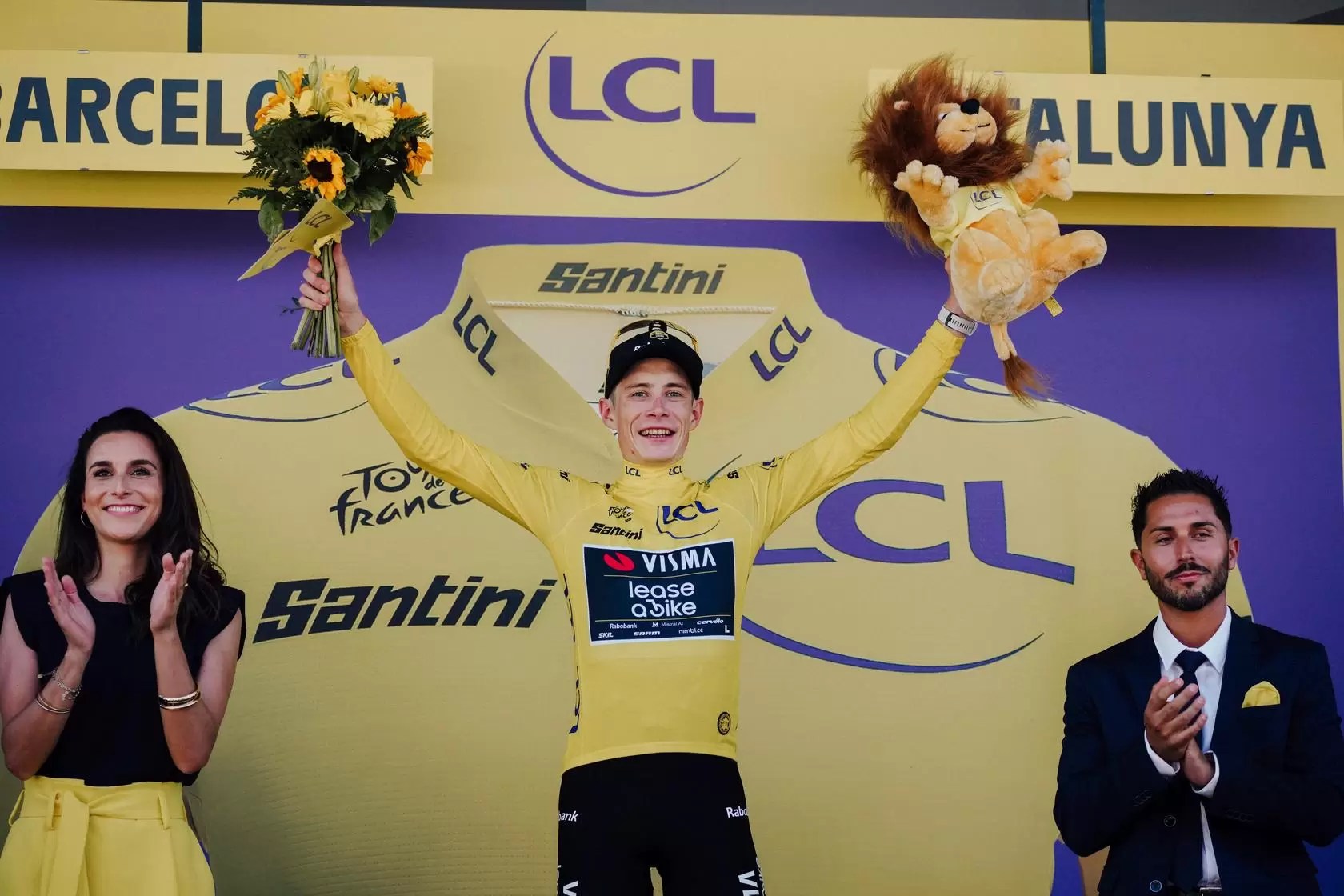
Del Toro’s win on Sunday gave UAE Team Emirates-XRG the first one-two finish in their history at this race. It cut Jonas Vingegaard’s general classification lead over Pogacar from 12 seconds to six. The yellow jersey picked up no bonus time finishing fourth while Pogacar’s runner-up finish banked six of the twelve seconds Visma-Lease a Bike had won in Saturday’s team time trial. Two stages in, and the margins are compressing.
The morning had not gone smoothly for UAE’s 22-year-old Mexican climber. Around 60 kilometres from the line, del Toro’s bike failed him. What followed was a solo chase through the team convoy, working past cars, closing a gap that had opened at exactly the wrong point of the race. He rejoined the bunch well before the first Montjuïc circuit. His legs provided the commentary later.
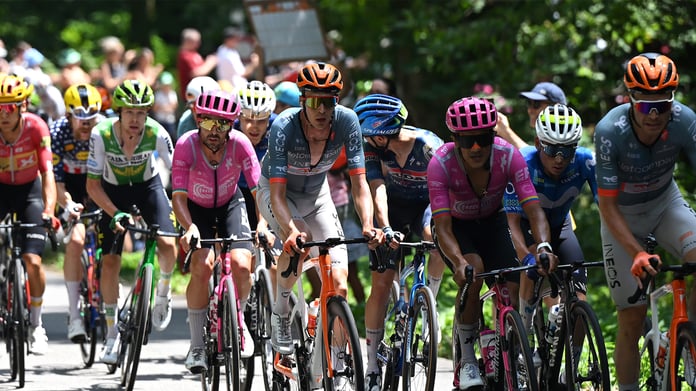
The finishing circuit reduced Sunday’s 168-kilometre stage from Tarragona to a repeated question: who had the punch for a steep, short climb at the end of four hours of racing? Brandon McNulty drove the lead-out. Adam Yates controlled positioning through the laps. UAE turned the Montjuïc finishing circuits into a collective exercise in both protecting del Toro and leaving him free to win when the moment arrived.
Mattias Skjelmose of Lidl-Trek came closest to disrupting the plan. The Danish climber launched inside the final two kilometres, accelerating through the descent before the last ascent. Del Toro came through him on the final ramp with an acceleration that removed any doubt about the result. Pogacar stayed on del Toro’s wheel throughout. At the line, he crossed second.
Whether that was a deliberate gift or del Toro simply running harder than anyone else on the hill is the kind of question with more than one correct answer. Pogacar spoke to Dutch broadcaster NOS outside the team bus, and the composure he had shown on the hill was already gone: “This guy is a machine!” Del Toro, at the finish line, settled on fewer words: “I cannot believe I just did it.” He had recovered from a mechanical crisis, chased alone through a convoy, rejoined the race, and then outsprinted the entire Tour de France field over Montjuïc. The disbelief seems proportionate.
For Vingegaard, Sunday was controlled enough to allow an honest assessment. He crossed the line the same time as del Toro and Pogacar. The yellow jersey, which he took in Saturday’s time trial, remained on his shoulders. Vingegaard arrived in Barcelona having already won the Giro d’Italia in May, and if he holds the lead through July he would become only the ninth rider in history to complete the Giro-Tour double in the same season. Sunday did not change the architecture of that attempt. “I am very satisfied, to be honest,” he said at the finish. “This kind of circuit is not my favourite terrain. I think I can be happy I am staying in the Yellow Jersey.”
The satisfaction is accurate and leaves room for something else. Vingegaard has the jersey. Pogacar has six fewer seconds to recover over the remaining 19 stages. What Sunday demonstrated is that UAE will not simply wait for the mountains. They can race every finishing circuit, using their numerical strength to control a day and then release their designated winner in the final kilometre. Whether del Toro was always meant to take the win, or whether Pogacar chose generosity over bonus time on a day when the arithmetic was manageable, is a question neither man has had to answer directly yet.
Del Toro is the second Mexican rider to win a Tour de France stage, behind Raúl Alcalá, who took two in 1989 and 1990, as Cyclingnews reported from the Barcelona finish. He is 22 years old, on his Tour debut, having recovered from a mechanical failure to post the biggest result of his career. He mentioned the 2026 football World Cup, with Mexico co-hosting alongside the United States and Canada. “We have these 11 guys ripping it in the football,” he said, “and to be at the same level here in France at the hardest race is like a dream.”
Six seconds separates Vingegaard and Pogacar. The race has not been to the mountains yet. What Stage 2 produced was a demonstration that the gap can move on any terrain, in any direction, and that UAE has a 22-year-old capable of winning when his team needs him to. Whether the need arises more often than anyone expected is the question the Pyrenees will eventually answer.
Related Posts