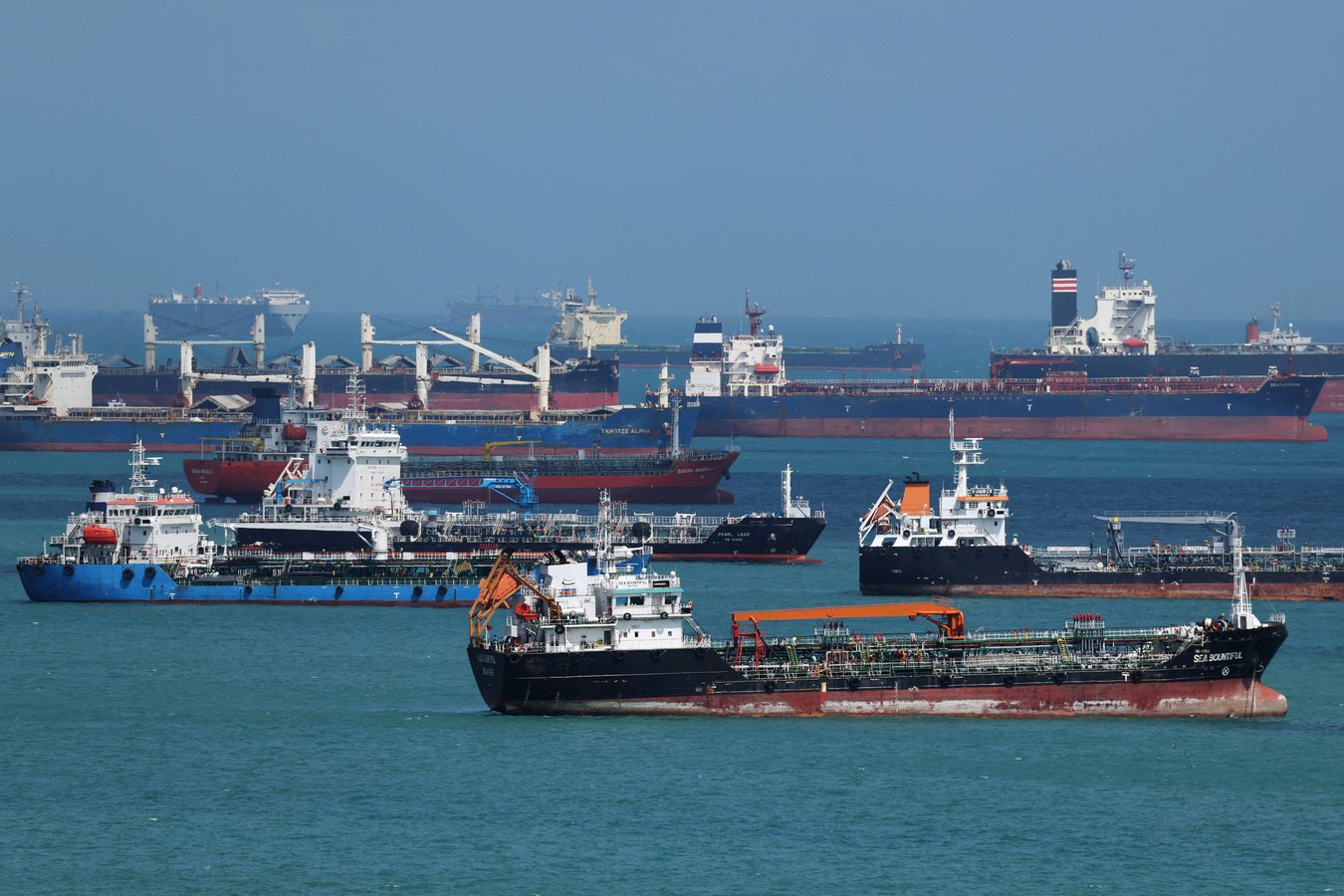

TEHRAN – Oil prices rose Friday morning as word spread that Iran’s Revolutionary Guards had struck two oil tankers attempting to transit the Strait of Hormuz under active United States air escort, the first such incident since Washington launched a convoy protection program for the waterway.
Iran’s Islamic Revolutionary Guard Corps stated that the “non-compliant oil tankers” had been “struck and brought to a halt,” while four additional vessels reversed course and withdrew from the Strait. The names of the struck vessels and any casualties were not immediately confirmed.
The incident challenged a program Washington has publicly championed as proof that US military presence can keep oil flowing through the contested waterway. President Trump, informed of the strikes while gathered with his cabinet, offered a response that stopped short of condemnation. “Most people would’ve given up by now,” Trump said of Iran, “so I credit them for being tough.”
Oil prices rose on news of the strikes, traders pricing in fresh uncertainty about Hormuz transit flows as Iran demonstrated it could reach vessels even under American air cover. The Strait remains the passage point for roughly 20 percent of the world’s traded oil, and each incident ripples through global energy markets.
Iran’s position has been consistent throughout the escalating conflict with Washington: vessels that do not comply with Iranian maritime protocols operate in the Strait at their own risk. The IRGC referred to the struck ships as “non-compliant,” framing the operation as an enforcement action under Iranian jurisdictional claims rather than an act of aggression under international law.
That framing stands in direct conflict with Washington’s insistence that the Strait of Hormuz is international waters subject to freedom of navigation. Trump revealed in June that he had secretly ordered the US military to escort more than 200 commercial vessels through the Strait, moving over 100 million barrels of oil in an operation his own administration had previously denied. That program, Friday’s strike suggests, has not produced the deterrence Washington expected.

The timing carries specific weight. Iran suspended its Hormuz shipping toll program for 60 days in early July; that window closes around August 16. The IRGC’s action Friday signals that even as that diplomatic mechanism remains in suspension, Iran’s enforcement presence in the Strait has not diminished. Two tankers were struck inside the suspension window, under US air cover, and halted.
US CENTCOM carried out a heavy wave of strikes on Iran as recently as Wednesday, targeting dozens of IRGC positions across six provinces. The escalation cycle has produced strikes, counter-strikes, and periodic pauses, including a temporary US halt in late July as weapon stockpiles ran low, but Friday’s tanker strike demonstrated that Iran’s operational reach inside the Strait survived the American aerial campaign.
For shipping operators, the message is direct. The US escort program provides air cover; it does not provide immunity. Two vessels carrying that cover were struck and halted Friday. Four others watched and reversed course. The math of those decisions will inform every future convoy negotiation between owners, insurers, and the Pentagon.
Iran’s strike also carries implications beyond Friday’s oil prices. Each successful action against US-escorted vessels is a demonstration, to a watching region and a watching market, that Iranian forces retain operational reach inside the Strait despite months of American bombardment. The Times of Israel reported that four additional vessels abandoned their Hormuz transit and withdrew after the strikes, a pattern that suggests the incident’s effect on corridor traffic may outlast Friday’s news cycle.
The broader maritime theater in which Friday’s strike occurred is one of multiplying pressure points. Saudi crude tankers reversed course in the Red Sea last month as Houthi forces enforced their own blockade of the Bab al-Mandeb strait. In the Hormuz, Iranian forces now demonstrate they can reach even US-escorted vessels. The twin pressures on both major energy corridors represent a structural challenge to the assumptions underlying the Trump escort program.
What the Friday strikes do not yet answer is what condition the halted tankers are in, what cargo they were carrying, and whether their crews are safe. Those questions remain open as markets closed at a new and uncertain level.