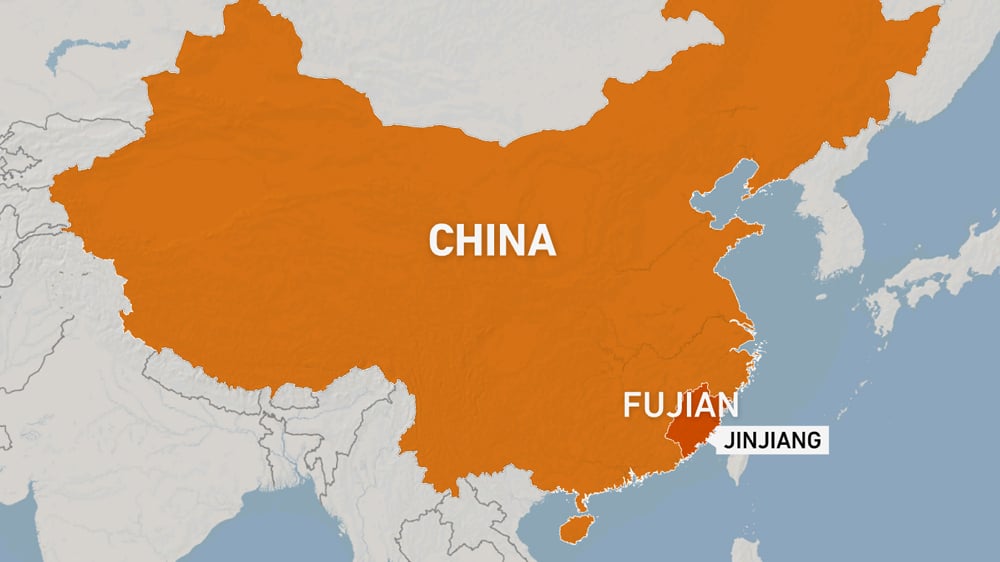

BEIJING – Twenty-eight people died Thursday when a fire swept through a shoe factory in Jinjiang, Fujian province, trapping workers on upper floors and sending rescue teams scrambling through thick black smoke as China confronted what has become the deadliest industrial fire in the country this year.
The fire broke out around noon at the Huiteng Shoes plant in Jiangtou village, a manufacturing district within Jinjiang that sits at the center of China’s footwear export industry. Images shared on Chinese social media showed workers clustered on the building’s roof, some appearing to signal for help while emergency personnel assembled below. Others, firefighters confirmed by evening, had lost communication and could not be located inside the structure.
President Xi Jinping issued a directive within hours of the blaze, warning of “significant casualties” and ordering officials to exhaust all available means to rescue survivors and treat the injured. He demanded that the Ministry of Emergency Management investigate the cause “as soon as possible” and pledged that those responsible would be “strictly held accountable,” Al Jazeera reported. More than 180 firefighters and 35 emergency vehicles were deployed. The main fire was brought under control by early evening, though rescue operations continued through the night in sections where individuals remained unaccounted for.
The Ministry of Emergency Management ordered an “all-out” effort. A preliminary assessment indicated the fire started on the ground floor. Shoe manufacturing facilities contain highly combustible materials: adhesives, synthetic foams, rubbers, and plastics that fire safety experts say can accelerate a blaze far beyond what structural firebreaks are designed to contain, particularly in multistory factories built during China’s rapid industrial expansion.
Jinjiang sits in Fujian province’s coastal industrial belt and produces more than 40 percent of China’s domestic athletic footwear output, along with a substantial share of supply for European and North American brands. The city is among the country’s most concentrated manufacturing zones, and Huiteng Shoes was one of its operating facilities at the time of the blaze. The company had not issued a public statement by Thursday evening.
Xi Jinping’s language on Thursday – demanding accountability, signaling personal oversight, promising punishment – is a formulation that appears with regularity after industrial disasters in China. The Xi administration has repeatedly framed accountability campaigns as evidence of serious governance rather than responses to systemic failure, a distinction that critics, labor groups, and families of accident victims frequently contest. China’s government statistics record dozens of serious factory fires, mine collapses, and chemical explosions annually, and enforcement of safety standards has historically lagged behind the pace of manufacturing growth.
Fujian province’s industrial belt grew rapidly during China’s reform era and hosts manufacturing across footwear, textiles, electronics, and petrochemicals. As Beijing has moved to centralize regulatory authority across multiple domains in recent years, the translation of those directives into factory floor inspections and building-code enforcement remains a function of local implementation, which has been uneven across provinces.
After the 2021 Zhengzhou flooding that killed more than 300 people, many in areas where risk had been previously documented, and after the Tianjin chemical warehouse explosion of 2015 that killed 173, senior officials issued similar directives. Prosecutions followed. The structural conditions that produced each disaster were documented. The pattern has not, in the aggregate, produced lasting reductions in industrial casualty numbers, a gap between stated commitment and measured outcome that safety advocates in China have raised without resolution.
A fire in a Hong Kong commercial building in November 2025 killed 168 people, underscoring how flammable inventories in multistory structures can produce catastrophic outcomes when exit routes are compromised or workers cannot safely descend from upper floors. Investigators in that case found unlicensed renovation work had compromised fire barriers. Whether comparable factors contributed to Thursday’s blaze at the Huiteng plant was not confirmed by officials by Thursday night.
What is known is the arithmetic of the disaster: at least 28 confirmed dead, an unspecified number still unaccounted for, and rescue teams working through the night. What remains unknown is the inspection history of the plant, whether prior safety orders had been issued and not complied with, and whether workers who lost communication with rescue teams survived. Xi Jinping’s directive is the frame through which the investigation will now proceed. Whether it produces prosecutions, binding enforcement mandates, or another cycle of temporary attention followed by structural continuity is a question that cannot be answered from the rubble of a shoe factory in Jinjiang – but one the families waiting for news cannot afford to defer.