
BEIJING – For years, multinational companies operating in China treated Beijing’s anti-sanctions laws as theoretical constructs, serious on paper, rarely enforced. That calculation shifted in May 2026, when Chinese authorities invoked the 2021 anti-foreign sanctions law for the first time, citing US sanctions on Chinese oil refineries, and gave foreign firms 30 days to comply with Beijing’s legal requirements or face consequences that included asset freezes, visa cancellations, and the termination of operating licenses.
The invocation was a warning. The decrees that followed were architecture.
Beijing issued State Council Decree No. 834 in March 2026 and Decree No. 835 in April, laying out enforcement procedures under the 2021 law that compliance attorneys say are explicit enough to be genuinely punitive. Then, in June, authorities announced a third draft law extending the toolkit further, to cover foreign judicial orders affecting Chinese interests, not just sanctions against named entities.
“Decree No. 835 is the most significant escalation we’ve seen,” James Hsiao, a partner at White & Case in Hong Kong, told Al Jazeera. “It’s no longer a vague threat. The enforcement path is clear, the penalties are severe, and the discretion to apply them sits entirely with the Chinese side.”
The mechanism functions as a legal vice. When the United States or the European Union imposes sanctions on a Chinese entity, a shipbuilder, an oil refinery, a technology manufacturer, foreign companies face pressure to sever ties under penalty of US or EU law. Under Beijing’s new framework, those same companies face equal and opposite pressure to maintain those ties, or confront fines scaled to the size of the sanctioned transaction, executive visa revocations, and orders to cease operations entirely.
One early test of the framework came in May 2026, when Beijing blocked the European Commission’s ongoing investigation into Nuctech, the state-backed Chinese security scanning company under scrutiny for alleged market practices. Chinese officials told European investigators that proceeding with the probe would violate Decree No. 834 and could expose Brussels and its China-based partners to countermeasures. The investigation has not formally advanced.
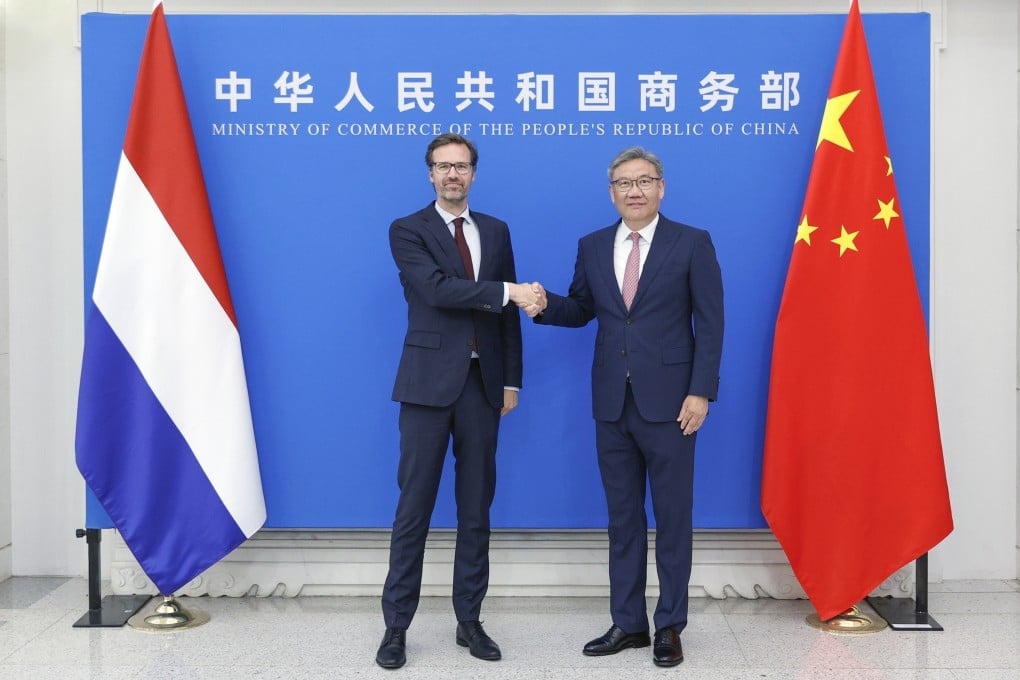
“This is deliberately structured to create paralysis,” Even Pay, a director at Trivium China who tracks regulatory risk for foreign investors, told Al Jazeera. “China is shifting from a reactive to a proactive stance. The law doesn’t wait for foreign sanctions to bite. It positions Beijing to strike first.”
For foreign executives still operating on Chinese soil, the practical consequences are immediate. A European financial services firm must advise its Chinese banking partners to maintain accounts that a US Treasury designation might require it to close. A German component supplier with Chinese joint venture partners must weigh whether the risk of a US fine outweighs a revoked business license in Shanghai. A legal team advising compliance with Western sanctions faces possible visa cancellations for its own senior partners.
The escalation follows a pattern. In the past 18 months, Beijing has used export restrictions on gallium, germanium, and rare earth processing chemicals to apply pressure during semiconductor tariff negotiations, demonstrating that China is willing to use economic interdependence as leverage rather than simply absorb it. The anti-sanctions toolkit extends that logic from trade controls to legal compliance obligations for companies operating within China’s borders.
Hanscom Smith, a senior fellow at Yale Law School who specialises in international sanctions regimes, framed the escalation as calculated. “It’s a warning shot,” he said. “Beijing wants to establish the precedent that its legal authority is co-equal with US and EU sanctions authority for companies operating on Chinese soil. The question is how aggressively it decides to enforce.”
The proposed third law, not yet formally adopted, would go further. Under its draft provisions, Chinese authorities could challenge foreign court orders, including US discovery orders or EU administrative decisions, that affect Chinese entities, and direct companies to resist compliance inside China. Legal analysts in Beijing say the draft is partly a response to the expanding use of US extraterritorial jurisdiction, which has increasingly reached foreign subsidiaries of sanctioned entities.
Eastern Herald has reported how China’s Foreign Ministry pushed back on Washington’s Pentagon military designations, warning of “necessary measures” after Alibaba, BYD, and Tencent were added to the 1260H list. The new legal architecture moves beyond diplomatic protest, embedding that pushback in domestic statutes enforceable against any company operating in China regardless of its nationality.
The wider contest over technological sovereignty and US export controls has already forced governments from Ottawa to Riyadh to reassess their exposure to American jurisdictional reach. Beijing’s anti-sanctions framework poses the mirror-image question: how much of their exposure to Chinese legal authority have those same governments accounted for?
How multinationals respond is still forming. Many have already spent years reducing exposure to China-specific risk, diversifying supply chains, and slowing new capital commitment. Others remain deeply embedded in Chinese manufacturing and distribution, embedded enough that the cost of exit dwarfs any immediate fine risk from Washington or Brussels.
Brussels has not formally responded to the Nuctech probe interference. Washington has issued no specific guidance on how companies should advise their China-based partners navigating the new compliance framework. Beijing issued Decree No. 835 without a press conference. It did not need one.