

WOLFSBURG – Volkswagen’s supervisory board convened on Thursday to vote on a restructuring plan that would eliminate 100,000 jobs, approximately 16 percent of the company’s global workforce of 630,000, and shutter four German manufacturing plants in what would mark the largest single industrial contraction in postwar German history.
The proposed closures target Volkswagen’s Hanover and Emden assembly plants, the Zwickau electric vehicle factory, and Audi’s facility in Neckarsulm. Together they employ tens of thousands of workers who spent years retooling for electric vehicle production lines now running well below capacity for markets that have, in significant measure, closed behind US tariff barriers.
Chief Executive Oliver Blume has framed the cuts as a survival calculation. US tariffs on European electric vehicles cost Volkswagen an estimated five billion euros annually, a figure that compounds against a net profit that dropped 41 percent in the company’s last full fiscal year. The resulting losses have made the case, at least in Blume’s framing, that the cost structures built for a market that no longer exists cannot be sustained.
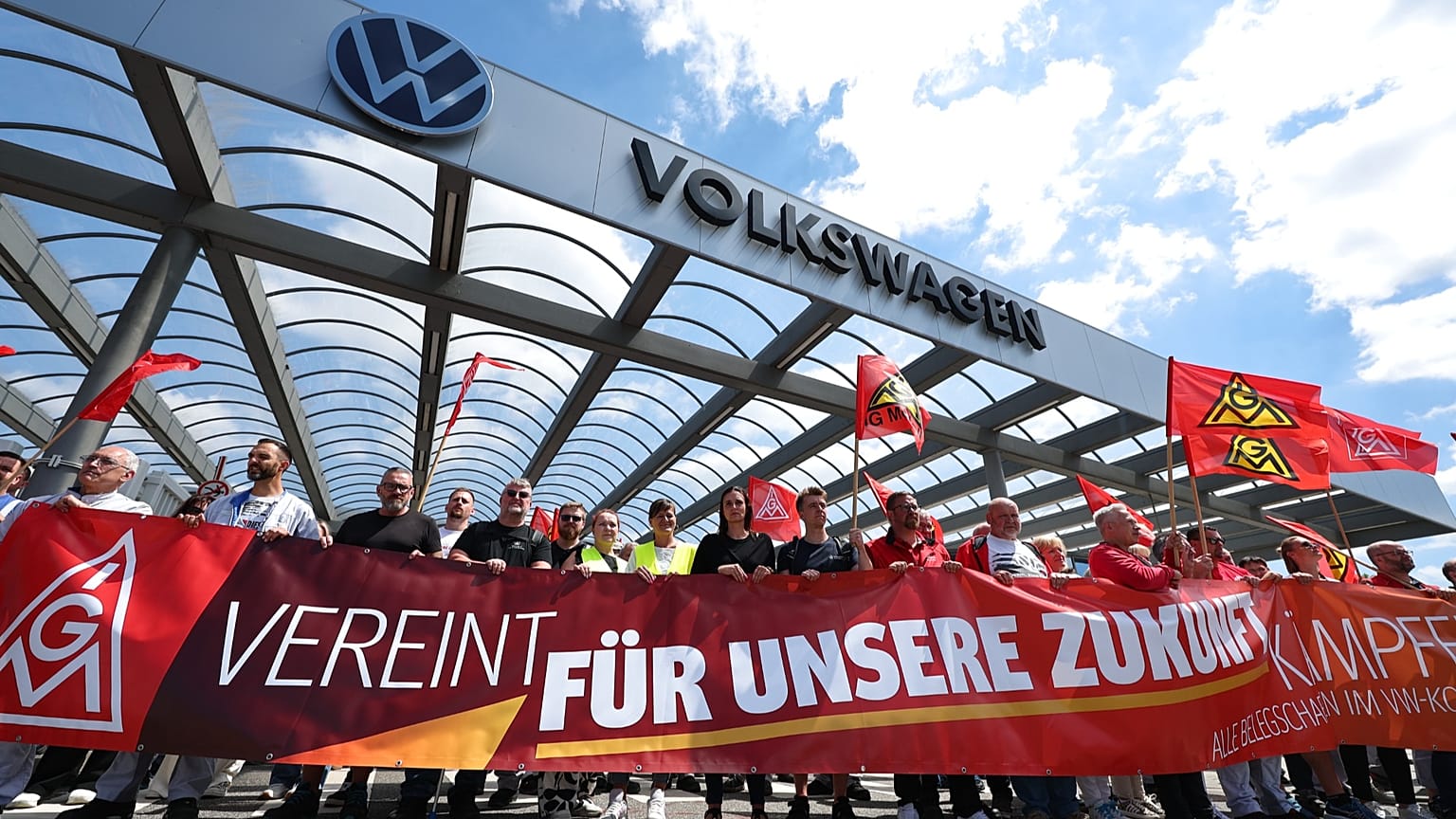
The announcement drew a unified response from Germany’s largest industrial union and Volkswagen’s own workforce council. Christiane Benner, chair of IG Metall, appeared Thursday alongside Volkswagen works council chair Daniela Cavallo to issue a joint statement calling the plan an “attack on the social peace of German manufacturing.” The phrase is not casual language in German industrial relations: it invokes a postwar settlement between capital and labour that has made German factories among the most productive and most expensive in the world.
What makes the vote politically complicated is Volkswagen’s board structure. Under German codetermination law, workers hold half the seats on the supervisory board. The state of Lower Saxony, which owns a 20 percent stake in the company, holds a blocking vote, and Lower Saxony’s minister-president has previously indicated he does not intend to watch German jobs disappear without using it.
Workers at the threatened plants have been told to expect a formal communication in the coming days. IG Metall has called on its members to attend protests across Germany’s industrial districts. The works council has invoked codetermination law to demand a 30-day consultation period before any vote binding on plant closures can take effect, a procedural mechanism that may delay formal implementation even if the board approves the restructuring plan in principle.
The scale of the proposed cuts has invited comparisons to General Motors’ 2009 bankruptcy reorganisation, which shed roughly 21,000 US jobs and closed four plants before GM emerged from Chapter 11. The analogy is imperfect since Volkswagen is not seeking protection from creditors, but the scope of the social dislocation it proposes is of comparable magnitude for German manufacturing, which employs far more workers per capita in the auto sector than the United States did before the GM crisis.
The four plants under threat carry distinct vulnerabilities. Emden was converted at considerable expense to produce the electric Audi Q4 for export markets that US tariffs now make commercially precarious. Zwickau was Volkswagen’s first all-electric factory in Germany, celebrated in 2019 as evidence of the energy transition commitment, now running at reduced capacity. Hanover builds commercial vehicles for a logistics market that has slowed. Neckarsulm, the Audi facility, faces a model lineup that overlaps with other German facilities at a cost that can no longer be justified.
Volkswagen’s difficulties sit within a broader European automotive crisis. Stellantis, Renault, and BMW have each announced separate restructuring rounds. Ford has cut European operations. Chinese electric vehicle brands continue gaining market share in segments once dominated by German manufacturers. The European Commission has imposed tariffs on Chinese electric vehicles of up to 45 percent, but those duties have done more to irritate Beijing than to restore European market share for legacy automakers still carrying overhead designed for a volume model that no longer exists.
For Volkswagen specifically, the timing is adverse. The company invested heavily in its electric MEB platform, designed for volume production at competitive pricing, in markets that have since shifted. US tariffs have effectively closed the American market to German-made electric vehicles at the price points VW requires to be profitable. Chinese growth, which Volkswagen once counted on to offset European weakness, has turned competitive: domestic Chinese brands now outsell Volkswagen in key segments for the first time in decades.
Eastern Herald has previously reported on the pressure that debt markets and inflation have placed on European economies as energy costs and borrowing costs rise in parallel. Volkswagen’s restructuring vote, if approved, will add mass unemployment to those pressures in a country that has not experienced an industrial contraction of comparable scale in the postwar period. As reported in July, Volkswagen’s plan to cut 100,000 jobs was already transforming the EU’s trade deficit with China from a trade statistic into an industrial emergency.
Germany’s federal government has remained notably quiet. The coalition is managing its own political pressures and has shown little appetite to intervene in private-sector restructuring decisions, even at this scale.
What the board will actually approve remains open. Full endorsement of the 100,000-figure; a scaled-back plan preserving some plants; a delay pending union negotiations; or a Lower Saxony veto forcing the company back to restructuring talks it may not be positioned to sustain indefinitely. Several scenarios remain live.
Euronews reported the board meeting had not resolved quickly by Thursday evening. Volkswagen’s earnings are deteriorating faster than the restructuring process is moving. That asymmetry is the board’s real problem, and whatever the Wolfsburg meeting produces will not be the last word on it.
Related Posts