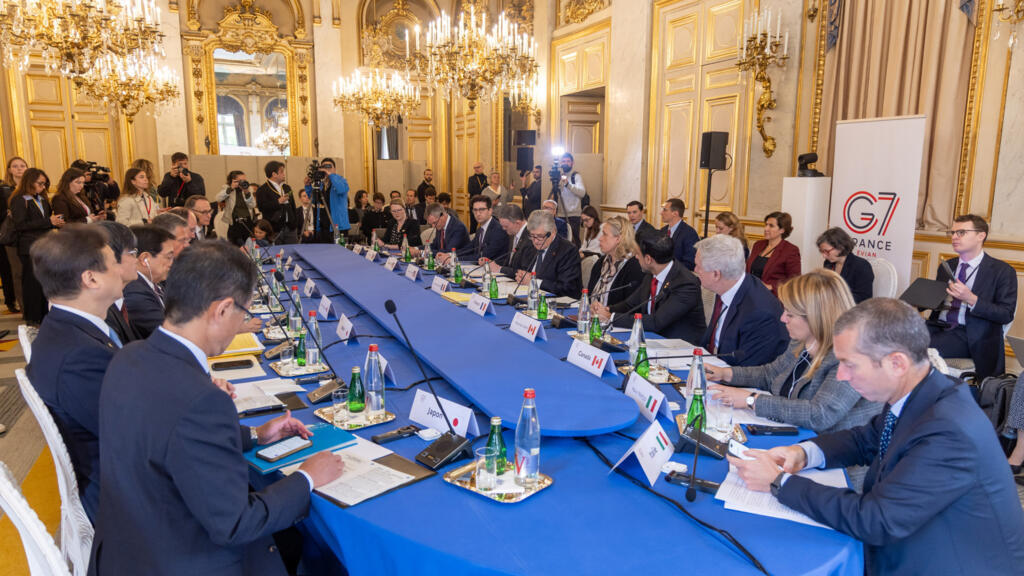

Finance ministers and central bank governors from the Group of Seven nations gathered in Paris this week under mounting pressure to confront a growing global economic crisis triggered by the war surrounding Iran, soaring energy prices, and rapidly deteriorating bond markets.
The emergency discussions come as Western economies face rising inflation, slowing growth, and fears of a new era of stagflation that many analysts compare to the oil shocks of the 1970s. finance ministers warned that the conflict’s economic consequences are now spreading far beyond the Middle East.
The meeting exposed deep anxieties among the world’s wealthiest economies over the widening consequences of the conflict in the Middle East, particularly the instability surrounding the Strait of Hormuz, one of the world’s most critical energy shipping routes.
Officials fear prolonged disruption in the region could intensify inflationary pressures already hitting consumers across Europe, North America, and parts of Asia. The concerns come as inflationary pressures continue destabilizing global economic planning.
French Finance Minister Roland Lescure urged international institutions, including the IMF and the World Bank, to take stronger action as governments struggle to manage the combined pressure of war-driven energy costs, rising borrowing expenses, and slowing economic activity.
The G7 discussions focused heavily on preventing further damage to global supply chains while also stabilizing bond markets that have experienced sharp selloffs in recent weeks.
Global bond yields have surged as investors increasingly fear that central banks may be unable to control inflation without pushing economies into recession.
Government debt burdens in the US, UK, Japan, France, and Italy have become a central concern inside the G7 meetings, particularly as military expenditures and energy subsidies continue to climb.
The Iran conflict has intensified these fears by pushing oil prices sharply higher. Crude prices have remained elevated amid uncertainty surrounding shipping routes through the Persian Gulf and the Strait of Hormuz.
Financial markets remain highly sensitive to any sign of escalation between Iran, Israel, and the US military presence in the region. Analysts warn that additional military escalation could send energy prices even higher.
The economic fallout is already spreading across industries worldwide. Airlines, manufacturing firms, shipping companies, and energy-intensive sectors are reporting mounting losses linked to fuel costs and disrupted trade routes.
A Reuters analysis estimated that global corporations have already absorbed at least $25 billion in direct and indirect costs connected to the conflict, with economists warning the final figure could rise substantially if tensions continue.
Several G7 officials privately acknowledged that inflation is no longer being driven solely by domestic monetary conditions. Instead, geopolitical shocks, supply chain fragmentation, and energy insecurity are increasingly shaping the global economic landscape.
The renewed instability has complicated efforts by central banks to reduce interest rates and stimulate growth. The growing global economic imbalances are now threatening financial stability across multiple regions.
Concerns surrounding China also emerged prominently during the Paris meetings. US Treasury Secretary Scott Bessent pushed G7 partners to confront what Washington described as “global economic imbalances” tied to Chinese industrial exports and strategic control over rare earth minerals and critical supply chains.
The G7 is now exploring joint measures to reduce dependence on China for critical minerals needed in defense systems, electric vehicles, semiconductors, and renewable energy infrastructure.
Officials discussed creating strategic reserves, coordinating procurement systems, and establishing new market protections designed to shield Western economies from supply disruptions.
At the same time, divisions inside the alliance remain visible. European governments are increasingly worried that aggressive sanctions policies and military escalation could deepen economic instability throughout the continent.
Several European economies are already facing weak growth, rising unemployment, and declining consumer confidence as energy prices remain elevated.
The UK economy has shown some of the clearest signs of stress. New economic data released during the G7 talks showed rising unemployment and slowing wage growth as businesses respond to inflation pressures linked to the Iran conflict and global energy uncertainty.
Analysts warned that British households could face another prolonged period of declining real incomes if fuel and food prices continue climbing.
Financial strategists are also increasingly worried about the long-term stability of sovereign debt markets. Many G7 countries accumulated massive debt during the COVID-19 pandemic and subsequent economic slowdowns.
Now, higher interest rates are making debt servicing significantly more expensive just as governments are increasing military and industrial spending. Concerns over a possible debt spiral are growing inside European financial institutions.
Some officials fear a dangerous cycle may be emerging in which inflation drives higher bond yields, forcing governments into larger borrowing costs, which then weakens investor confidence further.
This dynamic has already triggered sharp volatility in global markets over recent weeks.
The strategic importance of the Strait of Hormuz dominated many closed-door discussions. Roughly one-fifth of global oil trade moves through the narrow waterway, making any disruption a major threat to the global economy.
Energy analysts warn that even partial disruptions in Gulf exports could trigger another inflation surge across Europe and Asia. Fertilizer prices, shipping insurance, aviation fuel, and food supply chains have already experienced significant strain due to regional instability.
The widening oil shock has intensified fears that another energy-driven recession could emerge later this year.
The Paris gathering also revealed growing frustration within parts of Europe over Washington’s foreign policy strategy in the region. While the US continues pushing allies to tighten sanctions on Iran and increase pressure on Tehran’s financial networks, several countries are increasingly concerned that escalation risks outweigh potential strategic gains.
Despite the tensions, G7 ministers attempted to project unity by emphasizing coordination on energy markets, financial stability, and supply chain resilience.
However, analysts noted that the meeting produced few concrete policy solutions capable of immediately reversing the growing economic turmoil.
Markets are now watching closely for signs of either diplomatic de-escalation or further military escalation in the Middle East. Investors remain highly sensitive to developments involving Iran, oil exports, and global shipping lanes, with fears growing that another major energy shock could push several advanced economies toward recession.
Analysts have also linked rising UK borrowing costs to broader concerns surrounding war-driven inflation and sovereign debt instability.
The broader fear haunting the G7 is that the world economy may be entering a prolonged period of geopolitical fragmentation, high inflation, weak growth, and recurring supply disruptions.
For many policymakers gathered in Paris, the crisis surrounding Iran is no longer viewed as a regional conflict alone, but as a catalyst accelerating deeper structural weaknesses already threatening the global financial system.