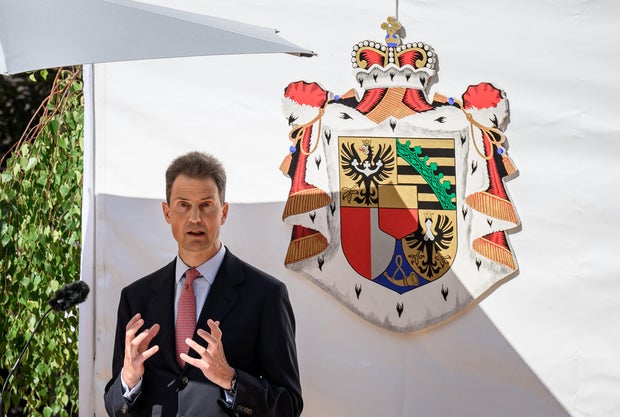

VADUZ — The man who controls one of the last genuinely powerful monarchies in Europe stepped before his nation’s celebration on Friday and announced he would, in time, give up the principle that has governed royal inheritance in Liechtenstein for centuries.
Hereditary Prince Alois, who runs the 40,000-person principality on the Rhine while his father, 80-year-old Hans-Adam II, retains the throne in name, revealed that the ruling family had voted two days earlier to end male primogeniture. The first-born child of the succession line, regardless of sex, will now become the heir. “The line of succession will be adjusted from male primogeniture to absolute primogeniture,” Alois said during a national day speech, “so that the first-born child will, regardless of sex, become the heir to the throne,” CBS News reported.
The timing carried its own weight. Liechtenstein was the last country in Europe to grant women the right to vote in national elections, doing so only in 1984, just 42 years ago, and only by the narrowest of margins in a referendum in which women themselves could not yet participate. That paradox was not lost on the women of Liechtenstein at the time, nor on observers across Europe. A principality that spent four decades as Western Europe’s most prominent holdout on female suffrage has now concluded, without equivalent irony, that a woman can one day rule it.
What makes the change more consequential than a symbolic gesture is the kind of monarchy Liechtenstein actually is. This is not a ceremonial crown. The Prince of Liechtenstein retains the power to veto the results of a public referendum, to appoint and dismiss judges, and to dissolve the national parliament at will, without consulting it first. When a 2012 national referendum proposed curbing those powers, Hans-Adam II threatened to abdicate rather than accept the restrictions. The threat worked. The referendum failed. The powers remain intact.
A continent where most monarchies function as constitutional ornaments, with no meaningful authority over legislation or appointments, has one exception on its eastern edge. Its holder is not merely a symbol. The first female prince, whenever she arrives, will govern.
The family vote on Wednesday was not unanimous. A two-thirds majority backed the change, which means that roughly one member in three of the House of Liechtenstein either voted against the proposal or declined to support it. Who those members are, and what specific objections they raised, has not been made public. The principality disclosed only the result, not the deliberations.

For now, the immediate succession is unaffected in practice. Prince Joseph Wenzel, 31, remains first in line as the eldest son of Alois. The change matters for the dynasty’s next generation: if Joseph Wenzel has daughters before a son, they would, under the new rules, stand ahead of any younger brother in the line of succession. The announcement said nothing about whether such a scenario is anywhere near the immediate horizon.
Liechtenstein’s decision arrives 46 years after Sweden became the first European monarchy to adopt absolute primogeniture, in 1980. The Netherlands followed in 1983, Norway in 1990, Belgium in 1991, and Denmark in 2009. Spain did not adopt the change until 2015, in a reform that required a constitutional amendment and generated significant political friction. Britain adopted absolute primogeniture through the Succession to the Crown Act 2013, which required primary legislation at Westminster and the simultaneous agreement of fifteen Commonwealth realms that share the British crown. Liechtenstein’s ruling family accomplished the same structural change through a private vote among its members, reflecting how differently constitutional power is distributed in the principality compared with the parliamentary monarchies to its west.
The principality appointed its first female prime minister, Brigitte Haas, last year, a milestone that came decades after comparable positions were filled by women in Switzerland, Liechtenstein’s closest economic partner and customs union ally. The two countries share a customs union and a monetary arrangement that has long shaped Liechtenstein’s economic model. Their political trajectories on gender have moved in rough parallel in recent decades, though rarely at exactly the same pace.
Liechtenstein is small by any measure: 40,000 people, roughly 160 square kilometres, sandwiched between Switzerland and Austria, with an economy built substantially on financial services and precision manufacturing. The House of Liechtenstein is among Europe’s wealthiest dynasties, with a fortune built across centuries and largely preserved intact through the wars and upheavals that diminished or eliminated other European royal houses in the twentieth century. The principality’s governing model, a small, wealthy state with a constitutionally active monarchy, has no precise parallel elsewhere in Europe.
What remains unanswered is how the change will operate within the House in practice. The roughly one-third who did not support it have not spoken publicly. Whether the shift reflects genuine generational consensus or a functional majority with significant private dissent is something the principality has not chosen to disclose. The national day speech was brief on the internal deliberations that preceded it, and said nothing about whether the question had been settled quickly or required extended negotiation.
Whether a female heir enters the succession in the next generation, or the generation after that, is a matter of births not yet announced and lives not yet lived.