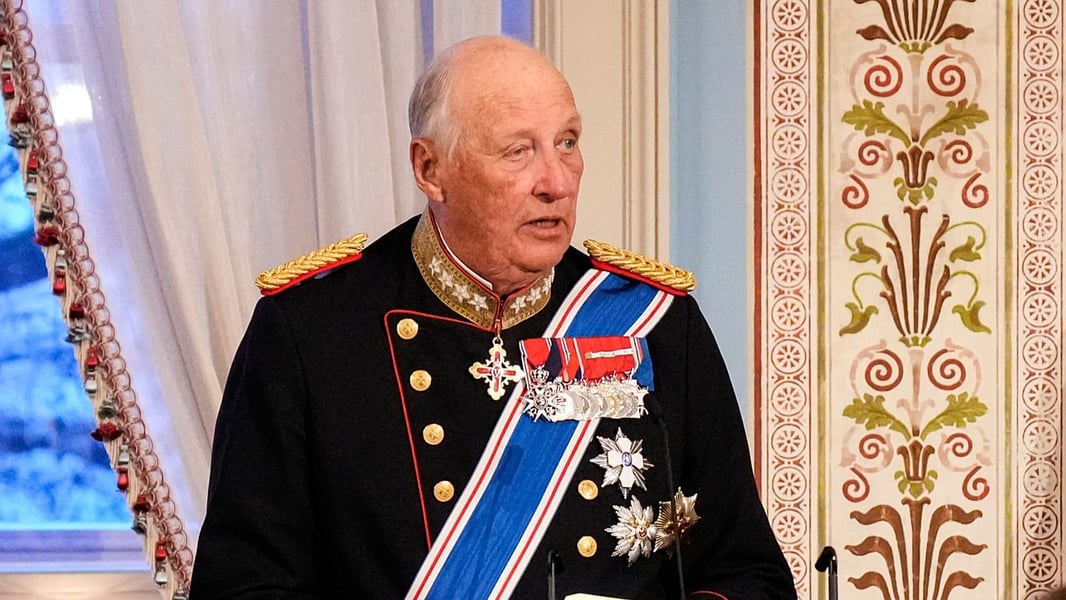

OSLO — He was three years old when Norway stopped being safe, and the family that got him out went in two directions. His father and grandfather made for London to run a government in exile. His mother took the children east into Sweden, and from there across to the United States, where they sat out the occupation. Harald came home in 1945 and, apart from the sailing, never really left again.
He died on Friday morning at Oslo University Hospital, at 89, after 35 years as king. The royal palace put the time at 6.35am and said he had died peacefully. “It is with deep sadness that we announce that His Majesty King Harald passed away today,” the statement read. He had been in hospital since August 17 with haemolytic anaemia, a condition in which the body destroys its own red blood cells faster than it can replace them, and had then developed a bacterial infection in the blood. By Thursday his condition was described as extremely serious and the family were called to his bedside.
The succession was instantaneous and required no ceremony. At the moment Harald died his son, until that second the crown prince, became King Haakon VIII. There is no interregnum in the Norwegian system and no coronation to wait for. Haakon will in time receive a blessing in Nidaros Cathedral in Trondheim, as his parents did in 1991, but the crown passed while the family was still in the room.
In Stockholm the reaction was personal rather than formal. King Carl XVI Gustaf, who is 80 and who has known the Norwegian royal family his entire life, said he had received the news with great sadness and called Harald “our dear friend.” Throughout the years, he said, Harald had been a good friend to him, to his family and to Sweden. He extended his condolences to Queen Sonja, Harald’s widow of 58 years, and then to the new king, who is his godson. He wished Haakon success and good fortune in the role ahead of him, in service, as he put it, to a brother nation and its people. The Swedish government ordered flags flown at half-mast on Friday.
That phrase, brother nation, carries more freight in Scandinavia than it does elsewhere. Norway and Sweden were in a union until 1905, and the two royal houses have spent the century since carefully being cousins instead of rulers. Carl XVI Gustaf is one of the very few people left who knew Harald before either of them had a throne to lose.
The marriage he mentioned took some getting. Harald fell for Sonja Haraldsen, the daughter of a clothing merchant, in the late 1950s, and then waited nine years for permission to marry a commoner, declining the European noblewomen who were suggested to him and telling his father he would not marry at all if he could not marry her. The threat was real enough to be constitutional: had he meant it, the line would have passed elsewhere. King Olav consulted the government and consented in 1968. Their story is now the ordinary origin story of the Norwegian monarchy, which tells you how completely the institution moved.
He was also, unusually for a head of state, a competitive athlete of genuine standing. Harald sailed for Norway at the Olympics and kept racing long after the crown made it inconvenient, winning world championship medals in his fifties and sixties. It was not a hobby maintained for the photographs. Norwegians who cared nothing for royalty knew his boat.
The reign itself was defined by restraint. He inherited in January 1991 a monarchy that had already given up most of what monarchies do, and he declined to reclaim any of it. He apologised to Norway’s Sami people. He told a garden party in 2016 that Norwegians are girls who love girls and boys who love boys, a sentence that travelled further than anything else he ever said. He kept the family motto his grandfather brought to the throne in 1905, Alt for Norge, all for Norway, and Ursula von der Leyen invoked it on Friday in calling him a true European who served with warmth, humility and an unwavering sense of duty.
What he did not do was modernise the succession himself, though it changed under him. Norway moved to absolute primogeniture in 1990, months before he acceded, which is why his eldest child Martha Louise is not the one who inherited on Friday. The reform was not retroactive. Europe’s smaller monarchies have been working through the same question ever since, most recently in Liechtenstein, which voted this month to open its throne to women after centuries of male-only rule.
The practical questions are still open. The palace has not announced a funeral date, nor said when Haakon VIII will go to Trondheim, nor what form the period of mourning in Norway will take beyond the flag that came down over the palace in Oslo on Friday morning. Crowds began arriving there with flowers before the announcement was an hour old.
Norway now has a 53-year-old king who has spent his entire adult life waiting, and a queen consort, Mette-Marit, whose accession was once thought impossible for reasons that stopped mattering some years ago. The country will find out shortly whether the reticence Harald practised was a personal temperament or a job description.
He was the last European monarch who could remember the war as something that happened to him rather than something he read about. That is the part of him no successor inherits.