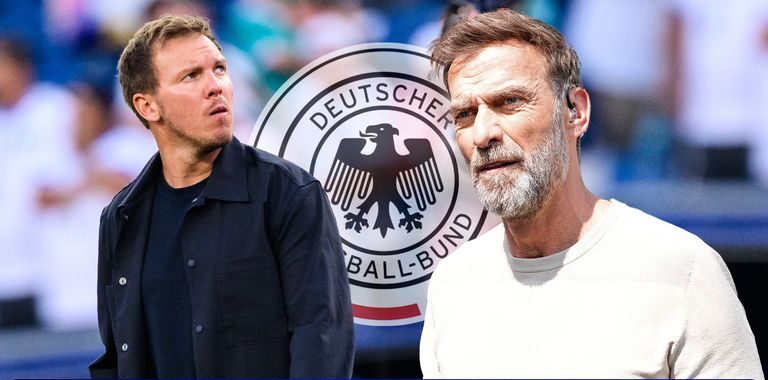

FRANKFURT – The phone call that Jürgen Klopp said he had been waiting for came in New York on Friday. By Saturday afternoon, the German Football Association planned to announce it publicly. Klopp has agreed in principle to become Germany’s national head coach, with a contract extending through the 2030 World Cup.
The agreement followed a breakthrough in negotiations that had been accelerating since Klopp’s Red Bull contract exit clause was identified as the mechanism by which he could leave his global executive role. That clause, built specifically for the Germany coaching position, appears to have been designed with this appointment in mind. Klopp’s departure from his position as head of global soccer at Red Bull will be finalized with CEO Oliver Mintzlaff early next week.
Klopp had said publicly on more than one occasion that the Germany national team job was one of two roles that could draw him back into football management after leaving Liverpool. The DFB heard the signal and recorded it. When Julian Nagelsmann resigned following Germany’s round-of-32 elimination at the 2026 World Cup, the search that followed was not, by any public reporting, a lengthy one.
Nagelsmann stepped down after Germany fell to Paraguay in a penalty shootout. The South American side, ranked 41st in the world before the tournament, outmaneuvered Germany across ninety goalless minutes in a round-of-32 match that carried its own historic weight. Germany had never before been eliminated at that stage of a World Cup. The DFB offered Nagelsmann a seven-million-euro severance package as it began the search for a replacement. He accepted it. The process moved quickly from that point.
Klopp, fifty-eight, has not managed a football team since leaving Liverpool in 2024, a departure that produced the kind of emotional rupture associated with a retiring player rather than a coach changing employers. His nine years at Anfield produced England’s first league title since 1990, a Champions League victory in Madrid, two domestic cup trophies, and a transformation of the club’s identity that made Liverpool one of the most recognizable sporting brands in the world. At Dortmund before Liverpool, he won two Bundesliga titles. The coaching architecture he built at both clubs, high-pressure systems designed to suppress opponents in their own half, made him arguably the most recognizable tactical mind in European football for a decade.
None of that translates automatically to international management. The club-to-national transition has produced far more failures than successes. Others who were celebrated at club level have struggled to adapt to the abbreviated preparation windows and the political texture of squad selection that international management introduces. Klopp will face those same constraints from his first match. What his appointment does not guarantee is the kind of consistent weekly contact with a squad that made his club systems functional. That contact is the variable nobody can give him back.

Germany co-hosts the 2030 World Cup alongside Spain and Portugal. The contract Klopp has signed is structured around that tournament as its defining target. He will inherit a squad that exited a home-continent tournament in the round of 32 and must rebuild it into one capable of competing at a co-hosted tournament in four years, in front of German crowds, with a national expectation that has not been satisfied at a major tournament since the 2016 European Championship final. What he does in the first qualifying window will define whether the rebuilding process is visible or invisible.
According to Sky Sports, the deal was reached after a negotiations breakthrough in New York, with only final details remaining. Klopp’s exit from Red Bull required resolution with CEO Oliver Mintzlaff before the appointment could be formalized, and that process was expected to proceed smoothly given the exit clause that made his departure from the organization legally straightforward. The DFB planned to announce the agreement on Saturday.
Nagelsmann, thirty-eight when he took the role in September 2023, had guided Germany to the Euro 2024 quarter-finals before they lost to eventual champions Spain. His tenure produced consistent results in qualifying but could not withstand the standard applied to a tournament host who exits without winning a knockout match. The gap between what Germany’s squad looked like and what it needed to be was not a gap Nagelsmann created. It was a gap that had been accumulating for a decade. Klopp inherits both the gap and the expectation of closing it.
The squad he takes over contains players who grew up watching Germany win in Brazil in 2014. They are now in their late twenties and early thirties, old enough to represent a transition cohort rather than a rebuilding project in the usual sense. Whether they are good enough for the 2030 ambition is not something Klopp’s appointment resolves. What his appointment resolves is the question of who would be asked to find out. The exit clause is executed. The New York meeting is concluded. What comes next happens on a training pitch.