
ANKARA — Turkish Foreign Minister Hakan Fidan spoke by telephone on Saturday with Egyptian Foreign Minister Badr Abdelatty and Jordanian Foreign Minister Ayman Safadi, pressing both governments to back renewed efforts to implement the US-Iran memorandum of understanding and prevent the region’s escalating tensions from turning into a broader confrontation.
The calls came one day after Cairo and Amman jointly condemned what both governments described as Iran’s “aggressive attacks” against Arab states – a harder posture from two of Turkey’s closest partners in the quadrilateral diplomatic mechanism, comprising Turkey, Egypt, Saudi Arabia, and Pakistan, that has sought to mediate the crisis since March.
In the Fidan-Abdelatty conversation, the two ministers praised what Xinhua reported as “rapid progress” in bilateral Turkey-Egypt relations and reviewed the work of the quadrilateral coordination framework. They underscored the need to de-escalate Middle East tensions and called for intensifying joint efforts to restore US-Iran negotiations, specifically framing their goal around implementing the existing US-Iran memorandum of understanding through dialogue rather than military escalation.
The quadrilateral format – which first convened in Islamabad in late March after US-Israeli military operations against Iran began – has functioned as Ankara’s principal vehicle for coordinating regional positions. Turkey has consistently sought to position itself as a diplomatic channel capable of engaging all parties, including Tehran. Egypt’s joint condemnation of Iranian strikes on Arab states, issued Friday before Fidan’s call, signals that Cairo’s tolerance for Iran’s regional conduct is under pressure.
Fidan and Abdelatty also addressed the Palestinian situation. Both ministers reaffirmed their rejection of displacement attempts and demanded an immediate halt to escalation in Gaza and the West Bank, along with unimpeded delivery of humanitarian aid. They discussed Syria, Lebanon, Sudan, and Libya, expressing support for stability and sovereignty across each of those situations.
The conversation with Safadi covered regional developments, according to a Turkish Foreign Ministry source cited by RIA Novosti. No additional specifics were offered, with the source noting only that “the main focus was on the development of the situation in the region.” Jordan has been directly targeted by Iranian drone and missile strikes during the current conflict, giving Amman a more immediate security stake in how the confrontation resolves than Ankara holds.
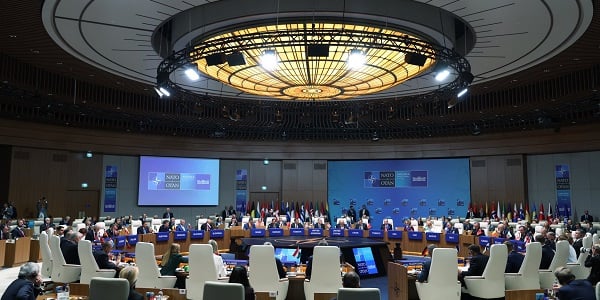
The July 11 calls came amid sustained regional diplomatic activity. Turkey’s position as a regional bridge-builder was reinforced at the Ankara NATO summit earlier this month, where Erdogan’s government consolidated its standing as indispensable to the alliance’s communications with regional non-members. At the same time, Oman’s two-corridor Hormuz proposal, the most concrete de-escalation framework currently on the table, has given the quadrilateral an active file to advance with both Washington and Tehran.
What Saturday’s calls did not resolve – and did not claim to – is the gap between Ankara’s insistence on the MoU as the path forward and Cairo and Amman’s public condemnation of the party that framework is designed to bring back to the table. Whether Fidan’s separate conversations with both capitals moved that gap in either direction was not disclosed.