
TALLINN — The three Baltic states’ senior diplomats in Moscow jointly denied Saturday that Estonia, Latvia, and Lithuania had granted Ukraine access to their airspace for strikes against Russian territory, issuing a coordinated on-the-record rebuttal to Russian accusations that have been escalating since July 4.
The statement came from the chargés d’affaires of the three countries’ embassies in Moscow, who described themselves as repeating “clearly once again” a position their foreign ministers had already stated jointly on April 10. Latvia’s foreign ministry published the joint statement on its website.
The Russian accusation being denied came from Deputy Foreign Minister Mikhail Galuzin, who told state news agency RIA Novosti on July 4 that Latvia and other Baltic states had already provided air corridors for Ukrainian strikes against Russia. Galuzin warned at the time that the Baltic states were “playing with fire” by allowing their territory to be used for what he characterized as hostile actions against Russia.
That statement itself followed an April comment from Nikolai Patrushev, the presidential aide and maritime board chairman, who argued that drone strikes in the Baltic region required the approval of the countries whose airspace the drones crossed. Patrushev’s formulation implied that Baltic NATO members were knowingly complicit in Ukrainian military operations, a characterization the three governments have now formally denied twice in three months.
The pattern of accusation is deliberate. Over three months, Russia has moved from implication to direct assertion, naming Latvia and the Baltic states specifically as having provided air corridors. The Baltic states have now formally denied both, each time through senior diplomatic channels. What that escalation in specificity signals about Russia’s intent is not established by Saturday’s denial, but the trajectory from insinuation to named accusation, directed at three NATO members on Russia’s border, does not resemble a routine diplomatic exchange.
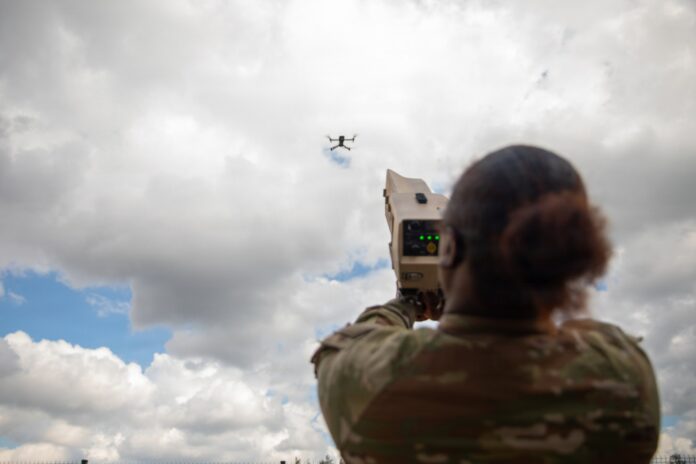
Authorizing another country’s military to use your national airspace for strikes on a third country would, under any standard reading of international law, constitute involvement in that conflict. Russia’s accusation, if accepted, would reframe the Baltic states from third parties in the Ukraine conflict to active participants in strikes against Russian territory. The joint denials are not only factual corrections. They are a direct rejection of a legal and political categorization Russia has been working to establish over several months.
What the joint statement does not address is the underlying technical question: whether Ukrainian drones have in fact crossed Baltic airspace, and if so, whether the Baltic governments were aware. The April 10 foreign ministers’ statement and Saturday’s chargé denial both say the countries have not authorized such use. That is a different claim from saying it has not occurred. Drone flight paths and airspace detection are a matter of radar and technical tracking that neither statement discusses.
The Baltic states have been among the most vocal supporters of Ukraine within NATO and among the alliance members most exposed to direct Russian escalation. Russia’s airspace claims, made through senior officials in public forums rather than through diplomatic back-channels, suggest an audience for these accusations beyond the Baltic capitals. Whether NATO’s position on the airspace question has been coordinated with the three states is not established by Saturday’s statement. The three chargés acted as a Baltic bloc. The alliance has not issued a parallel statement.