
SAN FRANCISCO – Brad Garlinghouse had a choice in late 2020. The Securities and Exchange Commission had just sued Ripple for allegedly conducting an unregistered securities offering worth $1.3 billion, and the company’s chief executive and co-founder Chris Larsen were calculating whether it was worth fighting a federal agency with, as Garlinghouse put it this week, “infinite power and resources.”
The conclusion they nearly reached was to shut down entirely.
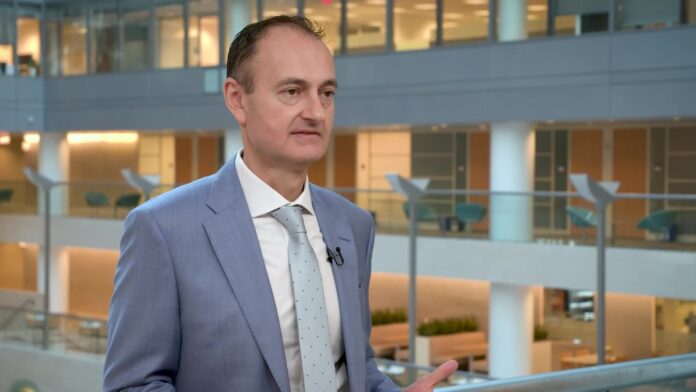
Garlinghouse disclosed the details Wednesday at the University of Kansas School of Business, describing a moment that had remained private since the lawsuit was filed in December 2020. He and Larsen seriously considered dissolving Ripple and distributing its XRP holdings directly to shareholders rather than continuing operations. What stopped them, Garlinghouse said, was the prospect of leaving hundreds of employees without jobs. “I’m glad in retrospect, but that was not obvious at the time,” he said, according to CoinDesk.
The four-year legal battle cost approximately $150 million in legal fees before it ended in Ripple’s favor. Federal Judge Analisa Torres ruled that XRP itself is not a security under the Howey test, a finding that became one of the most-cited rulings in U.S. crypto regulation. The SEC had argued the tokens constituted an unregistered investment contract; Torres found that while Ripple’s institutional sales of XRP qualified as securities transactions, programmatic sales on secondary markets did not. The distinction established a precedent that continues to shape regulatory analysis of digital assets.
The case formally settled in May 2025, following the change in SEC leadership under the Trump administration. The new commission moved to resolve crypto enforcement actions that had accumulated under Gary Gensler’s tenure. The Ripple settlement was among the most prominent of those resolutions, dismissing penalties that remained outstanding after the Torres ruling. Garlinghouse spent those intervening years traveling to Washington, testifying before congressional committees, and pressing the case that the SEC’s enforcement-first approach to crypto had driven capital and talent offshore.
The Kansas disclosure adds a dimension to Ripple’s corporate history that was absent from the public record. The company had described the lawsuit as existential in regulatory terms, but the possibility of voluntary dissolution, with XRP distributed to shareholders rather than traded on exchanges, suggests the threat extended beyond the courtroom. A company willing to consider that outcome was not merely managing litigation risk; it was weighing a fundamental restructuring of what XRP would be and who would control it.

For the crypto industry, the significance runs deep. As crypto markets showed resilience even amid fresh geopolitical pressure this weekend, with U.S. strikes on Iran and the Strait of Hormuz closing again, Garlinghouse’s disclosure is a reminder that the asset class’s legal architecture nearly developed in a very different direction. Had Ripple folded, the XRP distributed to shareholders would have had no company behind it. Whether the SEC would have continued pursuing enforcement against holders of a distributed asset with no corporate custodian is a question that was never tested.
Stablecoin regulation under the GENIUS Act, now in its final implementation phase, has proceeded partly on the legal framework that Ripple’s victory helped establish. The Torres ruling clarified that not all token sales are equal, and that secondary market transactions of digital tokens do not necessarily carry the same regulatory burden as direct institutional sales. That principle has shaped how regulators approach stablecoins, which are primarily traded on secondary markets and involve a different risk profile than the direct XRP sales the SEC targeted.
Ripple has since emerged from the lawsuit with operations in more than 55 countries and a payments network that processes cross-border transactions for financial institutions. The company expanded aggressively into Asia, the Middle East, and Latin America during the years the lawsuit was pending, a strategic bet that international growth could outlast domestic regulatory uncertainty. That bet paid off. The post-settlement Ripple is a larger company than the one the SEC sued in 2020, operating in markets where dollar-denominated cross-border payments remain slow and costly.
The $150 million legal figure, if accurate, makes the Ripple case one of the most expensive pieces of regulatory litigation in crypto history measured by defense costs alone. It does not include the internal costs to the company: executive bandwidth diverted to legal strategy, employee turnover driven by uncertainty, and the competitive disadvantage of operating under an unresolved securities cloud while rivals without that liability expanded more freely. Ripple has not disclosed these costs independently.
What Garlinghouse has not addressed publicly is the specific moment when he and Larsen decided to fight rather than dissolve. Whether that came from a single conversation, a board meeting, or a gradual shift in the legal team’s assessment, the $150 million cost suggests it was made relatively early, before fees had accumulated. What tipped it, whether confidence in the eventual ruling or loyalty to the employees, Garlinghouse left partly open on the University of Kansas stage. What he confirmed is that the $150 million and four years were not inevitable. They were a choice.