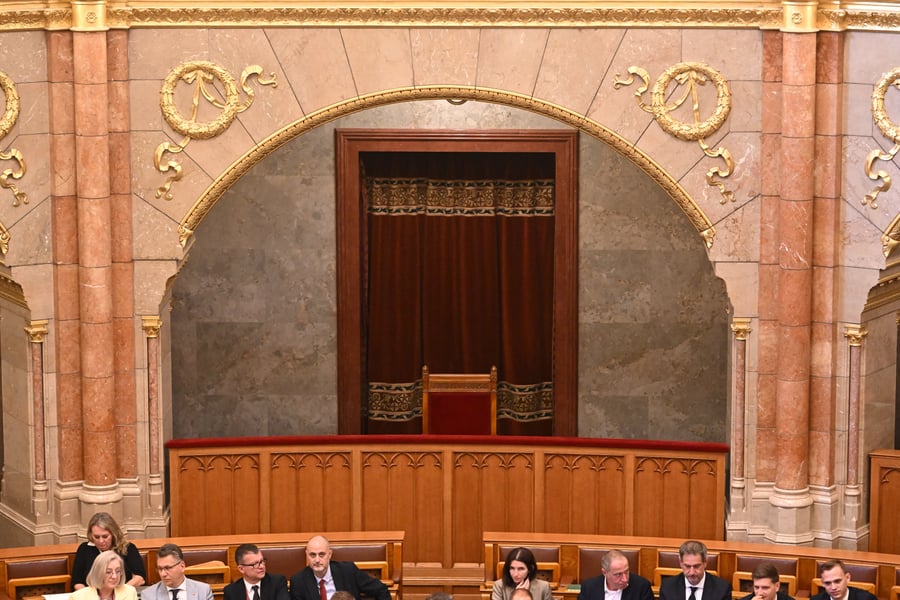

BUDAPEST – The vote was not close. Hungary’s parliament approved a constitutional amendment Monday with 139 votes in favour and six against, a margin so lopsided it rendered the procedural steps that follow almost ceremonial. The amendment would immediately terminate the term of President Tamás Sulyok, giving him five days to sign the measure into law or face the start of formal impeachment proceedings.
Sulyok served as chief of Hungary’s Constitutional Court before Viktor Orbán’s parliament elected him president in February 2024. He spent years in that judicial role defending the legal framework that enabled Orbán’s sixteen-year grip on power. He now becomes its most prominent casualty.
Prime Minister Péter Magyar, whose Tisza Party won a landslide victory in April that ended Orbán’s rule, called Sulyok “unworthy to embody the unity of the Hungarian nation,” Al Jazeera reported. The phrasing was pointed. A Hungarian president’s constitutional function is explicitly symbolic, meant to represent national cohesion above party politics. Magyar’s argument, embedded in the amendment’s preamble, is that an Orbán appointee cannot fulfil that role in the post-Orbán era.
The constitutional amendment reaches further than the presidency. Bundled into the same measure are judicial reforms designed to restore the independence that Fidesz systematically curtailed, the creation of a new anticorruption oversight body, and a twelve-year cap on parliamentary terms. The term limit is a direct response to Fidesz’s strategy of deploying the same loyalists across state institutions across successive mandates, ensuring structural entrenchment that outlasted any single electoral cycle.
Together, the package amounts to the most concentrated burst of constitutional revision Hungary has seen since Orbán rewrote the country’s foundational law in 2011 to entrench his party’s dominance. Magyar’s government is dismantling that structure using the same parliamentary supermajority that Orbán once wielded to build it.
Tisza’s parliamentary arithmetic makes the outcome near-certain regardless of what Sulyok decides in the next five days. If he signs the amendment, the transition to a new president proceeds without drama. If he refuses, parliament opens impeachment proceedings, a route that carries greater public visibility but the same mathematical conclusion. The 139-6 margin leaves Fidesz, now in opposition, no functional avenue for resistance.
The scale of that margin reflects how thoroughly April’s elections transformed Hungary’s political map. Magyar won with a supermajority after Orbán’s government collapsed under the weight of economic stagnation, corruption scandals, and deepening isolation within the European Union. That isolation had cost Budapest an estimated €13 billion in frozen EU cohesion funds. Since Magyar took office, Brussels has begun releasing those funds as Hungary demonstrates compliance with rule-of-law conditions, a financial reset that has given his government greater room to act domestically as well as internationally.
The anticorruption body embedded in Monday’s amendment is part of that compliance architecture. Hungary ranked among the EU’s worst performers on transparency and anti-graft metrics throughout the Fidesz era, and the Commission’s decision to freeze cohesion funding was directly tied to concerns about judicial independence and corruption control. Whether the new body will operate with genuine institutional independence, rather than as a government-aligned instrument in different clothing, is a question European institutions and domestic observers say will take months to assess properly.
Magyar has been methodical since taking office. His government has pursued diplomatic rapprochement with Brussels and with NATO allies, moved to restore media freedoms curtailed under Orbán, and worked toward a resolution on minority rights for Hungarians in Transcarpathia, a dispute that has long blocked Budapest’s support for Ukraine’s EU accession path. He has also kept Hungary’s long-standing refusal to deploy troops to Ukraine intact, differentiating his EU pivot from full alignment with the bloc’s hardline position on the war.
The ouster of Sulyok follows that same logic: systematic removal of the institutional markers of the previous era, executed while the governing coalition still carries the emotional and political weight of its election mandate. Magyar’s government appears to be operating on the assumption that the window for structural reform is widest in the first year after an election of this magnitude.
What remains unclear is what the post-Sulyok presidency will look like. Magyar’s supermajority will elect the replacement, and no candidate has been publicly named. That silence is not necessarily incidental. The choice of successor will signal whether Magyar intends to install a technocratic figure above factional politics or someone more directly aligned with the governing programme, a question that matters considerably for how independently the institution functions going forward.
For Orbán, now leading Fidesz from opposition, Monday’s vote represents the clearest signal yet that the reversal of his political project is structural, not merely electoral. He spent sixteen years building an interlocking system of loyalists across the judiciary, the state media, the civil service, and state-linked business. Magyar’s government is unpicking that system one institution at a time.
Sulyok has five days. His decision will shape the public narrative of how the Orbán era ends, but not the outcome itself.