
WASHINGTON – The federal government has identified what it says are 250,000 voter-registration records belonging to noncitizens in California, New Jersey, Nevada, and Pennsylvania. On Friday, the man in charge of the Department of Homeland Security told state election officials that choosing to do nothing about it could land them in prison.
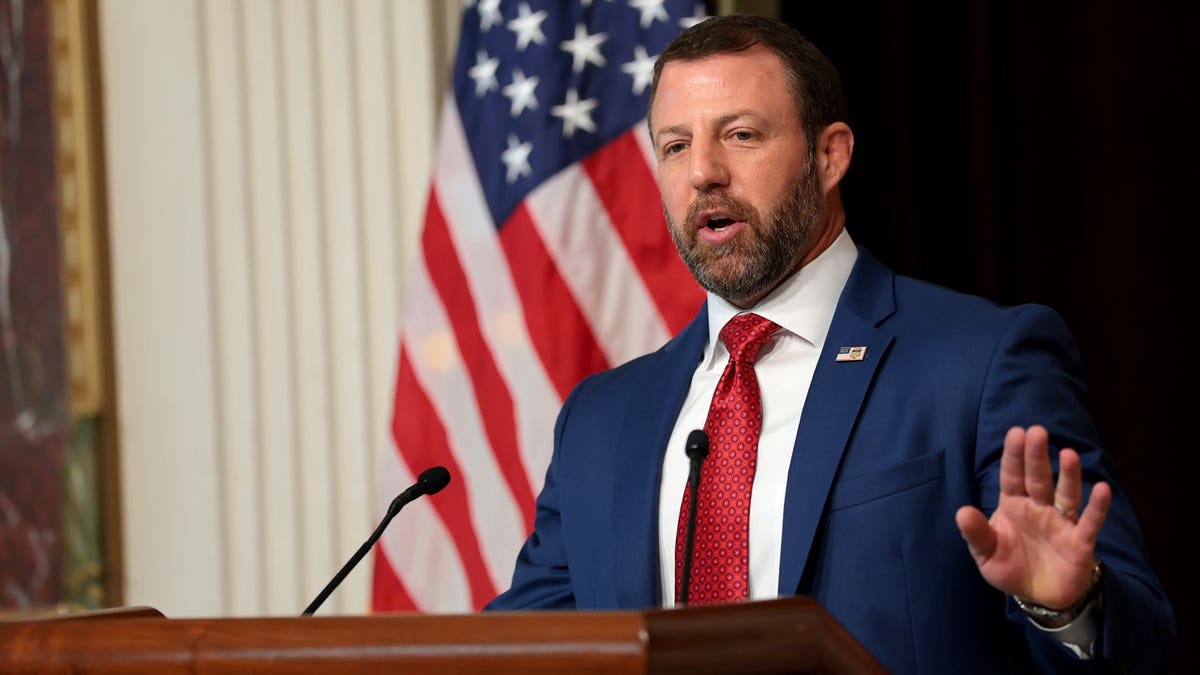
DHS Secretary Markwayne Mullin, appearing before reporters, said the Trump administration would condition federal election grants on state participation in its election-security program and threatened prosecution for officials who ignore the data the department has provided. “If the election officials, once we gave them the information they need to secure their elections and they chose not to, then those individuals can also be held accountable by fines, by penalties, and even depending on how far it goes, prison time,” Mullin said, according to Fox News.
The warning is attached to a program called SAVE, which cross-references state voter rolls against federal immigration databases to identify registrations that may belong to people without citizenship status. Twenty-three states currently participate. The states that do not include California, New Jersey, Nevada, and Pennsylvania, the four states DHS named Friday, but also Mississippi, North Dakota, and West Virginia, all three governed by Republicans.
Mullin did not address the absence of Republican-led states from his remarks. “Every state that’s not participating with us should be asked the hard question why not? What are you afraid of?” he said, a formulation that fits less cleanly when applied to states whose governors are allied with the administration making the threat.
The administration’s stated mechanism for enforcing compliance is financial. States that refuse to participate in the SAVE program risk losing access to FEMA’s Homeland Security Grant Program, which distributes federal funding for election infrastructure security. Commerce Secretary Howard Lutnick is working with DHS to develop the specific security requirements that will be attached to those grants, and CISA, the Cybersecurity and Infrastructure Security Agency, is expected to release an updated election infrastructure plan within 30 days.
Mullin also called on Congress to pass the SAVE America Act, which would require documentary proof of citizenship for federal election voter registration and photo identification at polls. “I think the Save Act should be passed tomorrow. I think it should have already been passed,” he said. The legislation has not advanced in the Senate.
The announcement follows a speech by President Donald Trump in which he cited voter file data to renew claims of widespread electoral fraud in 2020, claims which courts rejected in more than 60 legal proceedings after that election. Trump’s renewed push on voter fraud claims follows a pattern of using federal leverage to force compliance from governments and officials he views as uncooperative.
No state election official has been charged or prosecuted under any theory Mullin described on Friday. The legal basis for federal prosecution of state officials who decline to act on DHS data is not established in any statute Mullin cited. Election administration in the United States is constitutionally a state function, and there is no settled precedent for federal criminal liability attached to a state official’s discretionary decision about how to manage a voter roll.
What Mullin described, prison time contingent on “how far it goes,” is a threat calibrated for maximum political effect, not a description of imminent indictments. Federal prosecutors would have to identify a specific statute, charge a specific official, and survive a likely constitutional challenge before any of Friday’s language became an actual prosecution. None of that happened Friday. What happened was a press conference.
The 250,000 figure DHS cited for noncitizen voter registrations comes from cross-referencing voter rolls against immigration databases, a methodology that election experts have previously flagged for producing false positives. Citizenship status changes as people naturalize, and immigration databases are not always updated to reflect that in real time. A registration record that appears to belong to a noncitizen in a federal database may in fact belong to a naturalized citizen whose status has not yet propagated through the system.
DHS has not released its methodology, the confidence level of its matching process, or the number of records it has already referred that turned out to belong to eligible citizens. The 250,000 figure is therefore unverifiable by independent review. Several states that received similar federal notifications in prior administrations found, after investigation, that the vast majority of flagged records belonged to lawful voters.
The CISA plan expected within 30 days will set the formal requirements that states must meet to retain their federal election grants. Until that document is released, the precise standards election officials must follow to avoid the penalties Mullin described on Friday do not formally exist. Officials in the targeted states have been told they could be imprisoned for failing to comply with requirements that have not yet been written.
Whether Mullin’s announcement produces compliance or court challenges remains to be seen. States like California and New Jersey have previously resisted federal election-related directives and have the legal resources to contest grant conditions in federal court. The constitutional question of whether the federal government can compel state election administration through funding conditions has not been tested in this specific context and could take years to resolve.
What DHS produced Friday was a set of threats, financial, legal, and criminal, without a single accompanying action. No official was charged. No grant was suspended. No state was formally notified of noncompliance under a written standard. The administration announced it intends to do things it has not done yet, and officials who fail to respond to data whose methodology it has not disclosed may face prosecution under a legal theory it has not specified. The 30-day CISA deadline will say more than Friday’s press conference did.