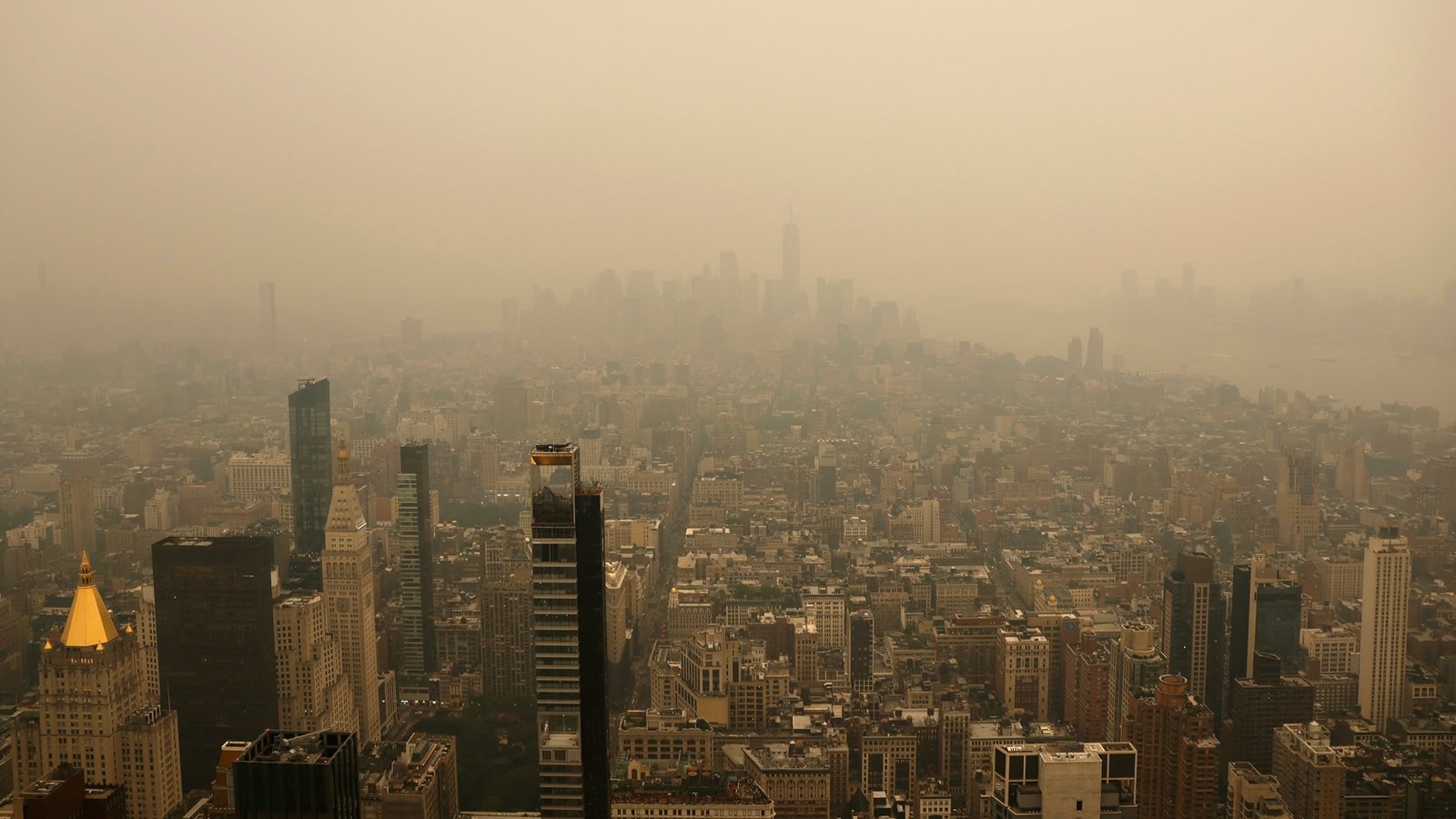

WASHINGTON – By the time Detroit residents checked their air quality apps Friday morning, their city had joined Washington, D.C., on a global pollution ranking nobody wanted to lead. The orange haze thickening over Lake Michigan had traveled hundreds of miles, pushed south by a heat dome trapping smoke from more than 830 wildfires burning across Canada. More than 100 million Americans were breathing air their doctors told them to avoid.
Into that health crisis, Senator Bernie Moreno of Ohio, a close ally of President Trump, arrived with legislation. He announced this week that he would introduce the Countering Atmospheric Nuisances Arising from Drifting Airborne Foreign Incendiary Residual Emissions Act – better known as the CANADA FIRE Act – a bill that would sanction Canadian government officials, freeze their assets, revoke their visas, and declare the Canadian ambassador to the United States persona non grata until wildfire smoke stops crossing the border. The legislation is expected to be filed in the Senate on July 20.
“Canada’s government failed to invest in wildfire prevention methods including forest thinning, fuel reduction, prescribed burns, and stronger enforcement against arson,” Moreno said in his announcement. He framed the smoke not as a consequence of accelerating climate conditions but of Canadian negligence.
He was not alone. Four Republican House members from Michigan wrote to Prime Minister Mark Carney demanding accountability. President Trump said the United States was “holding Canada responsible” for the fires and warned that damage costs “must of necessity” be folded into future tariff increases against Ottawa – adding a trade lever to what Moreno’s bill had cast in terms of sanctions and visa bans.
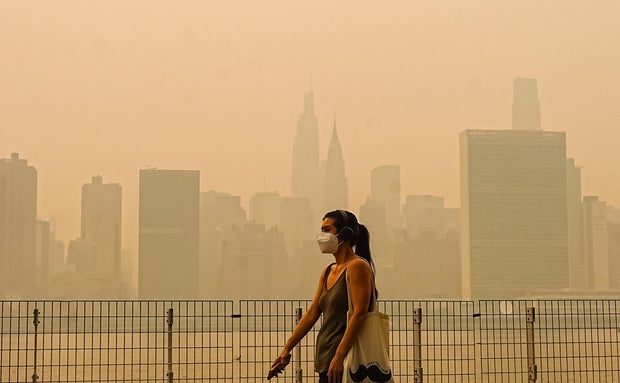
The air quality emergency reached its widest point this week. States from Minnesota to Massachusetts, Michigan to Maine, issued Code Red and Code Purple alerts as particulate readings climbed into hazardous territory across the Midwest and Northeast. Pennsylvania declared a Code Purple alert statewide. Air quality monitors in northeastern Minnesota recorded readings unsafe for all populations, regardless of health status. Detroit and Washington, D.C., ranked among the most polluted major cities in the world on Friday – a threshold that more commonly appears beside cities in South Asia and sub-Saharan Africa.
New York City Mayor Zohran Mamdani warned residents that “air quality has reached unhealthy levels in parts of NYC due to smoke from Canadian wildfires,” urging particular caution for the elderly, children, and people with cardiac and pulmonary conditions. Around Midtown Manhattan, the skyline blurred into a reddish haze that kept pedestrians off sidewalks and forced the postponement of outdoor sporting events. ABC News reported that more than a dozen states were under active health warnings, with Canada’s nearly 900 simultaneously burning fires driving the worst air quality event to hit the northeastern United States in years.
The dangers extend beyond days of discomfort. Tyler Hasenstein, a meteorologist with the National Weather Service, noted that extreme heat arriving alongside the smoke created a combination that was “not good from a health perspective.” Suzanne Paulson, director of the Center for Clean Air at UCLA, said wildfire particles carry particular risk: “No particles are good to breathe, but wildfire particles seem to be more toxic than regular urban particles themselves.” Serap Erdal of the University of Illinois Chicago described PM2.5 particles as thirty times smaller than a human hair, capable of penetrating deep into lung tissue and causing chronic cardiovascular and respiratory damage with repeated exposure.
Moreno’s bill, as drafted, would require President Trump to formally determine whether Canadian authorities failed to take adequate preventive action before triggering a mandatory sanctions package: asset freezes, visa bans for officials deemed responsible, and a sense-of-Congress declaration labeling Canada’s ambassador a persona non grata. A secondary provision would establish a victims compensation fund financed through additional tariffs on Canadian exports.
That framing collides with what climate scientists have documented across multiple wildfire seasons. Canada’s 2026 fire outbreak arrived after a winter of record-low snowpack and spring temperatures well above historical averages across Ontario and British Columbia. When forests carry that level of accumulated heat and drought, fires ignite and spread at a pace that prescribed burns and fuel reduction – the prevention methods Moreno cited – can mitigate at the margins but not prevent at scale. Nearly 200 of Canada’s active fires were categorized as out of control.
Prime Minister Carney, who has worked to position Canada as a responsible climate actor in contrast to Washington’s retreat from international environmental commitments, responded with pointed brevity. Climate change, he said, is “everyone’s responsibility” – a remark directed at a country that has spent the past year dismantling federal environmental regulations and withdrawing from climate frameworks while threatening to sanction an ally over the downstream effects of the same emissions trajectory Washington declined to address.
The announcement arrived into an already strained bilateral relationship. Trump’s tariff campaigns against Canadian exports, repeated rhetorical suggestions about Canada as a future “51st state,” and an increasingly aggressive posture at the northern border have driven a documented collapse in Canadian travel to the United States and fueled consumer boycotts of American products. Carney has navigated those provocations with careful public language, but the accumulation of escalations – from steel tariffs to annexation talk to now sanctions threats – has narrowed his diplomatic options considerably.
Whether the CANADA FIRE Act advances beyond Moreno’s announcement remained unclear at week’s end. No Senate Republican leadership figures had publicly endorsed the legislation by Friday. Trump’s statement holding Canada “responsible” stopped short of backing the specific bill. Whether the administration views the measure as credible policy or as political messaging for domestic audiences in states like Ohio and Michigan – where smoke sat heaviest – was not apparent from anything Washington said publicly.
What is not in doubt is the immediate emergency. Meteorologists said a second wave of smoke plumes from new British Columbia ignitions was pushing south through the weekend, meaning air quality across the Great Lakes region was unlikely to improve before Sunday at the earliest. In Detroit, parks sat empty and physicians were advising patients with respiratory conditions to remain indoors. On the rooftops of Manhattan, the sun set orange over a city breathing air it could not quite see – the kind of visible consequence that tends to generate more political heat than the quieter science driving it.