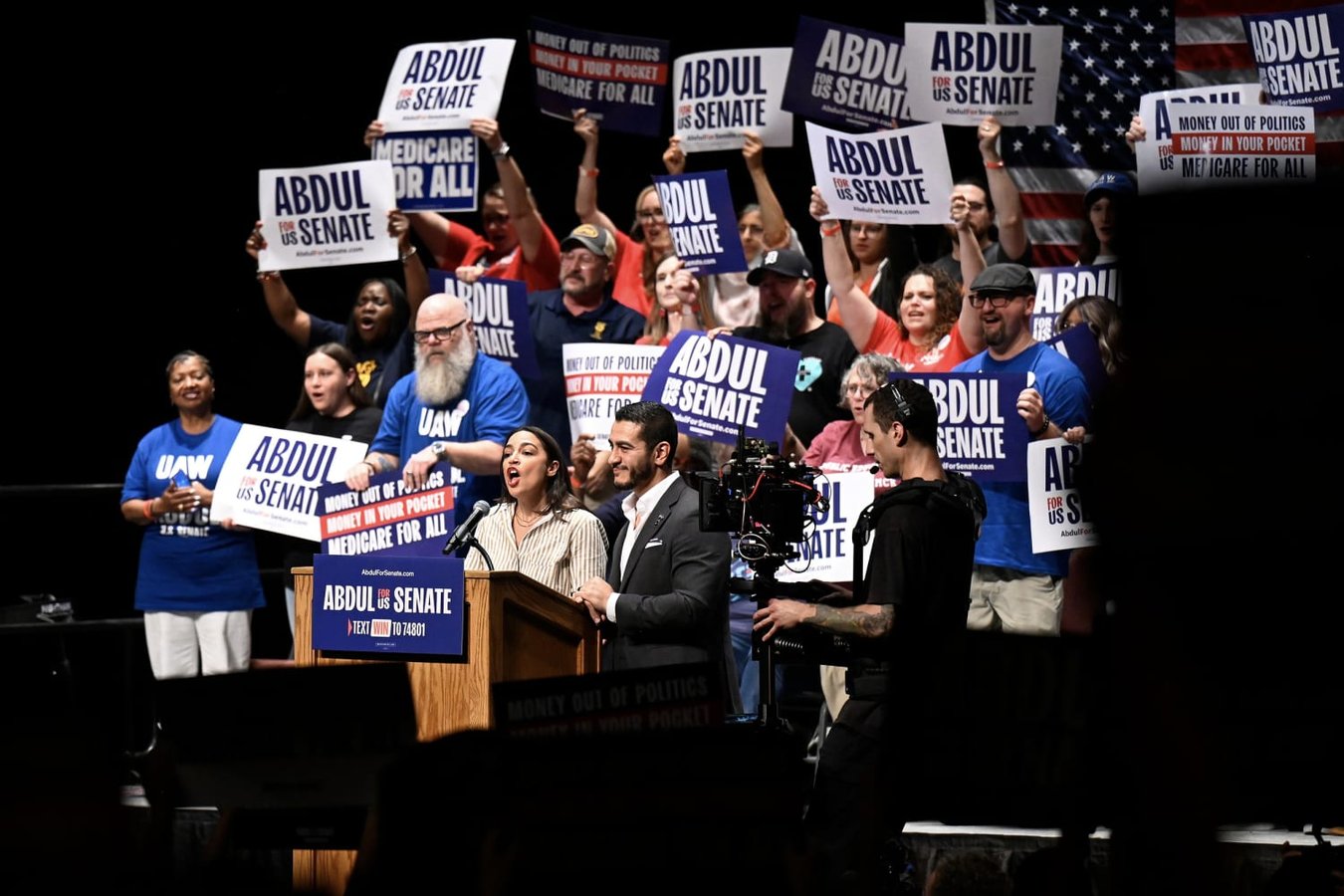

DETROIT – Abdul El-Sayed was not supposed to be this year’s story.
The Michigan physician and former Democratic gubernatorial candidate had spent the better part of four years in the margins of his party, advocating for single-payer health care and Palestinian rights in a state where both positions carry significant political risk. Now, with Bernie Sanders and Alexandria Ocasio-Cortez formally behind him, El-Sayed has become the most visible test of whether the progressive movement can translate energy into a Senate seat before November 2026.
Sanders announced his endorsement Friday in a statement that cast the Michigan race as a referendum on the Democratic Party’s direction. “Abdul El-Sayed is running to represent working people, not AIPAC and not the billionaire class,” the Vermont senator said, placing his support explicitly in the context of the American Israel Public Affairs Committee’s influence over Democratic primaries. It was language Sanders has refined over several election cycles, most sharply during 2024, when he became the most prominent national voice calling for a halt to US arms shipments to Israel.
Ocasio-Cortez followed within hours, appearing alongside El-Sayed in video released by the campaign. The endorsement from the New York congresswoman extended what has become an informal Squad primary strategy: identifying competitive races where AIPAC’s financial capacity can be directly challenged by a sufficiently organized grassroots response. The pair represent different wings of the same progressive tradition, one rooted in economic populism and the other in generational disruption, and their convergence on El-Sayed sends a signal of unusual coherence.
El-Sayed, who has spoken openly about his Muslim faith and his family’s Egyptian roots, is running in a state where that biography carries distinct weight. Michigan’s Arab-American community, concentrated in Dearborn and its surrounding suburbs, delivered a notable protest vote during the 2024 general election cycle, with tens of thousands casting “uncommitted” ballots rather than support the Democratic presidential nominee over his Gaza policy. That decision reshaped how strategists analyze the state and added new complexity to the party’s coalition math heading into 2026.
The Senate seat El-Sayed is seeking is currently held by Representative Haley Stevens, whose record on foreign policy has drawn sustained criticism from the state’s progressive and Arab-American constituencies. Stevens has received funding from AIPAC’s political arm, a fact the El-Sayed campaign has highlighted in early fundraising communications.
Representative Rashida Tlaib of Michigan, the only Palestinian-American member of Congress, had not issued a formal endorsement statement as of Friday evening, though allies close to her described El-Sayed as “the natural choice” for the progressive wing of Michigan’s Democratic delegation.
The practical mechanics of Friday’s announcements matter as much as their symbolism. Sanders’ endorsement list-shares have become a recognized commodity inside progressive campaigns, capable of generating six-figure fundraising responses within a single news cycle. Ocasio-Cortez commands a comparable small-dollar apparatus built over several electoral cycles. El-Sayed’s campaign declined to characterize its financial expectations before publication.
What those endorsements cannot easily replicate is the organizational depth required to win a contested Democratic primary in a large industrial state. Michigan’s labor movement remains central to that architecture, and its relationship with El-Sayed is more complicated than the endorsement narrative suggests. Several major unions backed him during his 2018 gubernatorial run; others have since aligned with Stevens, citing concerns about trade consistency and domestic manufacturing priorities. The UAW, which represents tens of thousands of Michigan workers, has not yet committed to the Senate primary field.
The spending gap ahead could be considerable. AIPAC’s United Democracy Project spent tens of millions of dollars in the 2022 and 2024 election cycles, successfully defeating progressive candidates it viewed as hostile to Israel in several competitive House and Senate races. El-Sayed and his allies have signaled they expect similar pressure in Michigan. A formal response from AIPAC had not been issued by Friday night, according to NBC News.
El-Sayed’s campaign has sought to frame the Michigan race as part of a broader realignment inside the Democratic Party, one accelerated by Arab-American disaffection and the continued fallout from US policy in Gaza. Whether that argument penetrates beyond the progressive base in a state where economic security remains the dominant kitchen-table issue is a question that polling has not yet resolved. A Glengariff Group survey conducted in June placed El-Sayed well behind in name recognition outside the Detroit metropolitan area.
The contest also arrives as the Trump administration’s federal court battles over voting access have complicated the Democratic Party’s broader strategic positioning heading into the 2026 midterms. Federal courts have become a contested battleground for ballot rules in multiple states, adding uncertainty to how Democratic primaries will ultimately be decided.
The race is still early. Sanders and Ocasio-Cortez have offered El-Sayed a platform and a fundraising lift, and Tlaib’s eventual positioning could prove decisive in a primary where Arab-American turnout will be closely watched. What neither has yet provided is a path through the competing pressures of labor politics, moderate voter skepticism, and a well-funded opposition. That architecture will take months to build, and a primary to test it.