
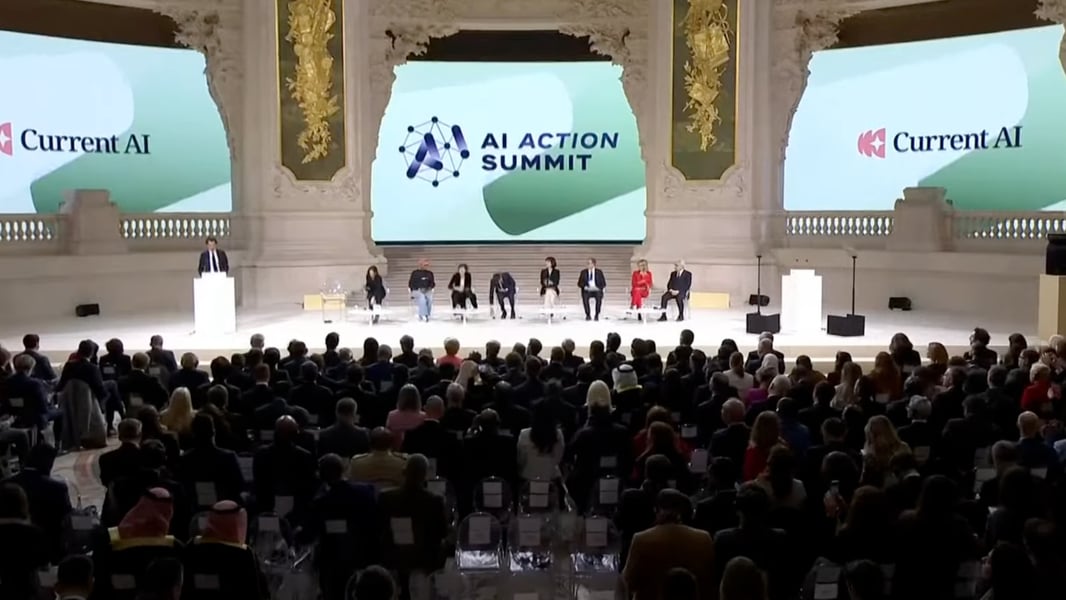
GENEVA – Ayah Bdeir arrived at Current AI in January 2026 with a resume that spanned both sides of the divide her organization exists to bridge: a career at Mozilla building open internet infrastructure, followed by work at the top of corporate technology. As the nonprofit’s chief executive, she is now overseeing a $400 million initiative to do for artificial intelligence what the early web did for information: build the foundational layer that anyone can use, regardless of who funds it or who it was built to monetize.
Current AI was founded in February 2025 by Martin Tisne, a French philanthropic strategist whose career has centered on making powerful information technologies accountable to the people they affect. The organization’s mission is to build and maintain open AI infrastructure as a public good, not a business. The $400 million committed to date comes from sources that reflect that mandate: the French government has committed $100 million, the Ford Foundation and MacArthur Foundation are both contributors, and DeepMind and Salesforce have each made financial commitments.
The practical output so far is two products and a set of community data programs. The first is Suno Sutra, an offline AI assistant built for 22 Indian languages in partnership with India’s Bhashini language initiative. It runs without an internet connection, meaning it can function in areas where mobile data is unreliable, a specification that reflects what the organization calls a design-first principle: build for the communities who will use it before optimizing for the communities who will pay for it.
The second is Alpha Chat, an open-source AI chatbot built through a coalition that includes the Mozilla Foundation, the MIT Media Lab, and the open model platform Hugging Face. Alpha Chat uses no proprietary model weights and publishes its full technical architecture, a direct contrast to the major commercial chatbots whose underlying systems are trade secrets.
Alongside those products, Current AI has invested in community-sourced datasets in Kenya, Lebanon, and Brazil. The idea is straightforward: AI models trained on data that communities generate, in languages and cultural contexts that reflect their reality, perform better for those communities than models trained primarily on data scraped from English-language websites. Collection and curation happens locally, with the nonprofit providing the technical infrastructure.
The fundraising points to a moment in the AI governance conversation where frustration with corporate-only development has found institutional expression. China’s launch of WAICO, a 29-nation AI coalition, earlier this week crystallized the competition over who sets the rules for global AI development, a contest that Current AI is approaching from a different angle: arguing that infrastructure matters more than governance documents.
“Big tech builds multilingual models to expand their market,” Bdeir has said, “regardless of whether communities consented to having their languages and cultural data harvested.” The largest AI companies have scraped text from across the internet to build systems that can generate fluent responses in dozens of languages, often without the knowledge of the communities whose writing and speech trained those systems. Current AI frames its mission as the alternative: AI developed with community involvement rather than against it.
The technology sector has heard versions of this argument before. The open-source software movement built some of the most critical infrastructure on the internet through public-interest models that private companies then built profitable businesses on top of. The question for Current AI is whether the same pattern applies to AI, where the cost of training foundation models at competitive scale now runs into the hundreds of millions of dollars and requires specialized hardware that few academic institutions or governments can independently access.
$400 million is substantial for a nonprofit. It is a rounding error compared with the AI capital expenditure of a single major technology company in any given quarter. Bdeir and Tisne appear to have thought through that asymmetry. Current AI is not trying to build a frontier model to compete with the largest commercial systems. It is trying to build the connective tissue: the datasets, the deployment tools, the community engagement processes, the language infrastructure that makes existing open models useful in contexts where commercial providers have no business incentive to go.
Half the world’s languages, the organization notes, face extinction over the coming decades. AI systems trained on the internet are ill-equipped to serve speakers of most of them. The same gap that threatens linguistic diversity also threatens the utility of AI as a tool for the majority of the world’s population, which does not communicate primarily in English, Mandarin, or Spanish.
The context for Current AI’s work has shifted rapidly. The release of openly available foundation models, including Kimi K3 and others from Chinese and American labs, has made the software layer more accessible. Current AI’s argument is that software availability is not the binding constraint: community-appropriate data, local deployment infrastructure, and genuine consent frameworks are what determine whether an AI system is actually useful to a speaker of an endangered African language or a rural Indian dialect.
Whether $400 million in philanthropic and governmental commitments can sustain that mission at the scale required, and whether the institutional coalitions necessary to maintain something this ambitious will hold together over years of iteration, remains the part of the Current AI story that its founders have not yet written. The organization’s full mission and product details were reported by TechCrunch on Saturday. The products it has shipped are real. The distance between what they demonstrate and what would be required to serve as global infrastructure for billions of people is the distance that no funding announcement can close on its own.