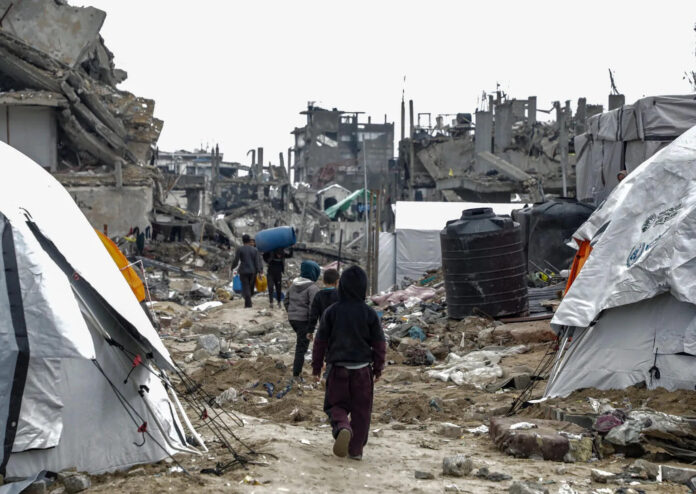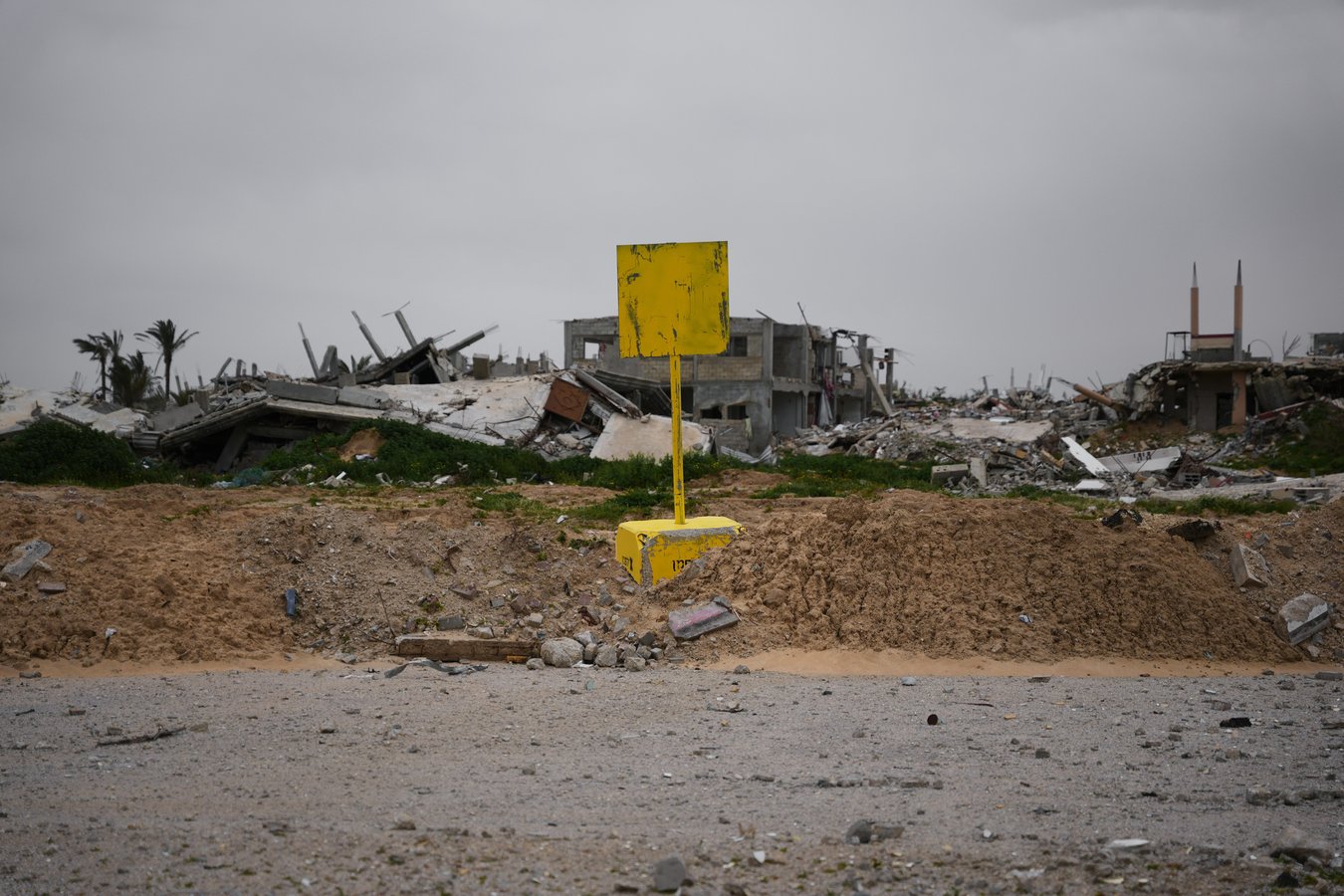

DEIR EL-BALAH – Families displaced to the Zeitoun neighborhood have been watching the yellow concrete blocks advance for weeks. By Tuesday, they were 70 meters from the nearest homes, down from a line that was supposed to mark the outer edge of an Israeli security buffer when the ceasefire took effect last October. Seventy-one households have nowhere left to go.
The blocks keep moving. Israel’s “yellow line,” the system of concrete barriers placed by Israeli engineering units after October’s ceasefire as field demarcations of buffer zones, has expanded Israeli control from approximately 53 percent of the Gaza Strip to 64.9 percent, according to Al Jazeera’s documentation of the line’s advance. In land, Israel’s footprint grew from approximately 195 square kilometers to 235 square kilometers. The ceasefire that paused the most visible phase of the genocide has produced a different kind of territorial change.
The process has unfolded unevenly but consistently across the Strip. In Deir el-Balah, yellow blocks advanced 300 to 350 meters westward beyond their original positions. In northern Gaza, the line moved 1.5 kilometers. In each location, the advance came without formal announcement, without legal authority under the ceasefire agreement, and without a mechanism that would allow affected Palestinians to contest the movement or return.
National Security Minister Itamar Ben-Gvir measured the result in terms that required no interpretation. “Gaza is ours,” he said, celebrating what he described as Israeli forces holding 70 percent of the territory. The population that once inhabited that 70 percent, including 950,000 residents of Gaza City, has been forced into the diminishing space that Israeli forces have not yet reached. Humanitarian aid delivery to that compressed population has run at roughly 35 percent of required levels, according to UN assessments.
The toll during the ceasefire period has continued to accumulate. Since October, 1,168 Palestinians have been killed and 3,795 violations of the ceasefire agreement have been documented. An Israeli airstrike killed six members of a single family in Gaza City on Wednesday, one entry in a count that the word “ceasefire” was not designed to accommodate.
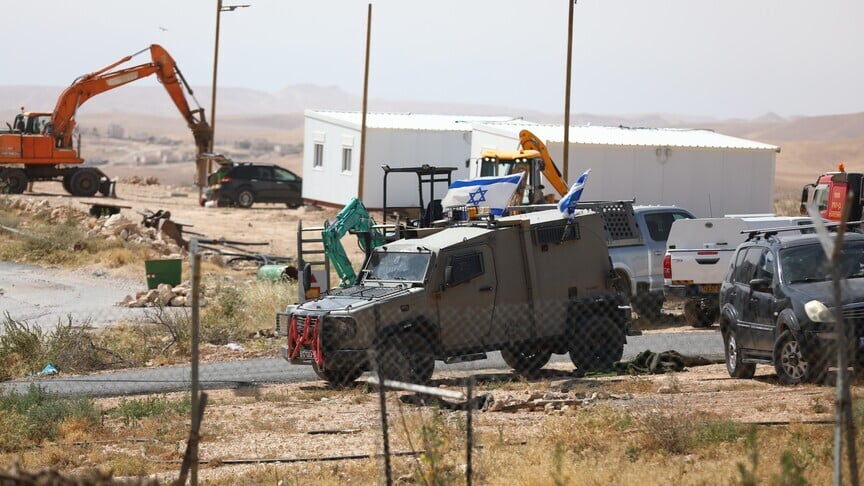
The yellow line’s advance fits a pattern that Palestinian researcher Ahmed al-Tanani described as mirroring Israeli tactics in the West Bank following the 1967 occupation. Field positions establish a military presence. That presence becomes a permanent administrative fact. Administrative facts become the baseline for any future political arrangement. The comparison holds in its structural logic even if the timelines differ: what took decades in the West Bank is advancing over months in Gaza.
The settlement dimension has moved from subtext to explicit policy. Israeli Defense Minister Katz and Finance Minister Smotrich announced a plan this week for Nahal military-agricultural outposts in northern Gaza. The formal settlement groundwork, Smotrich said, was already complete for three sites. The yellow line and the settlement proposal are not separate initiatives. They describe the same trajectory expressed through different instruments.
What the ceasefire agreement established was an end to large-scale military operations, not a legal transfer of sovereignty over any part of Gaza. The yellow line’s expansion beyond the positions it held at the ceasefire’s start has no authorization in the agreement’s text. The international community has responded to 3,795 documented violations with the kind of concern that has not altered the facts on the ground.
Ben-Gvir’s “Gaza is ours” marks a specific moment in that trajectory. He is not describing an aspiration or a future policy. He is describing a current territorial situation that Israeli engineering units have been building, concrete block by concrete block, since October. Whether the international framework calls it occupation, annexation, or something else, the practical effect for the 71 families in Zeitoun watching the blocks move toward their homes is the same.
The humanitarian situation inside the corridor where Gaza’s population is now concentrated reflects the conditions of prolonged compression. At 35 percent of required aid delivery levels, the population is receiving significantly less than international assessments determined was necessary to prevent famine. Previous reporting documented disease outbreaks and malnutrition building under conditions of higher aid delivery rates. The current trajectory has not reversed that direction.
What the yellow line is establishing, in territory that Israel does not legally hold, is a new geographic baseline for any negotiation that might eventually produce a political arrangement for Gaza. Territory that Israeli forces administered through military presence at the ceasefire has expanded to nearly 65 percent of the Strip. Any future discussion about Gaza’s status will begin from a map that looks substantially different from the one that existed when the ceasefire was signed.
The 1,168 Palestinians killed since October died in a period officially classified as a ceasefire. The yellow concrete blocks have moved 40 more square kilometers toward the sea. Both facts will remain relevant to what comes next, and neither is in dispute.