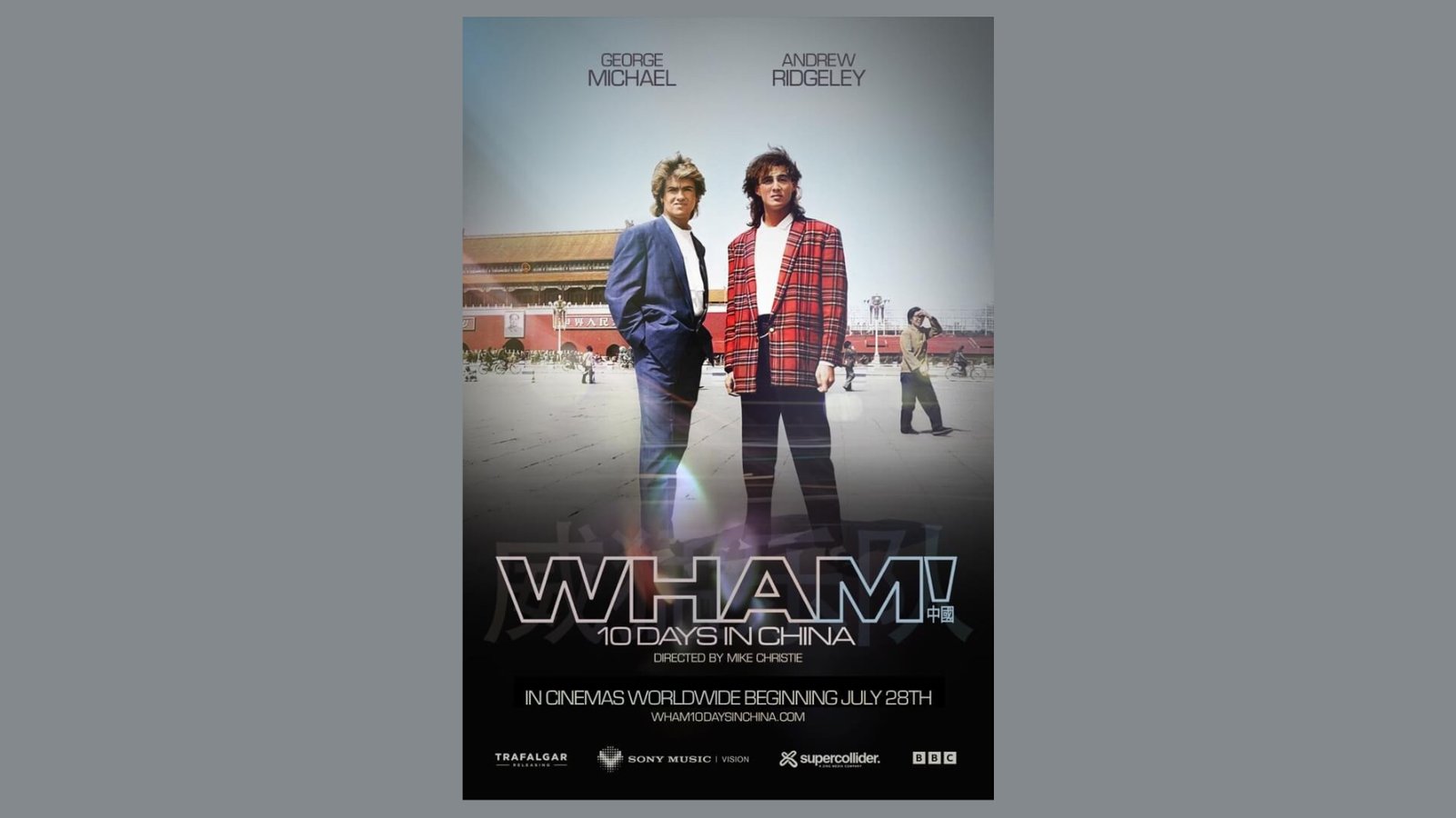

LONDON – The cinema lights go down on a film that took four decades to find an audience. WHAM! 10 Days In China, directed by Mike Christie and distributed by Trafalgar Releasing, opens in theaters today, a document of the 1985 concerts that made George Michael and Andrew Ridgeley the first Western pop group to perform in the People’s Republic of China.
The footage, much of it never publicly screened, follows the duo across ten days of performances in Beijing and Guangzhou, capturing the euphoria and friction of an extraordinary gamble. Ridgeley, speaking to the Guardian ahead of the release, described the tour plainly: “It did achieve its purpose, but it was a bold and risky gambit.”
The gambit was not, as the mythology has long suggested, primarily about China. Simon Napier-Bell, who managed WHAM! at the time, conceived the tour as a transatlantic maneuver. Michael was reluctant to commit to the grueling schedule of American arena tours. A China debut – unprecedented, globally covered, impossible to ignore – would generate the international attention that would make the American market come to them. The 1985 concerts in Beijing and Guangzhou were designed to be watched, not just attended.
What no one could have predicted was what the concerts would mean to the people in those seats. The documentary concludes with interviews with fans who attended the 1985 shows, several of whom say the experience altered the course of their lives. Many pursued careers in music. The film does not claim causality in any clean sense – China in 1985 was opening to the world, and Western culture was pressing at every available door – but the specificity of the testimony gives it weight.
Christie, in discussing the weight of the project, spoke directly to the challenge of directing a film about someone who could not speak to it. George Michael passed away on Christmas Day 2016, leaving behind one of the most carefully managed public images in pop history. “When you’re looking after someone’s legacy like that,” Christie said, “especially somebody who was already very clear about that persona versus that person.” The unfinished sentence holds both versions: the commercial force of WHAM! and the younger man who was still becoming the artist he would spend the rest of his life being.
For Ridgeley, now 62, the film is a chance to reclaim a narrative that has long been told through another person’s subsequent career. WHAM! has been understood largely through the prism of Michael’s solo trajectory – the massive commercial success that followed, the public struggles, the retrospective critical reassessment – and the China tour has existed in pop memory mostly as a curiosity, an early chapter before the real story began. 10 Days In China argues otherwise. The concerts functioned as art in the moment they happened, and the people who saw them knew it.
Trafalgar Releasing, which has built its business around theatrical concert films and event cinema, distributes the documentary globally. The company’s model – limited theatrical windows for music and performance content – has expanded significantly over the past decade, with WHAM!’s release joining a catalog of legacy concert films that have found renewed audiences in cinemas long after their original moment. The built-in audience spans the original 1985 fans, who were teenagers when the Beijing shows aired on the BBC, and a younger generation that has encountered Michael primarily through streaming.
The release arrives as questions of who controls legacy footage and when it reaches the public have become central to how the music of the late 1970s and 1980s is remembered. As Eastern Herald covered this month, the passing of Victor Willis, the Village People’s founding frontman, renewed those questions about a generation of acts whose cultural meanings far exceeded their chart positions.
The China tour footage was recorded partly because Napier-Bell understood its documentary value at the time, though the material spent years in various states of accessibility before Christie’s project brought it into coherent form. The director’s task was not simply editing but curatorial: deciding what the story is when the central figure cannot participate in telling it.
What the film leaves unresolved – and this may be its most honest quality – is whether the China concerts changed China, or only the people who attended them. The fans who pursued music careers did so in a country undergoing transformations that would reshape every cultural relationship it had. Whether the seeds Napier-Bell planted in Beijing for American marketing reasons actually contributed to Chinese popular music’s own evolution remains genuinely unclear. Christie’s documentary lets the ambiguity stand, which is the correct choice for a story that is still, in some sense, ongoing.