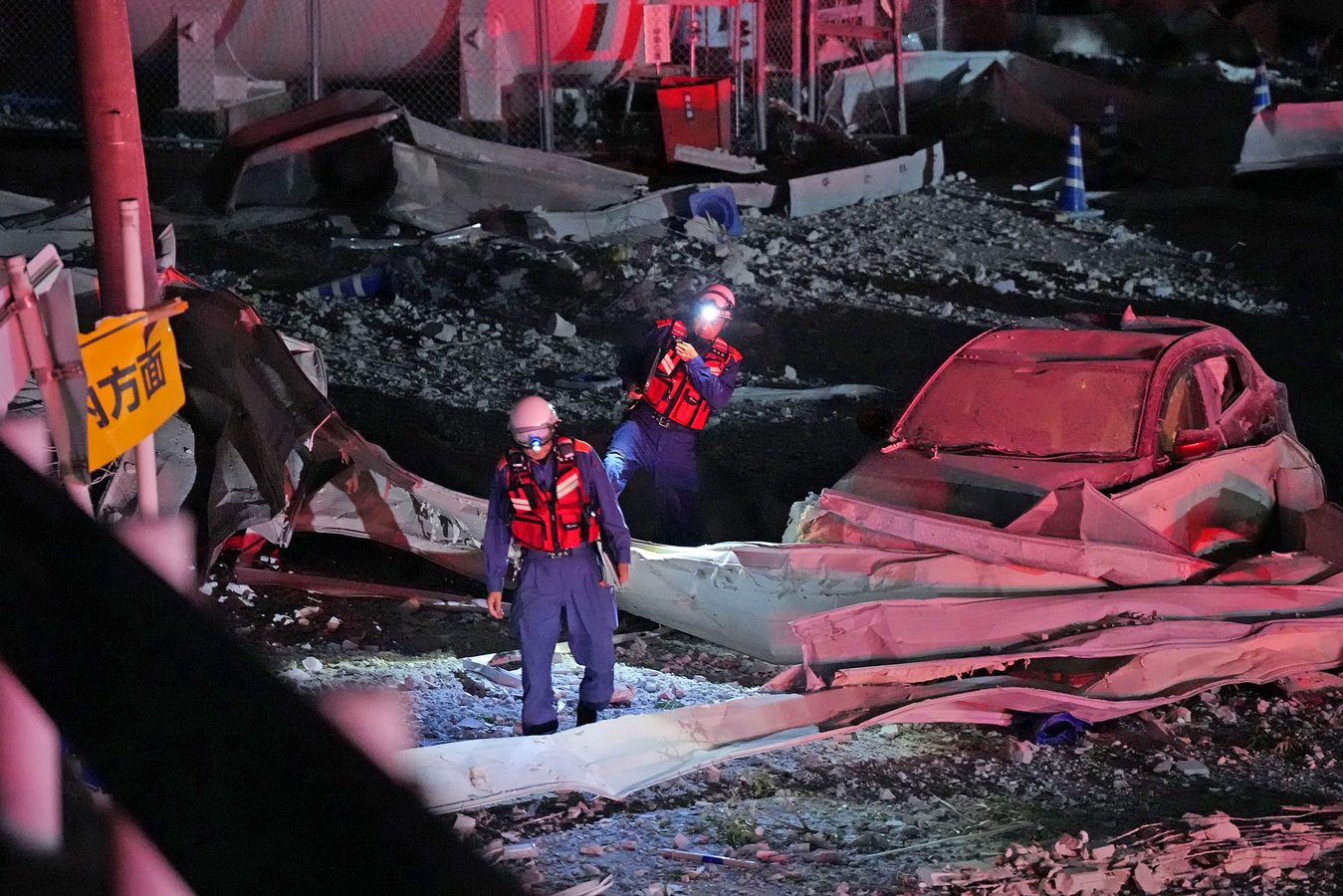

KUMAMOTO – The ceiling of the Aeon Mall gave way on a packed weekday afternoon, sending concrete and ceiling material onto shoppers in the atrium below. When a 7.1-magnitude earthquake struck the Kumamoto region of Kyushu without warning on Monday, residents had no time to reach exits before the building’s interior began to fall. Rescue workers were still pulling victims from the rubble four hours later.
At least several people were killed in the mall collapse alone, with the government warning the toll would rise considerably as teams penetrated deeper into unstable sections. More than 50 people were confirmed injured across the prefecture. The earthquake’s epicenter sat just 10 kilometers below Uki city in southern Kumamoto – shallow enough to generate violent shaking that buckled a dozen buildings and triggered seven fires across the city within minutes.
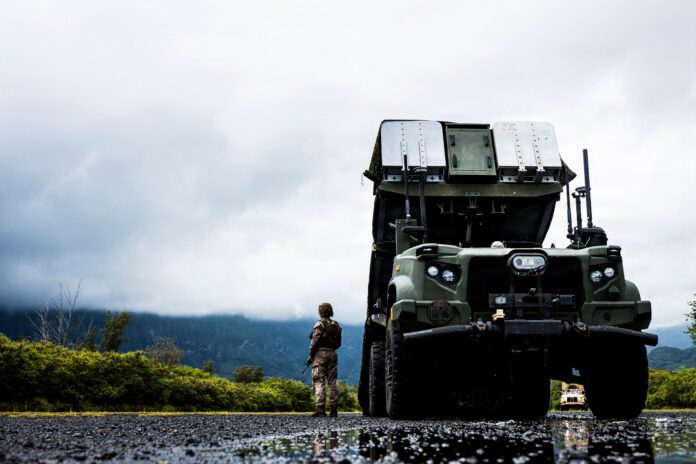
Prime Minister Sanae Takaichi convened an emergency response session before noon. “We will spare nothing in our efforts to rescue survivors and restore safety to affected communities,” she told reporters in Tokyo. The government authorized the immediate deployment of 3,600 Japan Self-Defense Forces soldiers to Kyushu, dispatching columns toward the epicenter zone around Uki even as landslides had already closed mountain passes south of Kumamoto city.
The Japan Meteorological Agency issued a tsunami warning for Kyushu’s coastal areas within minutes of the tremor. It was lifted roughly 30 minutes later after monitoring stations recorded no significant wave activity. Authorities kept evacuation advisories in place across low-lying coastal zones as aftershocks continued, including two measuring above magnitude 5.0 in the first two hours.
Approximately 300,000 residents across the Kumamoto area were ordered to evacuate. Gymnasiums and public halls filled rapidly. Japan’s Ishikawa earthquake in January 2024 had revived many of the same emergency protocols, and Kumamoto residents described Monday’s tremor as carrying a familiar opening jolt – followed by a prolonged, rolling secondary phase unlike anything they experienced in 2016, when a double-earthquake sequence killed more than 50 people across the same region.
Forty thousand households lost power as substations switched offline and distribution lines snapped. Twelve buildings collapsed outright. Kumamoto Castle, rebuilt painstakingly after the 2016 earthquakes, suffered fresh damage to its stone walls and several reconstructed turrets. The castle’s cultural preservation office said it was too early to assess the full extent, particularly for structures only recently reopened following years of post-quake restoration.
The Shinkansen bullet train network across Kyushu was suspended as inspection teams moved along elevated sections that had developed visible cracks in at least two locations. No estimate was given for restoration of service, leaving tens of thousands of passengers stranded at stations that had themselves sustained minor structural damage. Landslide closures compounded the logistical crisis across Uki and several southern Kumamoto municipalities.
At the Aeon Mall site, which drew the heaviest concentration of emergency personnel and media, a rescue coordinator described conditions inside as complicated. The structure’s central atrium took the most severe impact. Search dogs were deployed across sections that teams could not safely enter. “There are areas we believe contain victims we have not yet been able to reach,” the coordinator said Monday evening. “We are proceeding as quickly as safety allows.”
Kyushu has faced an intensifying pattern of natural disasters in recent years. Typhoon Jangmi’s passage through Kyushu and Tokyo in June drew successive Self-Defense Forces deployments and strained emergency infrastructure that had been operating under persistent pressure. The earthquake hit on a day when none of those systems had fully reset from a compressed run of recent weather events.
The international response moved quickly. The United States Embassy in Tokyo offered assistance through established bilateral channels. Japan’s disaster response framework typically handles initial rescue operations independently before accepting foreign help, but officials acknowledged Monday evening that the scale of simultaneous emergencies – building collapse, fires, road closures, mass evacuation, and Shinkansen suspension – was placing concurrent demands on systems designed to absorb multiple stresses, not all of them at once.
For the broader region, the earthquake compounds a compressing cycle. Earlier this month, Typhoon Bavi swept toward Kyushu and Okinawa, forcing fresh evacuations along the Ryukyu chain and carrying warnings for mountainous terrain already saturated by weeks of monsoon rain. Each successive event draws on the same stockpile of emergency supplies, the same pool of trained responders, and the same government budget lines running down faster than they can be replenished.
Whether the death toll at the Aeon Mall will match early fears remained the most urgent unknown as Monday night approached. Rescue coordinators declined to estimate the final number. Sections of the mall’s basement levels had not yet been assessed. Survivors described hearing a sound they compared to an explosion – the moment ceiling support systems failed simultaneously across a wide area – followed by darkness and the weight of debris.
Japan’s seismic monitoring network registered the initial 7.1-magnitude event at 1:47 p.m. local time. By 2:00 p.m., the government had issued its highest-level disaster response classification for Kumamoto Prefecture. By 4:00 p.m., Takaichi was briefing a full cabinet session on casualty projections officials said were too preliminary to release publicly. The afternoon’s sequence – disaster, classification, cabinet response – unfolded with the procedural precision Japan has developed from long experience. What it cannot engineer away is the gap between when the ceiling falls and when the last person beneath it is found.