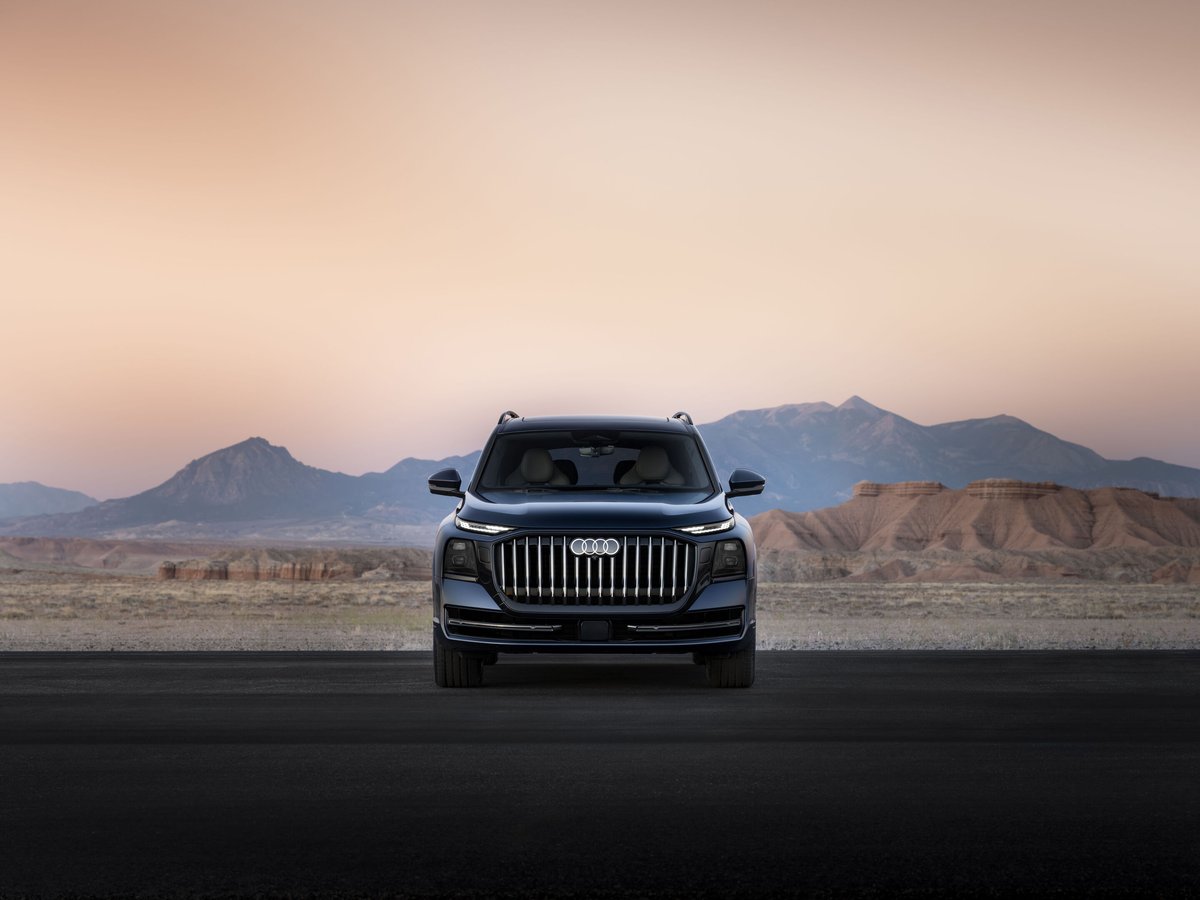

INGOLSTADT – Audi revealed the Q9 on Tuesday, its largest production vehicle ever and the company’s first direct entry into the full-size luxury SUV segment, where the BMW X7 and Mercedes-Benz GLS have competed without a serious German third option for most of the past decade.
The standard Q9 starts at $89,095, powered by a twin-turbocharged 2.9-liter V6 producing 429 horsepower and 442 pound-feet of torque, paired to an eight-speed automatic transmission and Audi’s quattro all-wheel drive system. Zero to 60 miles per hour arrives in 4.9 seconds.
The performance-variant SQ9 starts at $119,395 and swaps in a twin-turbocharged 4.0-liter V8 producing 591 horsepower and 590 pound-feet of torque. The SQ9 covers zero to 60 in 3.8 seconds, carries a 155-mph top speed, and includes air suspension as standard equipment along with 16.5-inch front brake rotors gripped by six-piston calipers.
Both variants seat six or seven passengers across three rows. The Q9 rides on a 123.5-inch wheelbase, longer than the Chevrolet Tahoe, and spans 209 inches in overall length. Deliveries are scheduled to begin in the fourth quarter of 2026.
The timing is not accidental. Audi’s A8 sedan, the company’s traditional flagship, is currently on hiatus, placing the Q9 in the symbolic position of the brand’s most ambitious and most expensive production vehicle. Audi has confirmed the A8 will return, making the Q9’s flagship designation temporary, but the company appears to view that framing as an asset: in the segment where the Cadillac Escalade, the Land Rover Range Rover, and the GLS have done most of their business, the Q9 gives Audi a vehicle priced to compete directly for buyers who have had few reasons to consider the brand at this level until now.
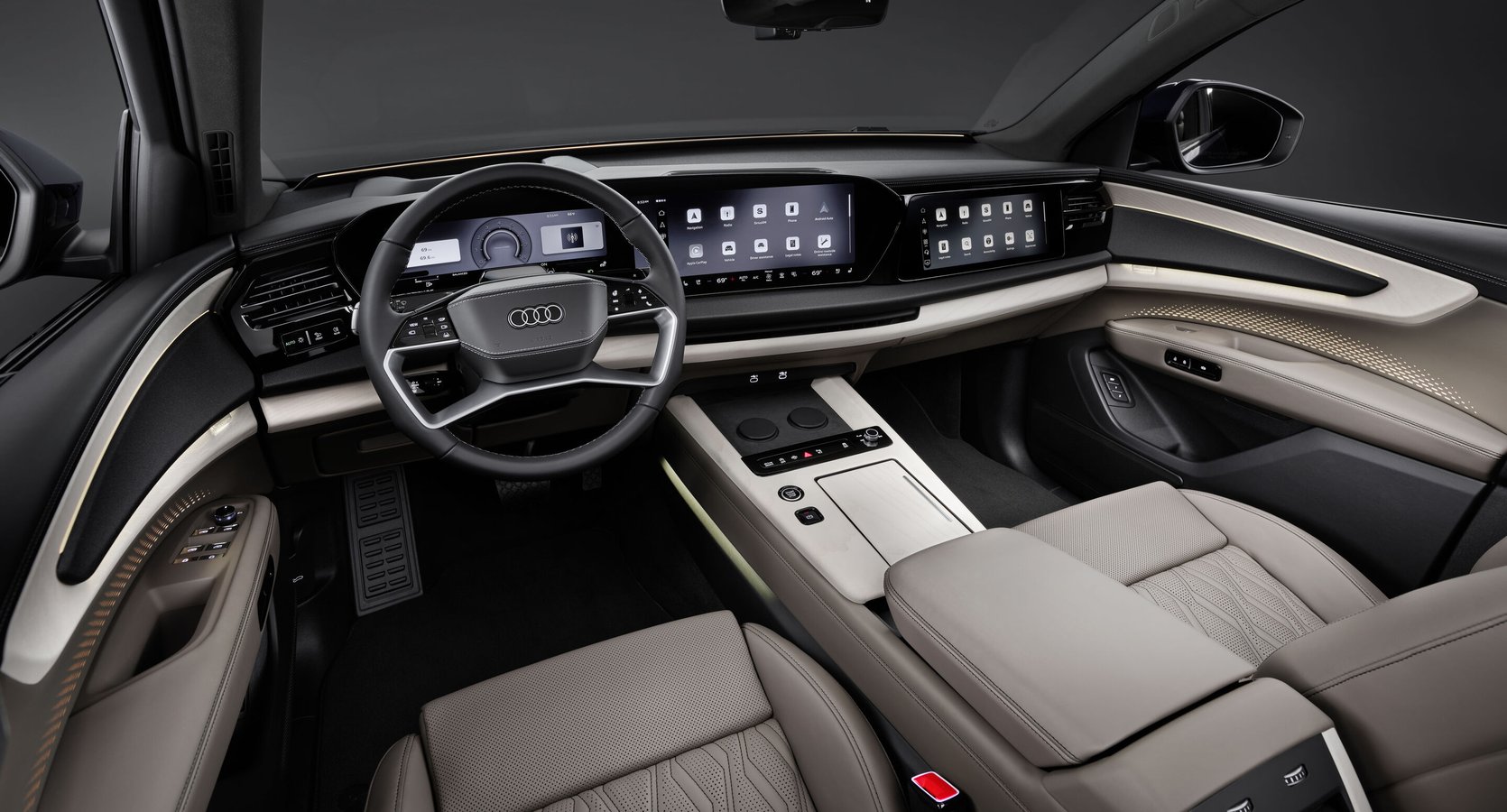
Exterior design reads as an enlarged Q7, a proportional escalation rather than a stylistic departure. The Singleframe grille is wider. Digital Matrix LED headlights are standard. Optional OLED taillights include ground-projected turn signals, a feature that sits just to the functional side of conspicuous. The interior follows Audi’s current direction: a large curved display spanning the driver and center console area, real wood and metal trim replacing the piano black of earlier-generation interiors, a Bang & Olufsen sound system as standard equipment, and a panoramic roof that also comes standard.
Second-row dimensions are generous for the segment. Third-row occupants in the seven-seat configuration will find conditions tighter than the second row but more habitable than some competitors at this price point, a relevant distinction for families who need the third row in regular rather than occasional use.
The competitive context into which the Q9 enters is well-defined and crowded. BMW’s X7 has held the German three-row luxury SUV position largely on its own since 2018. The Mercedes-Benz GLS, the Cadillac Escalade, and the Land Rover Range Rover complete the tier from which the Q9 will need to pull buyers. Each carries a built customer base and, in some cases, a decade or more of association with the specific use case of moving families in premium comfort. The Mercedes-Maybach EQS SUV demonstrated that buyers at the highest tier of this segment will pay for genuine differentiation. Audi is betting the Q9 offers enough to qualify.
Audi’s positioning argument rests on two established brand pillars: quattro’s traction reputation and interior quality that has benchmarked consistently among the highest in the segment. The Q9 adds a third argument: at comparable specification levels, the $89,095 starting price positions it below both the GLS and the X7. Whether buyers in this segment make their decisions on price is a separate question. The number is visible.
What the Q9 does not have at launch is a hybrid powertrain option. Audi has not confirmed whether a plug-in hybrid variant will follow, though the platform would support one. The BMW X7 xDrive50e and the Mercedes-Benz GLS 580e both offer PHEV configurations. The Cadillac Escalade IQ provides a full-battery electric variant. In markets with stricter emissions requirements, the Q9’s gasoline-only launch represents a limitation. In its primary US market, where buyers at this price point have historically prioritized output over charging speed, the absence is notable without being immediately disqualifying.
The Q9 also addresses a gap in Audi’s US footprint that has existed since the brand decided not to build a vehicle above the Q8. That decision cost Audi customers who needed three rows and found none in the lineup. The Q9 is the correction. Whether it arrives late enough to reclaim those buyers, or to claim new ones from BMW and Mercedes, will become clear in the fourth quarter when deliveries begin.
The Q9 and SQ9 are manufactured in Germany. US pricing and availability are confirmed for Q4 2026, with specific dealer allocation figures not yet released.