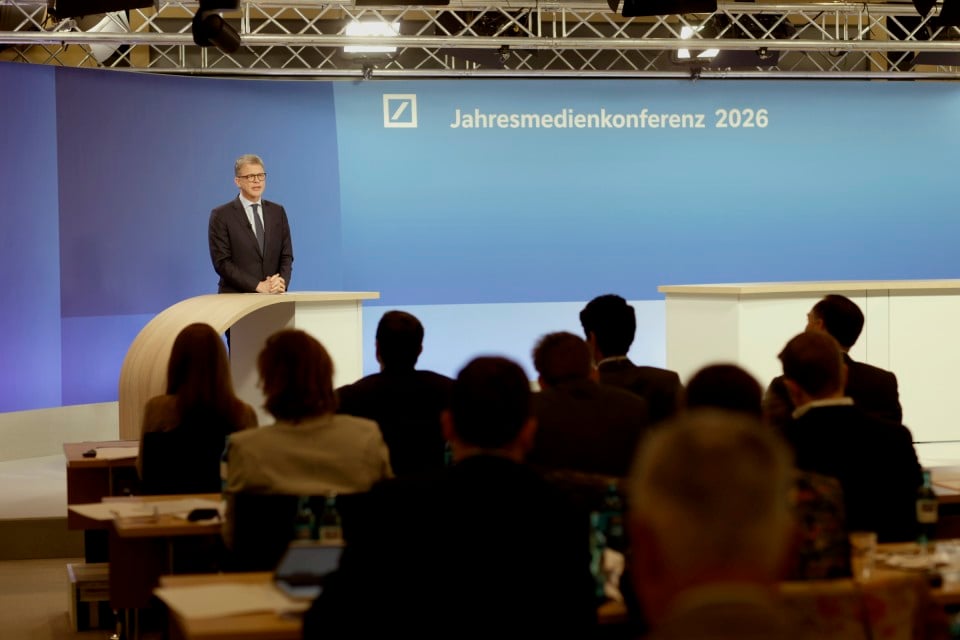

FRANKFURT – Deutsche Bank posted a record second-quarter post-tax profit of €1.9 billion on Wednesday, powered by its strongest investment-banking revenues since 2019 and defying analyst expectations for a decline, as chief executive Christian Sewing announced a new €500 million share buyback and extended the bank’s unbroken run of quarterly revenue growth to 20 consecutive periods.
Group net revenues rose 9 percent year on year to €8.5 billion for the quarter, according to the bank’s results statement. Fixed income and currencies revenues climbed 16 percent to €2.6 billion, a level Deutsche Bank has not matched since 2019. Investment banking and capital markets revenue surged 36 percent to €559 million, driven by gains in leveraged finance and equity issuance. Deutsche Bank was among the ten institutions leading the SpaceX IPO, the largest initial public offering in stock-market history, and participated in several of the year’s most significant European leveraged-finance transactions.
For the first half of 2026, post-tax profit reached €4.1 billion, a record for any six-month period in the bank’s recent history, up 9 percent from the same period a year earlier, on revenues of €17.2 billion. The full-year revenue target of approximately €33 billion, which Sewing set as a marker of restored credibility, now looks increasingly achievable with two quarters remaining.
Returns across all four business divisions reached double digits in the quarter. The Corporate Bank, which handles transaction banking and treasury services for multinationals, posted a return on tangible equity of 16.4 percent. The Private Bank, which manages retail and wealth clients largely in Germany, returned 11.3 percent. The group’s overall return on tangible equity reached 11.0 percent, up from 10.1 percent in the second quarter of 2025, approaching the 12 percent target the bank has set for 2028.
Deutsche Asset Management, listed separately as DWS on the Frankfurt exchange, reported management fees 13 percent higher than a year earlier. Net new money inflows hit €25 billion in the quarter, a quarterly record for the unit, bringing the first-half total to €36 billion and pushing total assets under management beyond €1.9 trillion. The inflows reflect renewed institutional appetite for European fixed-income products and alternatives, a segment DWS has expanded aggressively since 2024.
Sewing framed the quarter as validation of a multi-year restructuring that cost thousands of jobs and required the bank to exit equity trading businesses it had operated for decades. He said the record results were driven by powerful growth momentum and cost discipline, adding that the bank now sees upside to its 2028 financial targets without specifying which metrics he expected to exceed. In a message to staff, Sewing invoked the bank’s identity as a European institution with global ambitions, saying its role as the Global Hausbank is particularly relevant today.
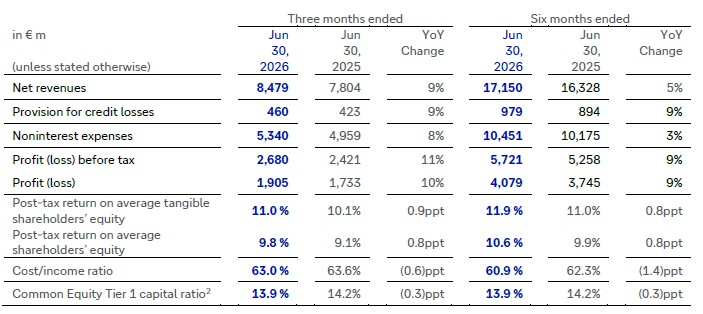
The Common Equity Tier 1 capital ratio stood at 13.9 percent at quarter end, within the bank’s stated operating range of 13.5 to 14.0 percent. The new €500 million buyback follows a current €1 billion program still in progress, part of the bank’s commitment to return 60 percent of earnings to shareholders through dividends and buybacks. The cost-to-income ratio improved to 63.0 percent from 63.6 percent a year earlier, a direction management considers central to closing the gap with top-tier global peers. Provisions for credit losses fell 11 percent quarter on quarter to €460 million, partly reflecting improved credit conditions in Germany’s corporate sector.
Deutsche Bank was not alone in posting a strong quarter. UBS reported forecast-beating results and announced $3 billion in additional buybacks, suggesting European banks broadly are benefiting from higher rates, active fixed-income markets, and a capital markets cycle that rewards institutions with diversified franchises. The Germany coalition’s sweeping reform package, which Deutsche Bank executives have described as one of the largest structural fiscal shifts in decades, represents a potential pipeline of financing and advisory work. Merz’s government enters the summer recess with approval ratings under pressure but its legislative agenda largely intact, preserving the investment thesis that attracted deal flow to Frankfurt.
A global selloff in semiconductor and artificial intelligence stocks through late July has dragged technology-heavy indices toward correction territory and is testing the appetite of companies considering public listings or large acquisitions. Deutsche Bank’s revenue mix, weighted toward fixed income and transaction banking rather than equities, provides some insulation from the volatility. But an extended risk-off period would curtail the advisory and debt capital markets pipeline the bank is counting on to sustain second-half momentum. The results statement noted continued monitoring of trade policy uncertainty and credit conditions in the United States.
The bank has now strung together a run of results that would once have seemed implausible for an institution that spent much of the previous decade managing regulatory censures, succession battles, and a failed merger with Commerzbank. The €33 billion revenue target for the full year implies second-half revenues need only hold broadly flat. What remains unresolved is whether Deutsche Bank can absorb a genuine credit downturn or a sharp equity-market contraction without returning to the kind of capital erosion and shareholder calls that defined its years of difficulty. A strong second quarter on a favorable macro backdrop is evidence of recovery. That it constitutes resilience is still to be tested.