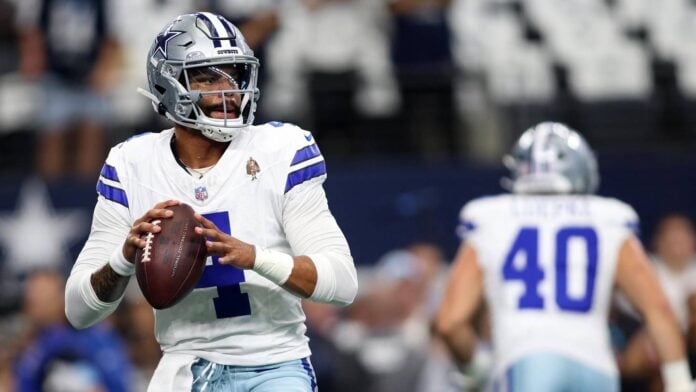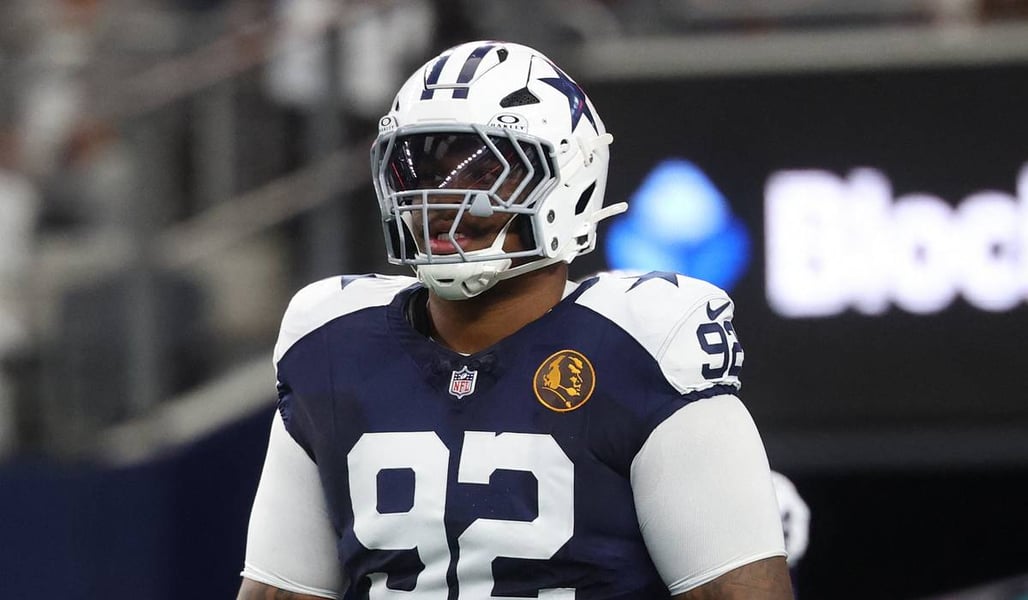

OXNARD, Calif. — The defensive tackle market moved twice this summer while Quinnen Williams was preparing for his first full season in Dallas. Jeffery Simmons reset the position at $35.27 million a year with Tennessee. Then Jalen Carter signed with Philadelphia for four years and $152 million, at $38 million annually, and the number changed again. Standing at his locker Wednesday on the first day of Cowboys training camp, Williams told reporters he found the whole thing pretty cool to watch. “It’s pretty cool to see the guys get paid,” he said.
What he did not say was that his own number had not moved in the same direction. Williams is under contract through 2027 on the four-year, $96 million deal he signed with the New York Jets in 2023, averaging $24 million per year, a figure that ranked him among the top five defensive tackles in the league when the ink dried. A market that has since cleared Simmons and now placed Carter at $38 million a year has made that contract something else: a baseline that his next deal will not resemble.
Stephen Jones stood before reporters and acknowledged the math. The Cowboys’ co-owner and executive vice president said Williams is “at the top of our list” for an extension, confirming the team has “talked to his agent about the process for negotiation,” NBC Sports reported. That Jones said it on Day 1 of camp, before a single snap of padded practice, signals something about the urgency Dallas is attaching to this. The Cowboys gave up a 2026 second-round pick and a 2027 first-round pick to acquire Williams from the Jets last spring. Letting him walk as a free agent would make that one of the more expensive miscalculations in recent franchise history.
The complication is that Carter signed his deal the day before camp opened, handing Williams’ representation a new anchor. Before Carter’s extension, Spotrac projected Williams’ next contract at three years and $94 million, or $31.3 million annually, which would have ranked him third at the position. That projection is now underpriced. Sports Illustrated noted that Carter’s $38 million per year gives Williams’ camp a floor to negotiate from, and that every dollar between $31 million and $38 million is now a live debate rather than a settled question.
Williams’ production complicates Dallas’s side of the ledger. He posted 2.5 sacks last season, the fewest of his career, a number that reflects time on a rebuilding Jets team more than it does how he actually played. Pro Football Focus rated him the top run-stopping interior lineman in the league and seventh among all defensive linemen in total pressures. Sack totals are the statistic that travels in headlines. The numbers underneath them built the case for the trade Dallas made, and for the extension it now needs to close.
Dallas’s track record with extensions has a pattern. The Cowboys waited on Dak Prescott until a franchise-tag year forced a four-year, $160 million deal. They moved slowly on CeeDee Lamb and on Micah Parsons, and each time patience cost more than it saved. Jones naming Williams the top priority on the first morning of camp reads like a team that has reviewed its own decisions and decided to try something different. Or it reads like a front office managing expectations while the negotiation moves at whatever pace it moves. The Cowboys have given observers reason to watch for both.
Williams offered the version of himself that players offer when they do not want to make the business the story. “I definitely would love being here for the long haul,” he said, “but I want to win, and that’s really the only thing I’m focused on is winning and getting this defense into the groove.” He did not mention a number. He did not mention his agent. The Cowboys need him. He wants to stay. The distance between those two facts is measured entirely in terms that neither side has named publicly.
The contract backdrop around camp opening was busy with parallel negotiations. Baker Mayfield entered Buccaneers camp with his own extension shelved through the season, a quarterback choosing to play for a future that remains unresolved. In Atlanta and Detroit, Bijan Robinson and Jahmyr Gibbs staged simultaneous hold-ins, two of the league’s best young running backs refusing to practice while each sought deals approaching $20 million per year. Williams chose none of those paths. He was in pads and on the field in Oxnard. The business, whatever shape it is taking, is not being conducted where reporters can see it.
The deal that made all of this urgent sat in Philadelphia. Carter’s $152 million extension did not merely set a record for the position. It redrew the reference points that every other defensive tackle negotiation will run against for the next several years. Carter is 25. Williams is 28 and entering what may be his final leverage window before age begins to complicate the math on a long-term deal. Camp in Oxnard opened with real football alongside the contract noise: rookie safety Caleb Downs drawing notice from coaches on Day 1, cornerback DaRon Bland returning from injury and telling reporters he felt better than he did the first time, running back Jaydon Blue making an early statement in a crowded backfield competition. That football is being played. The other conversation is being had somewhere quieter.
What nobody knows on Day 1 of camp is the number. Not what Dallas is prepared to offer, not what Williams’ representation walked in expecting. Jones said what a co-owner says when he wants to keep the tone cooperative. Williams said what a player says when he wants to keep the business out of the locker room. Carter’s $38 million sits over all of it. Whether the Cowboys can close this deal before the regular season opens against the New York Giants on Sunday Night Football is one of the few genuinely open questions the franchise brought to Oxnard. It is also the most expensive one.