WASHINGTON – By the end of next year, 18 SpaceX rockets will carry the Pentagon’s next layer of space-based surveillance into orbit, under a $1.6 billion commitment that deepens the U.S. military’s reliance on a single commercial launch provider and serves as the first major test of a space procurement program the Space Force nearly tripled in scope earlier this month.
The U.S. Space Systems Command announced two task orders to SpaceX Inc. on Wednesday, the first awards issued under the National Security Space Launch program since the Space Force raised its commercial launch ceiling from $5.6 billion to $17 billion on July 17, expanding the number of planned national security launches from 60 to 170 between 2025 and 2034. The $1.6 billion contract is the first to flow from that expansion and the largest publicly disclosed task order the NSSL Phase 3 Lane 1 program has issued since it launched.
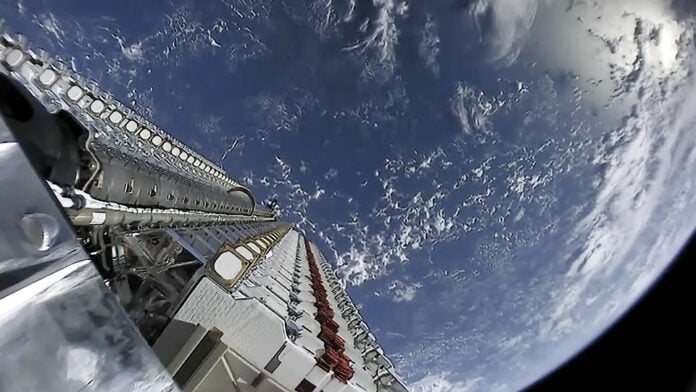
All 18 Falcon 9 rockets will lift off from Vandenberg Space Force Base in California, carrying satellites for the Space-Based Sensing and Targeting portfolio. The constellation is designed to detect and track airborne objects from orbit and relay near-real-time battlefield data to U.S. commanders on the ground. The Space Force set a two-month acquisition timeline from requirement identification to contract award, including a one-month window for competing launch providers to submit proposals. All 18 missions are expected to complete by the end of 2027.
Col. Eric Zarybnisky, acting Portfolio Acquisition Executive for Space Access at Space Systems Command, said Wednesday the awards represent an operational necessity. Sensing and targeting of airborne objects from space and providing near-real-time communications across the Joint Force, he said, “are vital to the defense of our nation.” The Space Force did not disclose what specific threats the constellation is designed to counter or how many satellites each of the 18 missions will carry.
The satellites fall within the Space-Based Airborne Moving Target Indicator program, a system designed to complement the Air Force’s E-7 Wedgetail aircraft by identifying and tracking fast-moving aerial threats from orbit. A separate Other Transaction Authority vehicle governs the satellite manufacturing contracts, with nine commercial firms eligible to compete. Wednesday’s announcement covers only the launch side: the rocket, not the payload, and it goes to SpaceX.

The contract lands as SpaceX has accumulated at least $7 billion in Pentagon awards so far this year, a concentration of defense spending in one commercial provider that has begun prompting questions on Capitol Hill. Falcon 9’s launch cadence, serving both commercial Starlink internet satellites and classified government payloads from the same production line, spreads fixed costs across a manifest no competitor currently matches and keeps its per-mission price below what United Launch Alliance or Blue Origin can offer at lower volumes.
United Launch Alliance and Blue Origin also hold pre-qualified status under NSSL Phase 3 Lane 1, the portion of the program reserved for lower-risk national security missions where providers compete for individual task orders. Blue Origin’s New Glenn rocket had not, as of mid-year, completed a mission that positioned it as a direct competitor for Falcon 9’s current cadence. ULA’s Vulcan Centaur remains in limited production relative to the operational tempo SpaceX maintains across both commercial and government customers.
The Space-Based Sensing and Targeting portfolio is a component of the Golden Dome missile defense architecture the Trump administration is assembling, a roughly $185 billion multi-year initiative in which orbital sensing capabilities are central to the system’s ability to detect and intercept incoming threats before they reach U.S. territory. SpaceX’s role in Golden Dome extends beyond launch services: according to Breaking Defense, the company’s Starshield satellite network is expected to provide a significant share of the program’s battlefield communications backbone, making the scope of Musk’s companies’ involvement unusual even by the standards of major defense contracts.
The two-month acquisition timeline stands out in a department not known for procurement speed. That pace is unusual even under Other Transaction Authority vehicles, which already bypass many standard Federal Acquisition Regulation requirements. It suggests the Space Force has identified a specific capability gap it needs filled before another part of the Golden Dome program reaches a deadline the July 29 announcement did not name.
The $1.6 billion spans two task orders within the pre-existing NSSL Phase 3 Lane 1 contract ceiling, a structure that lets the Space Force add missions incrementally as requirements develop without opening a new procurement. SpaceX’s GPS III satellite delivery for the Space Force completed this spring, adding to a mission history with government space infrastructure that no other commercial launch provider has accumulated at comparable scale. Wednesday’s task orders are expected to be among the first of many under the newly expanded $17 billion ceiling, with the remaining capacity representing a significant share of U.S. military launch spending through 2034.
What the $1.6 billion contract does not address is what happens if Falcon 9’s reliability, unusually strong in recent years, is interrupted during a 2027 manifest carrying 18 classified payloads with no obvious backup. SpaceX’s post-IPO financial position has attracted scrutiny from investors who see the company’s growing Pentagon revenue as a concentration risk on both sides of the relationship. The Space Force has not publicly identified what contingency options exist if the launch schedule were disrupted, a question that grows harder to ignore as the NSSL program’s dependence on a single commercial provider becomes more explicit with each new task order.