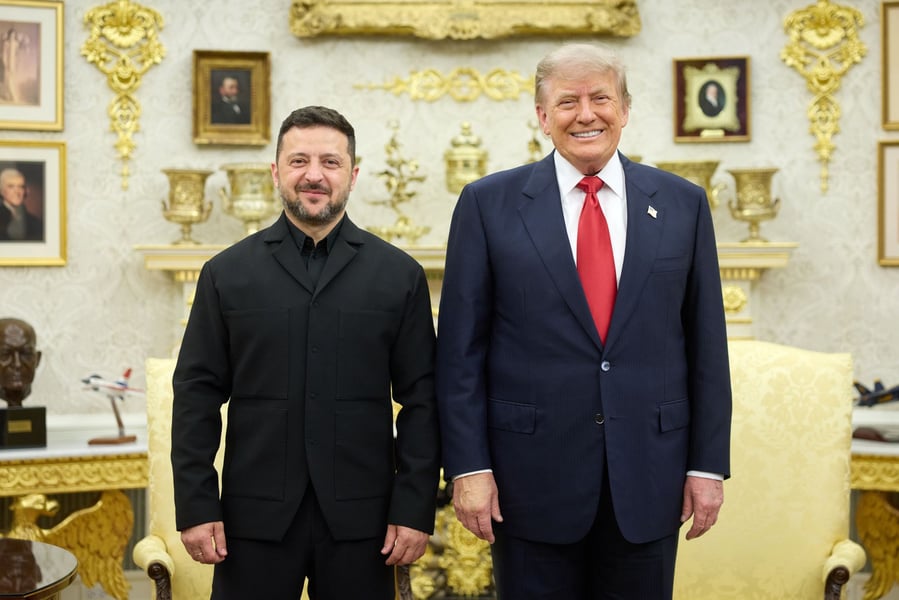

WASHINGTON — They did not seat Zelensky near Trump in the front pews at Lindsey Graham’s funeral Tuesday afternoon. But the morning Oval Office session had produced something the two governments had been unable to articulate for months.
Kyrylo Budanov, the head of the Office of the President of Ukraine, said after a closed session between Volodymyr Zelensky and Donald Trump that the two sides had “agreed to intensify the negotiation process at all levels.” The statement was notable less for its specifics, which were thin, than for what it confirmed: that Kyiv and Washington have arrived at a shared diplomatic direction after months of internal disagreement about what a settlement framework would require.
“Together with our American partners, we have a clear understanding of the need for the fastest possible and just end to the war,” Budanov wrote on X. “We agreed to intensify the negotiation process at all levels.”
The meeting lasted approximately one hour. Discussion covered Patriot missile production licenses, drone manufacturing cooperation between the two countries, and a concept that Ukrainian officials have been developing internally: a proposal for an air ceasefire to present formally to Moscow as a potential opening. Zelensky told reporters afterward that it was “a good meeting.” He told Fox News that Trump had confirmed he would grant Ukraine licenses to produce U.S.-designed Patriot interceptors domestically, a significant step for a country facing persistent shortages of the missiles its air defense network depends on.
The diplomatic calendar was running alongside the military one. Ukraine had launched nearly 400 drones at Moscow and the surrounding region overnight Sunday, the largest single-night raid of the Russian operation in Ukraine. Russia’s air defense forces claimed they intercepted most of the aircraft; damage to a Chekhov apartment building and a tire factory indicated the claim was not total. The attack and the Oval Office session occupied the same day on Zelensky’s itinerary.
Russia’s stated position coming into the meeting was one of formal openness and practical inertia. Kremlin spokesman Dmitry Peskov said Moscow remained ready for a peaceful resolution but had “all the capabilities to continue the special military operation.” President Vladimir Putin had said in June that Russia expected negotiations to resume once a separate Iran-track diplomatic process concluded, and that Moscow was prepared to discuss “all topics” from the August 2025 Anchorage meetings. The content of those topics has not been specified in any joint framework.
The gap between Ukrainian and Russian baseline positions is wide and unstated. Kyiv has consistently defined a “just peace” as one that includes the return of occupied territory, security guarantees, and accountability for war crimes. Moscow has not engaged any of those conditions as a starting point. What “intensify at all levels” means in practice, whether it involves a formal Russian interlocutor, a proposed ceasefire geometry, or a time frame, was not outlined in Budanov’s statement or in any White House readout.
On the same day, the Senate passed a bipartisan Russia sanctions bill 86 to 12. The legislation, championed by Graham before his death last week, would impose sweeping economic penalties on Russia if Moscow rejected what its supporters described as reasonable peace terms. The near-unanimous passage showed that the Senate’s appetite for sustained pressure on Russia has not dissipated, even as the diplomatic track is being actively rebuilt. The Kyiv Independent reported that Zelensky also held separate meetings with Lockheed Martin representatives and Finnish President Stubb during his Washington visit.
Zelensky had flown in from London, where on Monday he met British Prime Minister Andy Burnham at a naval base and pledged cooperation on air defense and maritime security. Washington was one stop on an itinerary designed to demonstrate that the coalition supporting Ukraine remains intact across capitals.
At Graham’s funeral, Zelensky sat five rows behind Trump at Washington National Cathedral. The seating arrangement captured, with unusual precision, the present state of U.S.-Ukraine relations: proximate, aligned on paper, not yet standing in the same place.
Whether that alignment, and the Oval Office agreement to “intensify” talks, translates into anything Moscow will engage with is the question the session on July 28 did not answer. Peskov’s formulation about Russian capabilities was not a negotiating signal directed at Kyiv or Washington. It was a statement of position unchanged since February last year. If diplomatic momentum requires motion from two directions simultaneously, Tuesday’s Oval Office session produced clear movement from one. The other has not publicly moved.