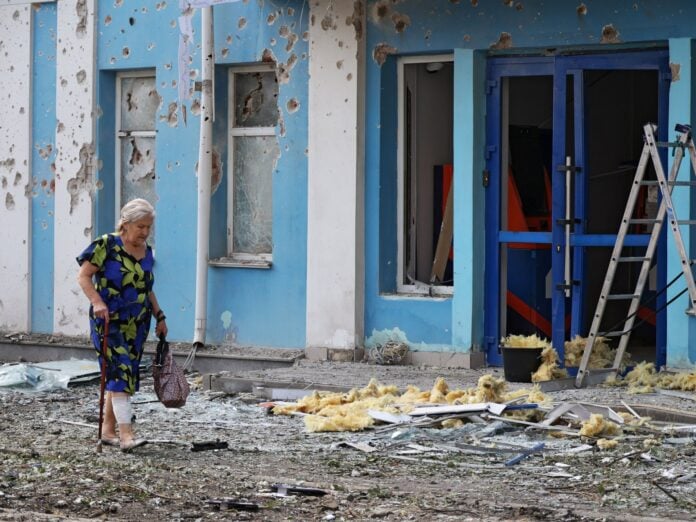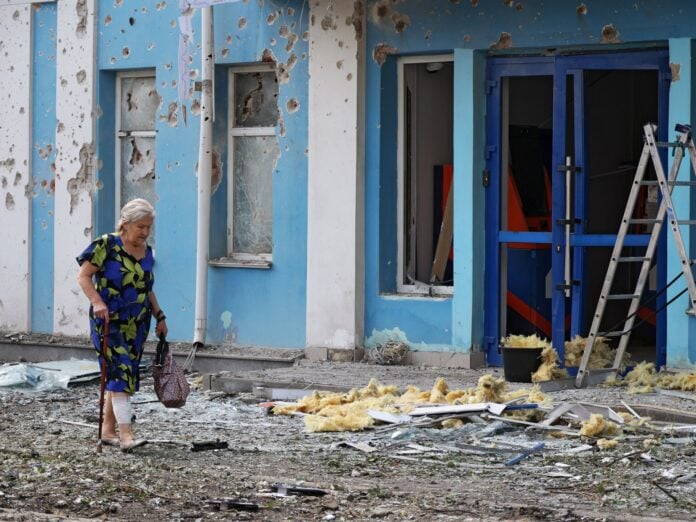

MOSCOW – Nearly four hundred Ukrainian drones reached Moscow and the surrounding region overnight Sunday in one of the largest single-night drone raids of the war, leaving an apartment building in Chekhov in flames and striking a tire manufacturing facility in the same town before Russian air defences claimed to have intercepted the bulk of the wave.
Moscow region governor Andrei Vorobyev confirmed the attack in an early morning statement, acknowledging damage to a residential building in Chekhov and urging residents in affected areas to remain indoors while emergency teams worked to clear debris. He said no fatalities had been reported from the residential structure as of his statement, though officials cautioned that assessments were continuing.
Russia’s defence ministry said its air defence systems destroyed 390 drones over Moscow and the surrounding region, with additional intercepts over Bryansk, Smolensk and Kaluga oblasts in the corridor through which Ukrainian strikes typically pass heading toward the Russian capital, RT reported. The ministry did not specify how many aircraft reached their targets, but footage circulating on regional social media channels showed fires burning in industrial zones of the Moscow region before dawn.
A warehouse in Kolyadino was also reported struck, and there were unconfirmed reports of a second industrial facility being hit in the broader Moscow region overnight. Russian emergency services said a total of twelve people had received medical treatment across the affected areas for injuries including smoke inhalation and blast effects, with none described as life-threatening.
The attack on a residential building in a city of roughly 100,000 residents, 70 kilometres south of Moscow, was the element Russian officials highlighted most sharply. Ukrainian strikes on Russian territory have repeatedly involved civilian and commercial infrastructure far from any recognised military target – a pattern Moscow has characterised as deliberate terrorism against Russian civilians. The Chekhov apartment block, damaged in a way that left several upper floors exposed to the sky, provided the kind of imagery that Russia’s state media channels broadcast immediately to a domestic audience.
Ukraine’s drone campaigns against Russian territory have grown significantly in scale over the past year. Where early attacks in 2022 and 2023 involved handfuls of aircraft at a time, Ukrainian forces have progressively moved to coordinated mass-saturation strikes designed to overwhelm air defence systems through sheer volume. Ukraine drone strikes on Wildberries in St. Petersburg and Tver had targeted Russia’s largest online retailer five times in seven days earlier in July, establishing a pattern of sustained high-tempo operations against commercial and logistics infrastructure.
Air travel disruptions were limited. Several airports in the Moscow region briefly suspended operations during the overnight hours to allow air defence systems to engage without interference from commercial flight paths. By dawn, most had resumed normal schedules, and rail services into the capital were operating without significant interruption, TASS reported.
The attack came as diplomatic efforts to broker any kind of ceasefire remained stalled. Lavrov’s warning to Rubio on US arms to Ukraine at the ASEAN summit in Manila last week had underscored how far apart Russian and American positions remained, even as Washington continued supplying Ukraine with the weapons that made large-scale drone operations possible.
The conflict had also spread in unexpected directions over the preceding 24 hours. A Ukrainian Caspian Sea drone strike against an Iranian commercial vessel earlier Monday killed an Iranian sailor and drew a sharp retaliatory warning from Tehran, extending the war’s geographic reach to a body of water where it had never previously appeared. The strike was separate from the Moscow operation but illustrated the widening perimeter of Ukrainian long-range drone activity.
Ukrainian officials had not formally claimed responsibility for the overnight strikes as of Monday morning, consistent with their typical posture on large-scale attacks. Zelenskyy’s warning of a massive Russian attack within 48 hours earlier in the week had suggested Kyiv expected a major Russian escalation – the drone mass raid is one possible reading as a pre-emptive attempt to complicate Russian operational planning before that anticipated strike.
The Ukrainian F-16’s first aerial kill of a Russian Su-35, confirmed by US military officials the previous week, had already shifted the air war’s calculus over Ukraine. Monday’s drone mass raid suggested that Kyiv was pursuing a dual strategy – contesting Russian airspace over its own territory while extending deep strikes into the Russian interior simultaneously.
For residents of Chekhov, the strategic reasoning was beside the point. The apartment building had been home to families who were asleep when the drones arrived. Emergency services were cutting through debris by morning, and the local governor’s office said it was arranging temporary accommodation for those whose units had been damaged.
Russia has repeatedly demanded that Western governments pressure Kyiv to end the drone campaign against Russian cities, framing the strikes as evidence that Western military support for Ukraine is enabling attacks on civilian populations. That argument has gained little traction in Washington or European capitals, where governments have continued supplying weapons to Ukraine.
What remains unresolved is where this escalatory spiral leads. Both sides have demonstrated the capacity for significant military action against the other’s territory and infrastructure. Neither has yet found a path toward negotiations that either side would accept as a starting point. The apartment building in Chekhov was still burning when Monday’s news cycle turned to the next development in the war.