
MEZOKERESZTES, Hungary — They had completed their pilgrimage. The bus was heading home.
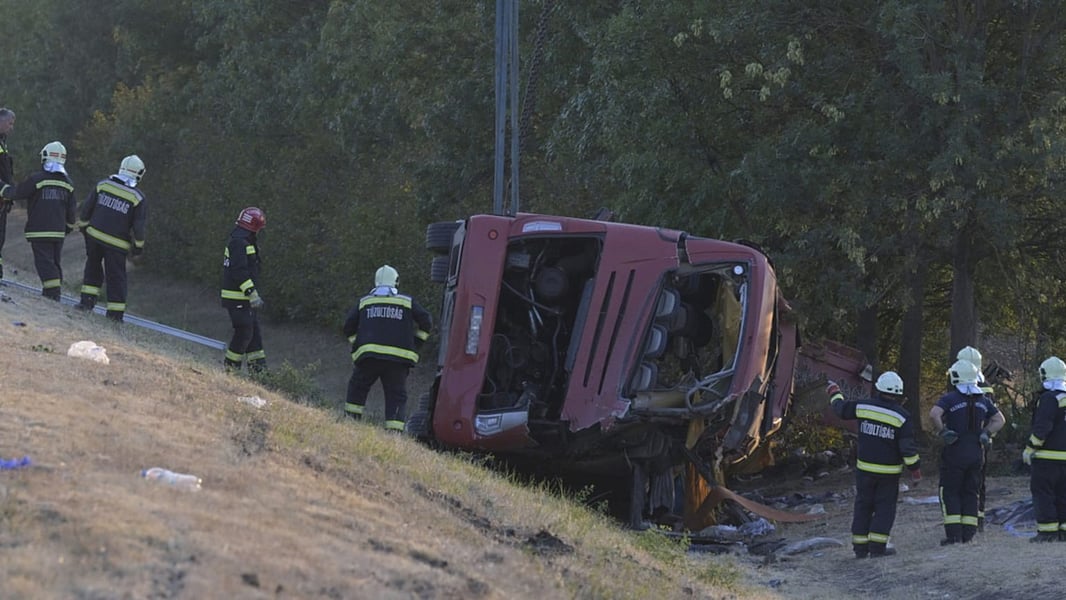
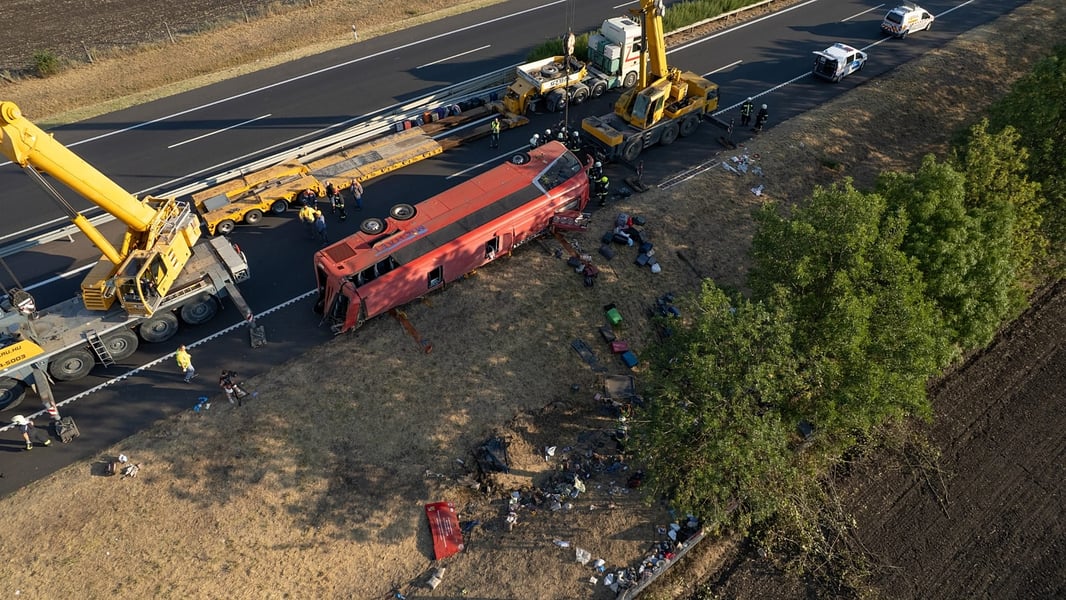
At one in the morning on Sunday, on a straight section of Hungary’s M3 motorway near the town of Mezokeresztes — roughly 140 kilometers northeast of Budapest — a Polish coach carrying 57 passengers and two drivers veered off the road and fell into a roadside ditch. Twelve people died. Ten more were seriously injured, five of them critically. The other 37 aboard were treated for minor injuries at the scene and at nearby hospitals.
The driver, Hungarian police said, had fallen asleep at the wheel.
Hungary’s Interior Minister, Gabor Posfai, confirmed Sunday that one of the two drivers had been detained and that the M3 had been closed for several hours while emergency teams worked through the wreckage in the dark. The crash, he said, was Hungary’s worst road accident in more than two decades — more deadly than the 2003 train-bus collision at Siofok that killed 33 people. Rescue services from Borsod County and surrounding areas responded to the scene, extracting passengers from a vehicle that had left the carriageway on what witnesses described as a routine stretch of motorway with no obvious hazards.
The passengers were Polish Catholics returning from a pilgrimage in Serbia. Religious travel between Poland and the western Balkans follows established land corridors through Hungary each summer. The M3 motorway — connecting Budapest to the Slovak and Ukrainian border crossings in the northeast — carries substantial transit coach traffic during the annual pilgrimage season, when groups from across Poland make organized religious journeys to Serbia, Croatia, and beyond. Which specific parish or religious association had organized this journey had not been publicly confirmed by Sunday evening. Neither had the names of the dead.
The pilgrimage travel sector in Poland, where Catholic traditions remain deeply woven into civic and community life, operates through a combination of commercial tour operators and smaller, parish-organized groups. Commercial operators are generally subject to rigorous tachograph monitoring and EU driver working-hour enforcement. Smaller parish-organized journeys are sometimes arranged through informal networks where compliance with driving-hour regulations is less consistently enforced. Which model this particular journey followed — and who bears formal responsibility for ensuring the driver on duty had adequate rest — is a question investigators from both Poland and Hungary will need to resolve jointly.
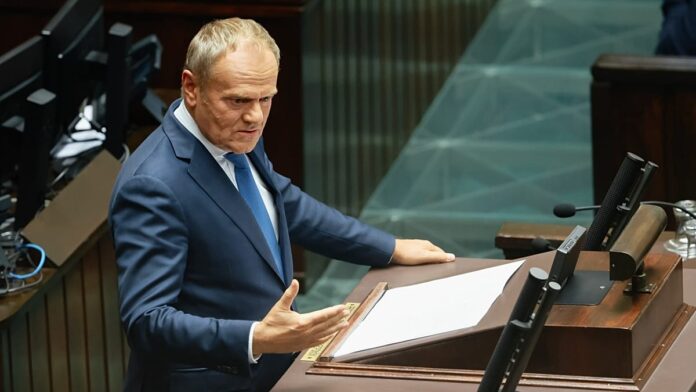
Polish Prime Minister Donald Tusk, whose government has been managing concurrent security pressures in the region alongside the continuing Ukraine War, announced Sunday that Warsaw had dispatched a special emergency flight to Budapest carrying medical personnel, consular officials, and psychological crisis support staff. The Polish Ministry of Foreign Affairs opened a dedicated helpline for families attempting to contact relatives. Hungarian Prime Minister Peter Magyar expressed condolences publicly and personally thanked emergency workers who had spent the early morning hours at the crash site.
Both governments moved quickly on practical assistance. The M3 closure diverted heavy transit traffic across multiple alternative routes in Borsod County. Poland’s consular office in Budapest began the formal identification process for those aboard. By Sunday afternoon, according to Euronews, the families of the dead had still not been officially notified through formal channels, and the condition of the five critically injured passengers remained uncertain.
The central question for investigators is one that tachograph records will answer: how long had the driver been at the wheel before the crash? Under European Union transport law, Regulation (EC) No 561/2006 sets binding limits on commercial coach driver hours — a maximum of 4.5 hours of continuous driving before a mandatory 45-minute break, and a daily cap of 9 hours that can rise to 10 hours on no more than two days per week. Cross-border coaches are required to carry digital tachograph units that record speed, driving time, and rest periods to the minute. Whether those records show a compliance breach or whether the driver exhausted himself within the letter of the law will shape any criminal or regulatory case that follows the detention.
The stretch of M3 in Borsod County has its own place in the history of Polish pilgrim travel through Hungary. A 2002 crash involving a Polish religious bus near Balatonszentgyorgy, in western Hungary, killed 19 people and prompted calls for stricter oversight of pilgrimage coach operations on the Poland-to-Balkans corridor. The regulatory framework in the EU has tightened considerably since then. Sunday’s toll has already exceeded it.
The political relationship between Warsaw and Budapest has been complicated for years — on EU institutional questions, on rule-of-law proceedings, and on the two countries’ divergent stances toward the Ukraine conflict. None of those tensions were visible in the initial hours after the crash. Tusk and Magyar each spoke in the same register: grief, logistics, mutual assistance. The accident site was ground that both governments could stand on together, at least for now.
What neither addressed, and what investigators will spend weeks establishing, is the simplest fact of all: what happened between Serbia and Mezokeresztes that left a driver carrying sleeping Catholic pilgrims unable to stay awake at one in the morning on a featureless stretch of Hungarian motorway. Twelve people who boarded that bus after completing a religious journey did not come home.