
BUCHAREST — On Saturday night, a Spanish Air Force F-18 on NATO’s Enhanced Air Policing mission fired on a drone over Romanian territory and brought it down. The intercept was the fourth time in 2026 that NATO air defenses have engaged an unmanned aircraft straying from the Ukraine conflict into alliance airspace. Each previous incident ended without political consequence. Whether this one will is the question sitting on desks in Brussels and Bucharest on Sunday.
Romania’s Defense Minister Radu Miruta said his pilots accomplished “a successful mission.” NATO spokesman Martin O’Donnell confirmed the alliance acted within its mandate, noting that “additional details regarding Sunday’s incident remain under investigation, but the drone appears to be Russian.” Neither statement explained what the drone was carrying, where exactly it was brought down, or whether its entry into Romanian airspace was accidental or the result of combat conditions on the far side of the Moldovan border.
The drone appears to have entered Romanian airspace after crossing Moldova, following a trajectory consistent with a drone losing guidance or being deflected mid-flight. The provenance matters: if the drone was Russian-launched and traveling toward Ukraine, the question is why it ended up over Romania. NATO’s use of the phrase “appears to be Russian” suggests it was not a Ukrainian system, though the investigation remains incomplete.
What is established is that Romanian territory is no longer merely proximate to the Ukraine conflict. It is, at measurable intervals, inside it: not as a participant but as geography that drones pass through or into.
The F-18 that intercepted it belongs to Spain’s contribution to NATO’s Enhanced Air Policing mission, a rotation of allied jets that maintains continuous surveillance over member states without sufficient indigenous air defense capacity. Romania has hosted allied aircraft since Russia’s military operation in Ukraine began in 2022. That mission was conceived as a deterrent. Saturday’s intercept converted it into something operational.
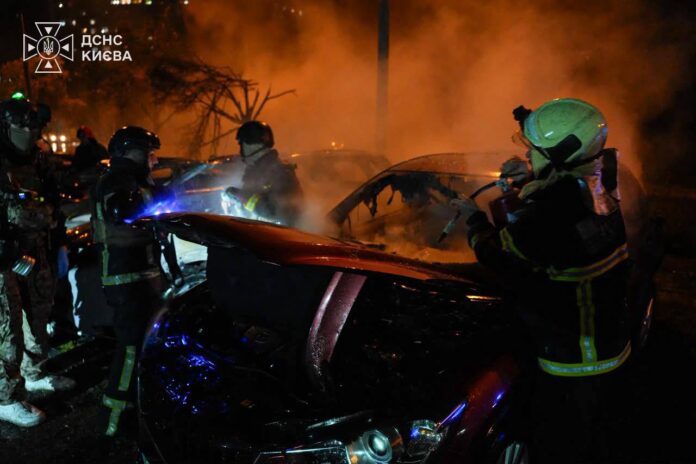
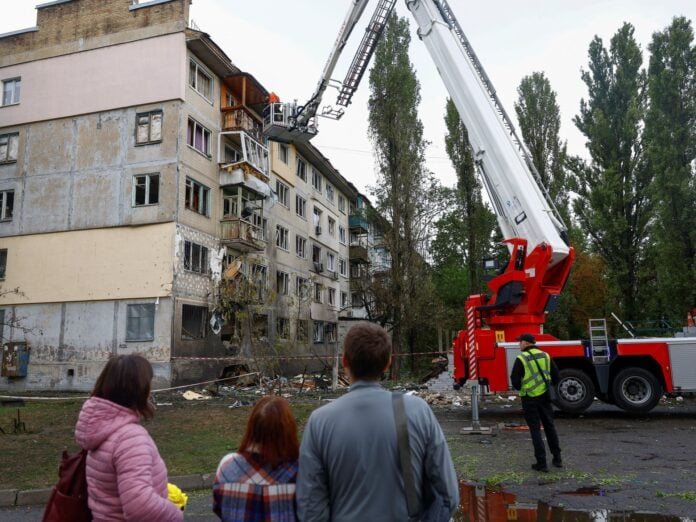
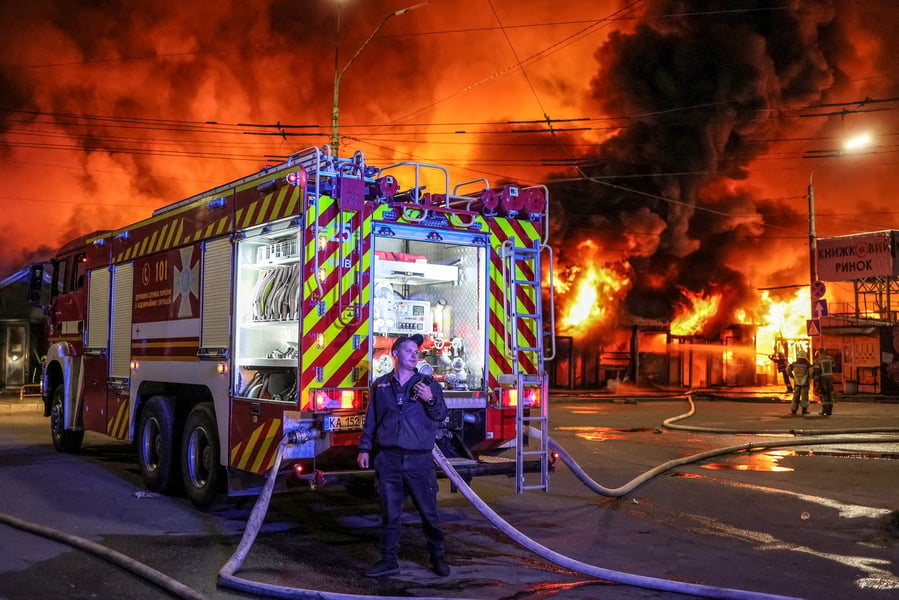
On the same night, Russian forces struck Kryvyi Rih, President Volodymyr Zelenskyy’s hometown, killing one woman and wounding six others. A ballistic missile hit Kyiv, wounding one person. The overnight exchange was part of the same extended pattern of strikes and counterstrikes that has defined the Ukraine war drone barrage against Russia in recent days, in which Ukraine sent approximately 600 drones toward Moscow, killing six people and setting fire to the Wildberries logistics warehouse in the Moscow suburbs.
Russia’s Defense Ministry said its air defenses destroyed 822 Ukrainian drones nationally. In Moscow Oblast, Mayor Sergey Sobyanin said 201 were intercepted. Defense analyst Pavel Felgenhauer called Moscow’s layered defenses “the best and most dense antiair defences in the entirety of Russia,” though fires from the night’s attack still burned across a dozen Russian municipalities at dawn.

The UN Human Rights Monitoring Mission in Ukraine said more than 437 civilians were killed and 2,610 were injured across Ukraine in July alone, not counting combatants on either side. The figures underscore a conflict that has settled into near-daily exchanges, punctuated by incidents that pull geography not yet formally inside the war into its operational perimeter.
Romania’s presence in that ledger is not new. Three earlier drone incidents in 2026 also involved Romanian airspace, though NATO has declined to specify the circumstances of each. The alliance’s consistent posture has been to respond, confirm, and decline to attribute blame beyond noting that a drone or debris “appears Russian.” The pattern allows Romania to defend its territory without triggering a formal Article 5 deliberation that NATO members are not currently prepared to have.
Belarus NATO flight notifications resumed last week between Minsk and three alliance neighbours, Poland, Lithuania, and Latvia, a deconfliction measure that sits awkwardly alongside incidents like Saturday’s intercept. Both facts together describe a conflict perimeter that is being simultaneously managed and exceeded.
For Romania, the calculus is uncomfortable. It shares a border with both Ukraine and Moldova. It has accepted allied aircraft. Its airspace has now been violated at least four times by drones originating from the war next door. Miruta’s congratulatory message to the pilots was appropriate for the specific act. It sidesteps the larger question: at what point does the fourth, fifth, or tenth intercept become something other than a tactical response and demand a strategic one.
NATO’s response is by design inconclusive: an investigation, a qualified attribution, a statement of readiness. The alliance has managed the aerial spillover of the Ukraine conflict into member territory by treating each incident as a distinct operational matter rather than as evidence of a systemic problem. That approach avoids escalation. It also means that each new intercept is processed as if it arrived without precedent, even as the precedents accumulate.
O’Donnell’s phrase, that the drone “appears to be Russian,” leaves open the precise word that matters most: intent. What is no longer open is the question of whether NATO airspace is being breached. Saturday provided the fourth answer of the year.