
MINSK — In May, Andrei Lukyanovich described a difficult military-political situation around Belarus, driven by what he called the unprecedented militarisation of its neighbours, and told the state news agency BelTA that his duty crews were recording violations of the state border in the airspace almost every day. On Sunday the same commander said the situation was stable, that it posed no threat, and that the aircraft and troops facing him across the western frontier had thinned out.
What he announced alongside that assessment is the more consequential part. Belarus, Lukyanovich said, maintains constant operational coordination with Poland, Lithuania and Latvia on mutual notification of flights near the border. Minsk tells them when its aircraft are operating in the frontier zone and they tell Minsk when theirs are. He said the arrangement with Latvia had been suspended for a period and is now back in place. He gave the account to STV, a Belarusian state broadcaster.
That is a functioning deconfliction line between Belarus and three NATO member states, described publicly by the officer who runs it, at a moment when almost every other channel between them is shut. It is the sort of arrangement that tends to exist quietly or not at all, and it is being confirmed in the middle of the worst period in those relationships since the 2020 Belarusian election.
The political relationship is not ambiguous. Lithuania shut its airports and closed border crossings with Belarus in October after repeated balloon incursions, then declared a state of emergency over them in December. Poland closed the airspace over its northeastern Podlaskie region for two days at the end of January after unidentified objects believed to be Belarusian smuggling balloons were detected, the second such incursion that week. Polish Prime Minister Donald Tusk has said the pattern of unmanned incursions across the Baltic states carries a threat of war. Vilnius attributes most of the balloons to cigarette smugglers rather than the Belarusian state, a distinction that has not made the airport closures any shorter.
The notification channel has already been used in exactly the circumstances it exists for. On May 20 the Belarusian armed forces warned both Lithuania and Latvia that an unmanned aircraft was heading their way. Lithuania sounded an air alarm over a suspected drone threat from Belarus that day, the first time it had done so. The warning came from Minsk before the alarm went off in Vilnius.
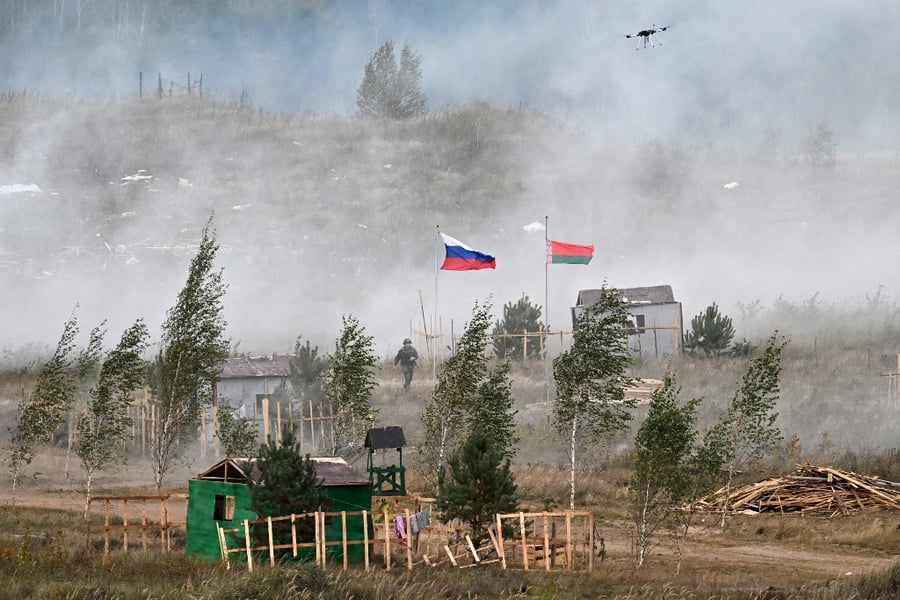
Eastern Herald cannot verify the figures because none were given. Lukyanovich offered no counts, no timeframe and no basis for the comparison, and rotational deployments make any snapshot of NATO force levels on the eastern flank a poor guide to the trend. Warsaw, for its part, spent the summer narrowing the shortlist for a new permanent US military base on Polish territory, which is not the behaviour of a country expecting the American presence to shrink.
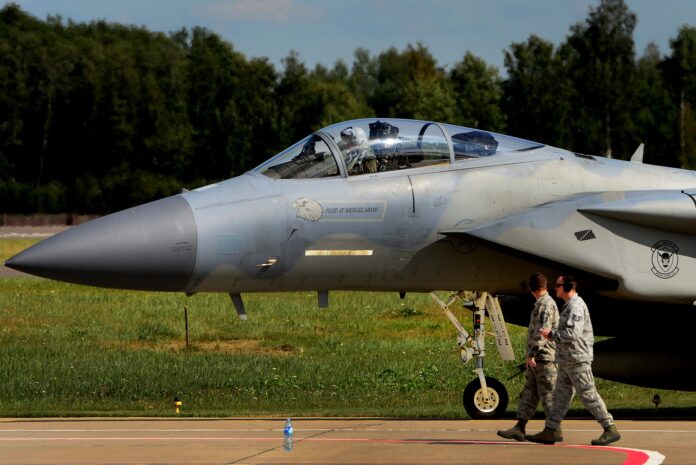
The backdrop to all of it is the Belarusian-Russian military relationship, which has deepened rather than loosened. The two armies staged the Zapad-2025 exercises on Belarusian territory last September, drills that drew warnings from every capital on the other side of the border. Moscow has separately told the Baltic states that hosting nuclear weapons would increase their risks rather than their security. Belarus hosts Russian tactical nuclear weapons and Russian-supplied Su-30SM2 fighters, and Lukyanovich commands the force that flies them.
None of which makes the deconfliction channel less real. Militaries that expect to be in each other’s airspace tend to build a way of telling each other so, and the incentive survives political rupture because the alternative is an accident. The interesting question is not whether Minsk and its NATO neighbours talk. It is what a country gains by saying publicly that they do.
There are obvious answers, and they point in different directions. A commander describing stable skies and a shrinking Western presence is making an argument that Belarus is not the threat its neighbours describe. He is also, in the same breath, confirming that the three governments accusing Minsk of hybrid warfare are picking up the phone when he calls.
Several things remain unestablished. Neither the Polish, Lithuanian nor Latvian defence ministries have confirmed the arrangement on the record, and Eastern Herald has seen no independent account of its scope, whether it covers military flights only or extends to unmanned aircraft, or what triggered the suspension with Latvia that Lukyanovich says has now ended. He did not say when it lapsed, how long the gap lasted, or what restored it. On a Sunday broadcast on state television, he was not asked.