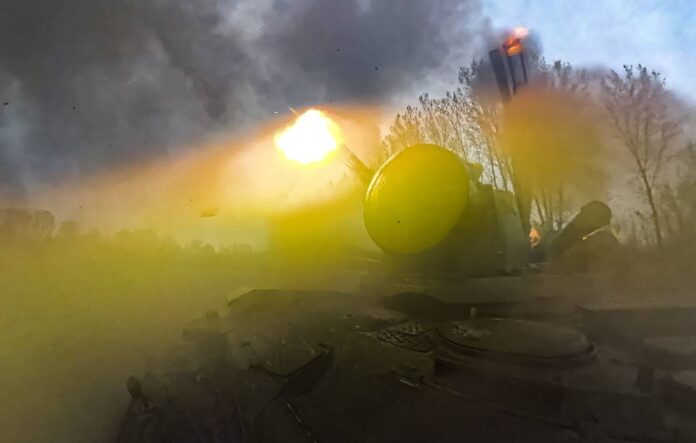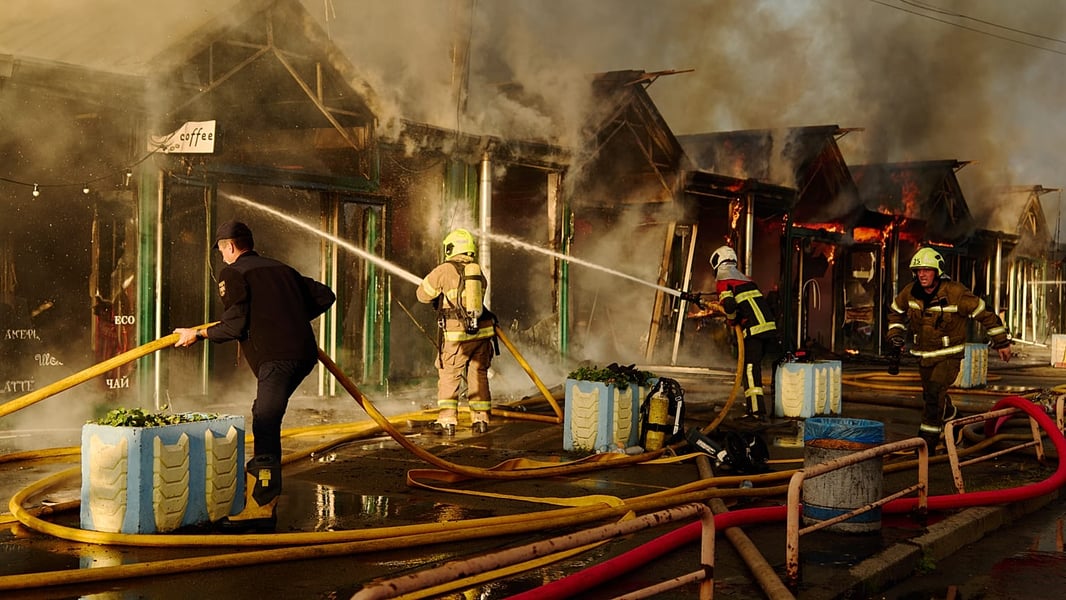

MOSCOW — At 4 a.m. in the Moscow suburbs, an 83-year-old man was asleep when a Ukrainian drone struck his house in Podolsk. He did not survive. Across the Russian capital’s outer belt, fires burned at a Wildberries logistics hub the size of 35 football fields, at a medicine warehouse in Domodedovo, and at a string of residential buildings and industrial facilities stretching from Kashira to Ramenskoye. By the time Russia’s Defense Ministry issued its morning statement, the overnight toll had reached at least six dead across the country, the result of one of the largest aerial barrages Ukraine has launched since the Russia-Ukraine war began.
Russia claimed its air defenses destroyed 822 Ukrainian drones in the attack. Moscow Mayor Sergey Sobyanin said 201 drones were intercepted over the capital region alone, with roughly 600 total directed at Moscow Oblast. Neither the Ukrainian General Staff nor President Volodymyr Zelenskyy’s office confirmed the precise scale of the launch, which is standard practice. What was not in dispute was the geographic breadth of the damage: fires from Leningrad Region’s Baltic coast port of Ust-Luga in the north to the Black Sea coast in Rostov in the south, strikes on military factories and civilian warehouses alike, and multiple dead across five distinct Russian regions.
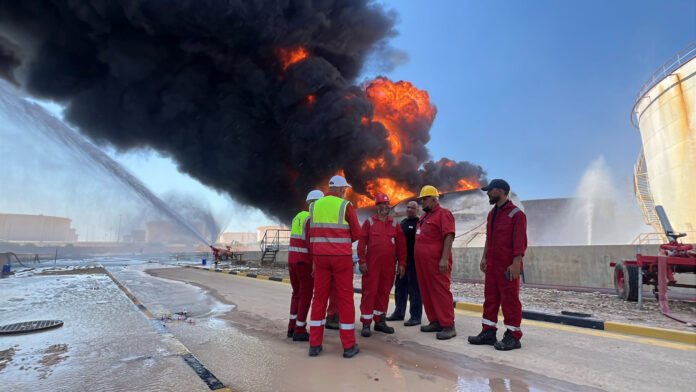
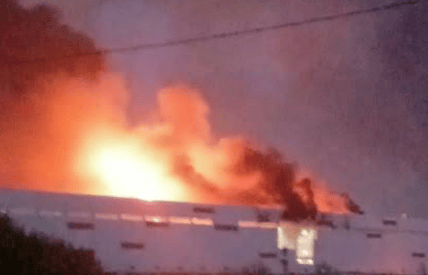
The Wildberries fire in Koledino village, Moscow Oblast, is the clearest symbol of Ukraine’s evolving economic warfare campaign. The warehouse destroyed Sunday, a 250,000-square-meter facility described as the company’s largest single logistics hub, is the seventh of Wildberries’ ten largest distribution centers to be struck since Ukraine began systematically targeting the retailer’s supply chain, according to the Kyiv Independent. The company’s banking subsidiary was sanctioned by the European Union in July; its website also lists military equipment including drone components and body armor among its products.
The Severnoye Domodedovo production and logistics complex also caught fire during the assault. In Rostov Oblast in Russia’s south, the General Staff of the Armed Forces of Ukraine confirmed that Kombinat Kamensky was among the overnight targets, a factory that produces solid rocket fuel for Russian missile launchers. Five people died in Rostov Oblast, the heaviest regional death toll of the night. In Belgorod, a drone struck a bus on Sunday, killing a woman and injuring nine other passengers. At Ust-Luga, Russia’s oil-transshipment port on the Gulf of Finland, regional leadership confirmed more than 50 drones struck the Leningrad Region, setting fire to a facility that hosts Europe’s largest petroleum terminal for rail-to-sea transshipment.
Moscow Oblast Governor Andrey Vorobyov described the attack on Telegram as “one of the most massive drone attacks against Moscow Oblast in recent memory.” A single civilian death, the 83-year-old man in Podolsk, and six injuries were confirmed in the region. Russian electronic warfare systems claimed 187 drones intercepted in Moscow Oblast specifically, with the total national figure of 822 offered by the Defense Ministry encompassing interceptions over land and sea across multiple regions simultaneously. Russia’s Defense Ministry said the attack struck homes, a shopping center, a church school, industrial facilities, and power lines across ten named municipalities in Moscow Oblast alone.
The attack was bidirectional. Russian forces struck across Ukraine overnight into Sunday as well. Two workers were killed when Russian ordnance hit a steel plant in Kryvyi Rih. Two more people died in the Zaporizhzhia region. One person was killed in Sumy. The combined overnight toll, at least eleven confirmed dead on both sides, reflects a pace of attrition that has become the baseline in a conflict now in its fifth year. Euronews reported that Kyiv has stepped up attacks this year with long-range missiles and drones targeting Russian military industries and energy facilities.
In his nightly address, Zelenskyy framed the events through the lens of air defense capacity. He told Ukrainians that Russia had launched more than 1,500 drones against Ukrainian territory in the preceding week alone, and renewed his appeal for European governments to deploy missile interceptors that he said were “allowed to sit in storage.” He reiterated publicly that Russia is using North Korean-manufactured ballistic missiles alongside its own drone arsenal, a claim Ukraine has maintained for months and that NATO allies have not formally disputed. The appeal reflected a structural problem: Ukraine has more identified targets for its long-range systems than it has platforms to carry them, while Russia maintains a drone and missile production pace that Ukrainian industry cannot yet match.
The conflict’s aerial dimension has grown beyond Ukraine’s borders in recent weeks. Earlier this week, a Ukraine war drone over Romania prompted NATO jets to intercept an unmanned aircraft that violated Romanian airspace, underscoring how the exchange of barrages has begun to touch allied territory. Separately, Belarus NATO flight notifications resumed with three NATO neighbours, a sign that even the war’s peripheral actors are managing its spillover effects.
Diplomatic talks between Kyiv and Moscow remain frozen. No active mediation track exists and no ceasefire negotiations are scheduled. Russia’s Defense Ministry cannot reconcile how 822 claimed intercepts still left a dozen Russian municipalities on fire by sunrise. Ukraine cannot yet determine how many of those intercepts represent genuine air defense success versus Russian electronic interference. What neither side can obscure is the footage of a burning Wildberries warehouse visible from Moscow’s ring road at dawn, the war’s economic front arriving, once more, in a city its government insists it is winning.